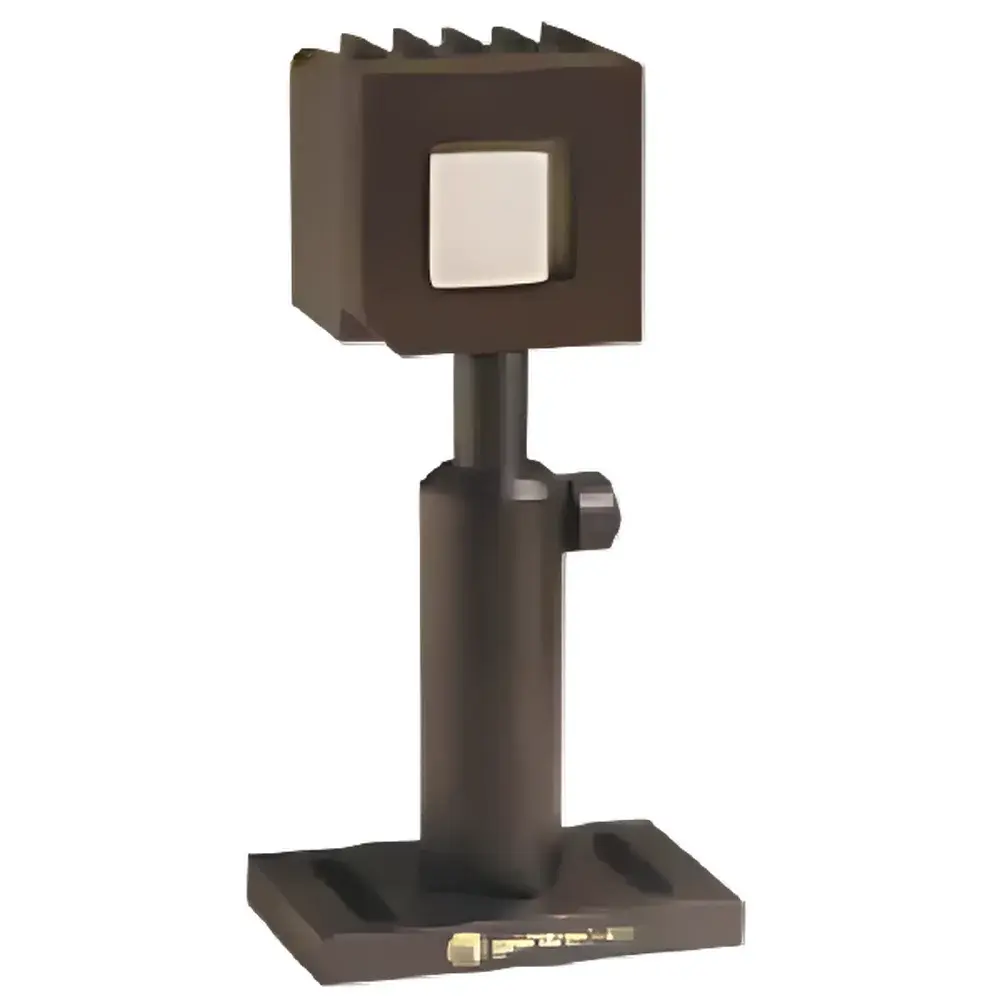
Gentec-EO Gentec-Eo Laser Power and Energy Meters
| Brand | Gentec-EO |
|---|---|
| Origin | Canada |
| Product Type | Thermopile & Pyroelectric Laser Power/Energy Sensors with Compatible Meters |
| Spectral Range | 0.19–20 µm |
| Power Measurement Range | 5 nW – 25 kW |
| Energy Measurement Range (Pulsed) | 50 nJ – 150 J |
| Max Avg. Power Density | 110 W/cm² – 100 kW/cm² |
| Pulse Width Support | 5 µs – 7 ms |
| Sensitivity (Energy) | 2 V/J – 1100 V/J |
| Sensitivity (Power) | 0.02 mV/W – 25 mV/W |
| Detector Aperture Options | 8 mm – 95 mm |
| Output Interfaces | USB, RS-232, 0–1 V Analog |
| Compliance | CE, RoHS, NIST-traceable calibration available |
Overview
Gentec-EO laser power and energy meters are precision metrology instruments engineered for traceable, high-fidelity optical radiation measurement in research, industrial, and regulatory environments. Built upon thermopile and pyroelectric detection principles, these systems provide absolute, wavelength-independent quantification of continuous-wave (CW) and pulsed laser output. Thermopile sensors operate via the Seebeck effect—converting incident radiant heat into a proportional DC voltage—enabling stable, low-drift measurement of average power from nanowatts to kilowatts. Pyroelectric detectors leverage transient temperature-induced charge displacement in crystalline materials, delivering high-speed, pulse-resolved energy capture across microsecond-to-millisecond durations. Both sensor families cover a broad spectral band (190 nm – 20 µm), accommodating excimer, diode, fiber, CO₂, and ultrafast laser sources without spectral correction factors.
Key Features
- Multi-sensor platform architecture supporting interchangeable thermopile (CW/average power), pyroelectric (pulse energy), and photodiode-based modules—all calibrated to NIST-traceable standards
- Detector apertures ranging from 8 mm to 95 mm, with optional beam dump attenuators rated up to 100 kW/cm² average power density
- Real-time analog and digital signal processing with 16-bit resolution ADC and auto-ranging circuitry for seamless dynamic range coverage (5 nW–25 kW power; 50 nJ–150 J per pulse)
- Integrated thermal management and active drift compensation for long-term measurement stability under ambient temperature fluctuations
- Front-panel touchscreen interface with intuitive navigation, multi-parameter display modes (power, energy, fluence, peak power, statistics), and real-time waveform visualization (bar chart, line plot, histogram)
Sample Compatibility & Compliance
The Gentec-EO platform accommodates diverse laser configurations—including free-space beams, fiber-coupled outputs, and high-peak-power ultrafast systems—via standardized mounting interfaces (e.g., SM1, C-mount, custom flanges). All sensors meet CE marking requirements and comply with IEC 61000-6-3 (EMC emissions) and IEC 61000-6-2 (immunity). Calibration certificates include uncertainty budgets aligned with ISO/IEC 17025:2017 practices. For regulated environments, optional 21 CFR Part 11-compliant software packages support audit trails, electronic signatures, and secure data archiving—enabling use in GLP and GMP workflows per ASTM E2750 and ISO 11554 standards.
Software & Data Management
- Free PC software (StarLab) provides full instrument control, real-time data logging, statistical analysis (min/max/mean/std dev), and export to CSV, Excel, or MATLAB formats
- USB and RS-232 communication protocols enable integration into automated test benches and LabVIEW-based DAQ systems
- Analog output (0–1 V) supports connection to oscilloscopes, PLCs, or custom feedback loops for closed-loop laser power stabilization
- Firmware updates delivered via secure web portal with version-controlled release notes and backward-compatible binary support
- Touchscreen firmware includes configurable alarm thresholds, pass/fail limits, and batch-mode measurement templates for routine QC testing
Applications
These instruments serve critical roles in laser system characterization, manufacturing process validation, and safety compliance. Typical use cases include: verification of medical laser output per IEC 60601-2-22; qualification of industrial cutting/welding lasers against ISO 11554 beam parameter tolerances; calibration of reference sources in national metrology labs; monitoring of ultrafast amplifier chains (e.g., Ti:sapphire, Yb-doped fiber) where pulse-to-pulse energy stability is essential; and validation of LIDAR transmitter performance across atmospheric transmission windows. The wide aperture options and high damage threshold make them suitable for high-energy Nd:YAG, CO₂, and excimer laser applications in semiconductor lithography and materials processing.
FAQ
How do thermopile and pyroelectric sensors differ in operational principle and use case?
Thermopiles measure average power via steady-state thermal gradient generation and are ideal for CW or high-repetition-rate pulsed lasers. Pyroelectric sensors respond only to changing thermal flux and thus require modulated or pulsed input; they excel at single-shot or low-repetition-energy measurement with sub-microsecond rise times.
Is NIST-traceable calibration included with purchase?
Each sensor ships with a factory calibration certificate referencing NIST-traceable standards. Optional accredited calibration services (ISO/IEC 17025) are available upon request.
Can the meter interface with third-party data acquisition systems?
Yes—via standard USB CDC, RS-232 ASCII protocol, or 0–1 V analog output. SCPI command sets and LabVIEW drivers are provided at no cost.
What beam diameters are supported without vignetting?
Detectors feature uniform responsivity across their active area. Full utilization requires beam diameters ≤ 80% of aperture size; e.g., a 50 mm sensor supports ≤ 40 mm beams for <1% spatial non-uniformity error.
Are there environmental operating limits for temperature and humidity?
Operating range: 15–35 °C ambient, ≤70% RH non-condensing. Storage range extends to −10–50 °C. Thermal drift specifications assume stabilization within ±1 °C of calibration temperature.