
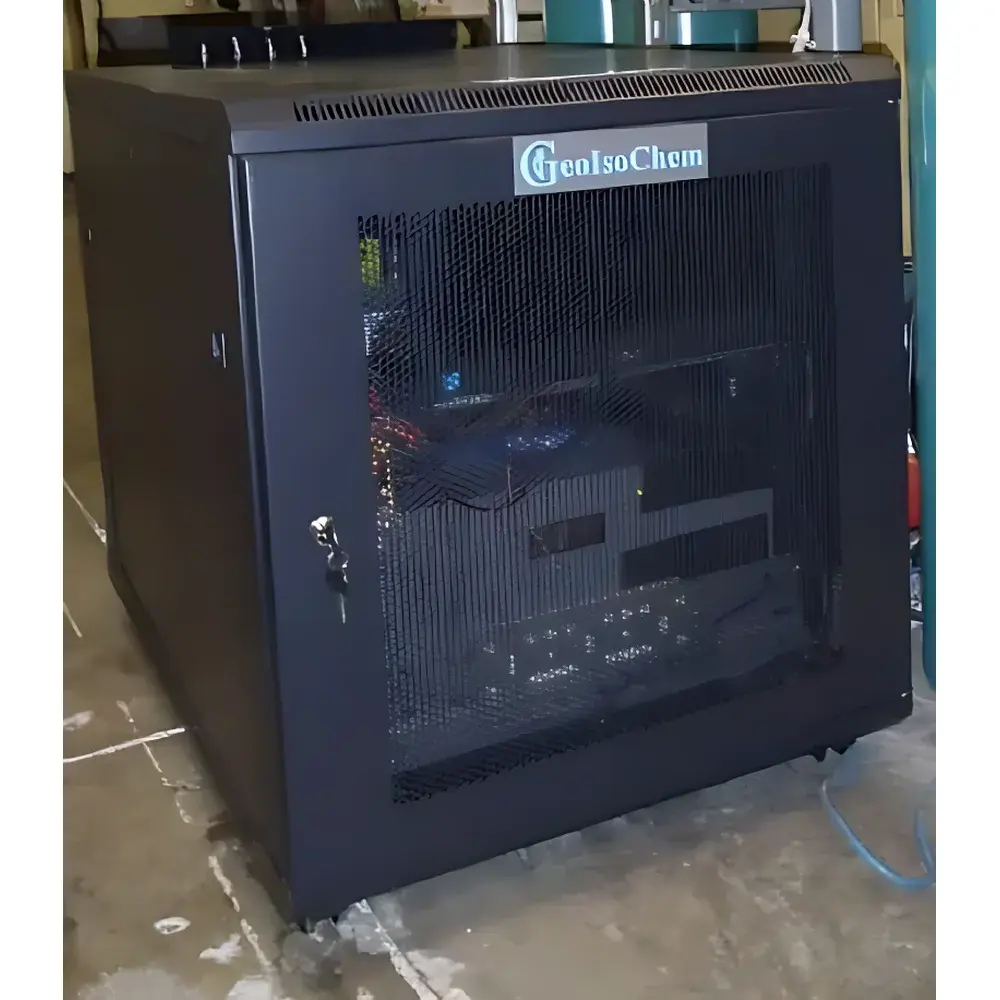
Geoisochem CSIA Monomolecular Compound-Specific Isotope Analyzer
| Origin | USA |
|---|---|
| Manufacturer Type | Authorized Distributor |
| Origin Category | Imported |
| Model | Geoisochem CSIA |
| Pricing | Available Upon Request |
Overview
The Geoisochem CSIA Monomolecular Compound-Specific Isotope Analyzer is the world’s first field-deployable, real-time instrument engineered for in situ carbon isotope ratio (δ13C) analysis of individual hydrocarbon species in natural gas streams. Unlike conventional isotope-ratio mass spectrometry (IRMS) systems—which require cryogenic trapping, offline sample preparation, and laboratory-grade vacuum infrastructure—the CSIA leverages a patented integration of high-resolution gas chromatography (GC) with dual-wavelength semiconductor infrared laser absorption spectroscopy through hollow-waveguide optical cells (GC-IR2; US PCT No. 13/669,410). This architecture enables direct, continuous measurement of δ13C values for methane (CH4), ethane (C2H6), and propane (C3H8) without reliance on carrier-gas purification, high-vacuum pumps, or external calibration gases during routine operation. Its design targets operational robustness in non-laboratory environments—including active wellheads, coal mine ventilation shafts, shale gas production sites, and landfill gas monitoring stations—where ambient temperature (0–35 °C, above dew point) and relative humidity (<100%) fluctuate dynamically.
Key Features
- First commercially deployed field-capable CSIA system certified for unattended, long-term deployment in industrial and environmental settings
- Patented GC-IR2 platform combining capillary GC separation with tunable diode laser absorption spectroscopy (TDLAS) in fused-silica hollow waveguides—eliminating need for ultra-high vacuum or liquid nitrogen cooling
- Automated baseline drift correction and internal reference tracking; achieves <0.5‰ δ13C precision over 30 days without calibration standards, and <0.2‰ with periodic standard injection
- Real-time quantification of CH4, C2H6, and C3H8 at concentrations from 5,000 ppm to 100% (v/v), with full speciation resolution even in complex background matrices (e.g., CO2-rich mine air or N2-diluted biogas)
- Rack-mountable 19-inch, 20U enclosure (110 kg) with industrial-grade thermal management and EMI-shielded electronics for stable performance in electrically noisy field environments
- Power-flexible operation: 110/220 V AC, 50/60 Hz; peak draw ≤3 kW, average consumption ~1 kW
Sample Compatibility & Compliance
The CSIA accepts raw,未经干燥或净化的 natural gas, coalbed methane, landfill gas, and biogas samples directly via standardized 1/4″ Swagelok inlet fittings. It complies with ASTM D7169 (Standard Test Method for High Boiling Point Petroleum Fractions) for hydrocarbon speciation context and supports traceability under ISO/IEC 17025:2017 for testing laboratories performing isotopic fingerprinting. While not an FDA-regulated device, its data integrity architecture—including timestamped audit logs, user-access controls, and non-erasable measurement records—aligns with GLP and 21 CFR Part 11 principles for regulated environmental forensics and source apportionment studies. No sample preconcentration or derivatization is required, minimizing analytical bias and enabling true process-integrated monitoring.
Software & Data Management
Instrument control, chromatographic method sequencing, spectral deconvolution, and isotope ratio calculation are managed through Geoisochem’s proprietary CSIA Control Suite v4.x—a Windows-based application with role-based user permissions, automated QC flagging, and export to CSV, NetCDF, or LIMS-compatible XML formats. All raw interferograms, chromatograms, and calculated δ13C values are stored with SHA-256 hash-verified metadata (instrument ID, operator, GPS coordinates if enabled, ambient T/RH, pressure). Remote diagnostics and firmware updates are supported via secure TLS-encrypted Ethernet or optional LTE module. Data files retain native precision (0.001‰) and support post-acquisition reprocessing using updated calibration models without re-injection.
Applications
- Petroleum exploration & production: Discrimination of thermogenic vs. biogenic gas origins; migration pathway tracing; reservoir compartmentalization studies
- Mine safety & emissions monitoring: Real-time δ13C-CH4 trending to distinguish ventilation air methane from spontaneous combustion signatures
- Environmental forensics: Attribution of petroleum hydrocarbon contamination in soil gas or groundwater plumes
- Climate science: Long-term eddy covariance–compatible CH4/C2H6 isotope flux measurements at wetland or permafrost sites
- Food authenticity verification: Detection of synthetic vs. fermentation-derived ethanol or flavor compounds via compound-specific δ13C profiling
FAQ
Does the CSIA require daily calibration with reference gases?
No. The system maintains <0.5‰ long-term precision without external standards. Optional periodic calibration (e.g., weekly) improves reproducibility to <0.2‰ but is not mandatory for routine field operation.
Can it analyze gases other than CH4, C2H6, and C3H8?
The current configuration is optimized for these three light alkanes. Future firmware releases may extend capability to i-butane, n-butane, and CO2 based on customer demand and spectral library expansion.
Is the instrument suitable for mobile deployment on vehicles or drones?
It is designed for fixed or semi-permanent installation (e.g., trailer-mounted monitoring stations). Vibration sensitivity and power requirements preclude airborne or high-mobility use, though ruggedized transport cases are available.
What maintenance intervals are recommended?
GC column replacement every 12 months; laser diode lifetime exceeds 20,000 hours; hollow waveguide cells require cleaning only after exposure to particulate-laden or high-H2S streams (typically every 6–24 months depending on sample matrix).






