
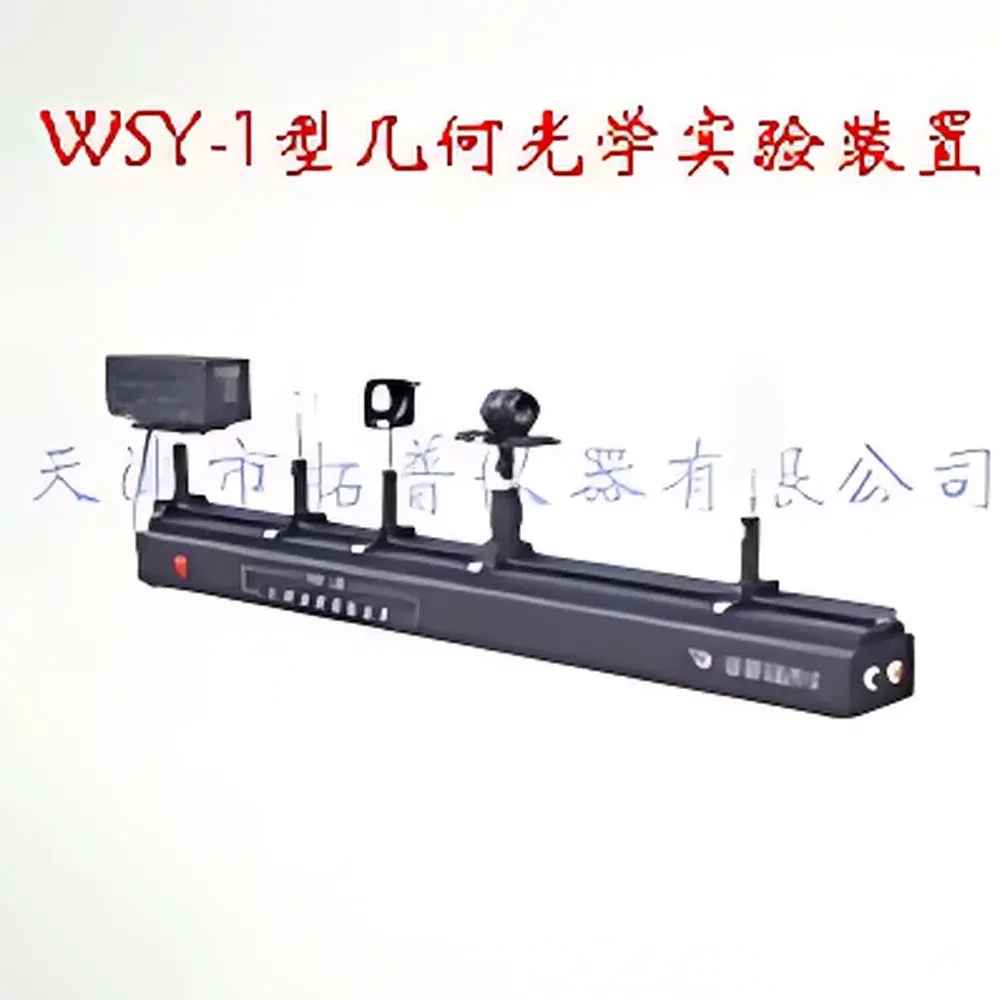
Geometric Optics Experiment Kit WSY-1 by TOP (Tianjin TOP Optics Co., Ltd.)
| Brand | TOP |
|---|---|
| Origin | Tianjin, China |
| Manufacturer Type | Manufacturer |
| Country of Origin | China |
| Model | WSY-1 |
| Pricing | Upon Request |
Overview
The Geometric Optics Experiment Kit WSY-1 is a modular, benchtop educational and research platform engineered for rigorous experimental verification of fundamental principles in paraxial optics. Based on the classical ray-tracing framework of Gaussian optics, the system enables precise determination of focal length, principal planes, nodal points, and image formation characteristics of both single and compound optical elements—including singlets, doublets, cemented achromats, and plane mirrors. Its design adheres to first-order optical theory, where light propagation is modeled via straight-line rays obeying Snell’s law and the thin-lens approximation. The kit serves as a foundational tool for undergraduate physics laboratories, optics engineering courses, and preliminary optical alignment studies—providing hands-on experience with real-world constraints such as aberration awareness, mechanical alignment sensitivity, and measurement uncertainty propagation.
Key Features
- Modular rail-based architecture with precision-machined aluminum optical bench (standard 1200 mm length, M4 threaded mounting holes at 25 mm intervals)
- Adjustable component holders: two-axis translation/rotation stages for lenses and mirrors, enabling fine angular and lateral alignment
- Dedicated nodal point measurement assembly with calibrated rotational axis and vernier scale (±0.1° resolution)
- Included high-stability white-light source (LED-based, 5500 K CCT, intensity stabilized ±2% over 30 min)
- Optical components: BK7 plano-convex lenses (f = +100 mm, +200 mm), plane mirror (λ/10 surface flatness), ground glass viewing screen, and calibrated reticle target plate
- Measurement instrumentation: focusing eyepiece with micrometer-driven crosshair (0.01 mm readability), digital readout microscope stand (20× magnification, depth-of-field optimized for paraxial focus detection)
- Compliance with ISO 10110-1:2017 for optical element labeling conventions and ASTM E1316–22 terminology standards for non-destructive optical testing
Sample Compatibility & Compliance
The WSY-1 supports optical elements up to Ø75 mm diameter and ≤50 mm thickness, accommodating standard academic-grade lenses, prisms, and reflective surfaces. All mechanical interfaces conform to DIN 3180 (optical mount thread specifications) and are compatible with third-party accessories using M4 or SM1 threading. The system facilitates experiments aligned with common university curricula including those referenced in Hecht’s Optics (5th ed.) and Pedrotti’s Introduction to Optics. Data collection workflows comply with GLP documentation requirements for teaching lab records, and experimental procedures may be adapted to satisfy ISO/IEC 17025 clause 7.2.2 (method validation for educational instrumentation).
Software & Data Management
While the WSY-1 operates as a manual, analog-optical platform, it integrates seamlessly with external digital acquisition systems. Students may use USB-connected CCD cameras (e.g., Thorlabs DCC1545M) mounted on the microscope stage to capture image-plane data for quantitative analysis in MATLAB, Python (with OpenCV or SciPy), or LabVIEW. Calibration templates and coordinate mapping routines are provided in the user manual to support pixel-to-mm conversion and magnification error correction. Audit trails for student measurements—including lens position, object distance, image distance, and calculated focal length—are documented manually per institutional lab notebook standards; optional CSV export templates are available for LMS integration (e.g., Canvas, Moodle) under institutional license.
Applications
- Determination of effective focal length (EFL) and back focal length (BFL) of singlet and compound lenses via conjugate plane method
- Experimental localization of cardinal points (front/rear focal points, principal planes, nodal points) using nodal slide technique
- Verification of lensmaker’s equation and Abbe number estimation through chromatic defocus comparison
- Analysis of image inversion, magnification, and field curvature using gridded targets and reticle overlays
- Quantitative study of spherical aberration and coma via axial/radial spot diagram acquisition (with optional camera add-on)
- Alignment training for collimation, autocollimation, and telecentric setup—prerequisites for interferometry and laser cavity design labs
FAQ
Is the WSY-1 suitable for accreditation-aligned teaching labs?
Yes—the mechanical repeatability (<±0.05 mm positioning accuracy), standardized component labeling, and traceable measurement methodology support compliance with national laboratory accreditation frameworks (e.g., CNAS-CL01:2018, equivalent to ISO/IEC 17025).
Can third-party lenses be used with this kit?
Absolutely—all mounts accept industry-standard kinematic interfaces (SM1, M4, C-mount); lens cells must be mechanically stable and within specified size limits.
Does the kit include calibration certificates?
Standard delivery includes dimensional verification reports for rails and stages; NIST-traceable calibration of optical components (e.g., focal length certification) is available as an optional service.
What safety standards does the white-light source meet?
The LED source complies with IEC 62471:2006 (Photobiological Safety of Lamps) Risk Group 1 (Exempt), with no UV or IR emission beyond visible spectrum limits.
Is technical support available for curriculum integration?
TOP provides instructor guides, experiment protocols aligned with AAPT-recommended learning outcomes, and remote troubleshooting assistance via secure academic portal access.




