
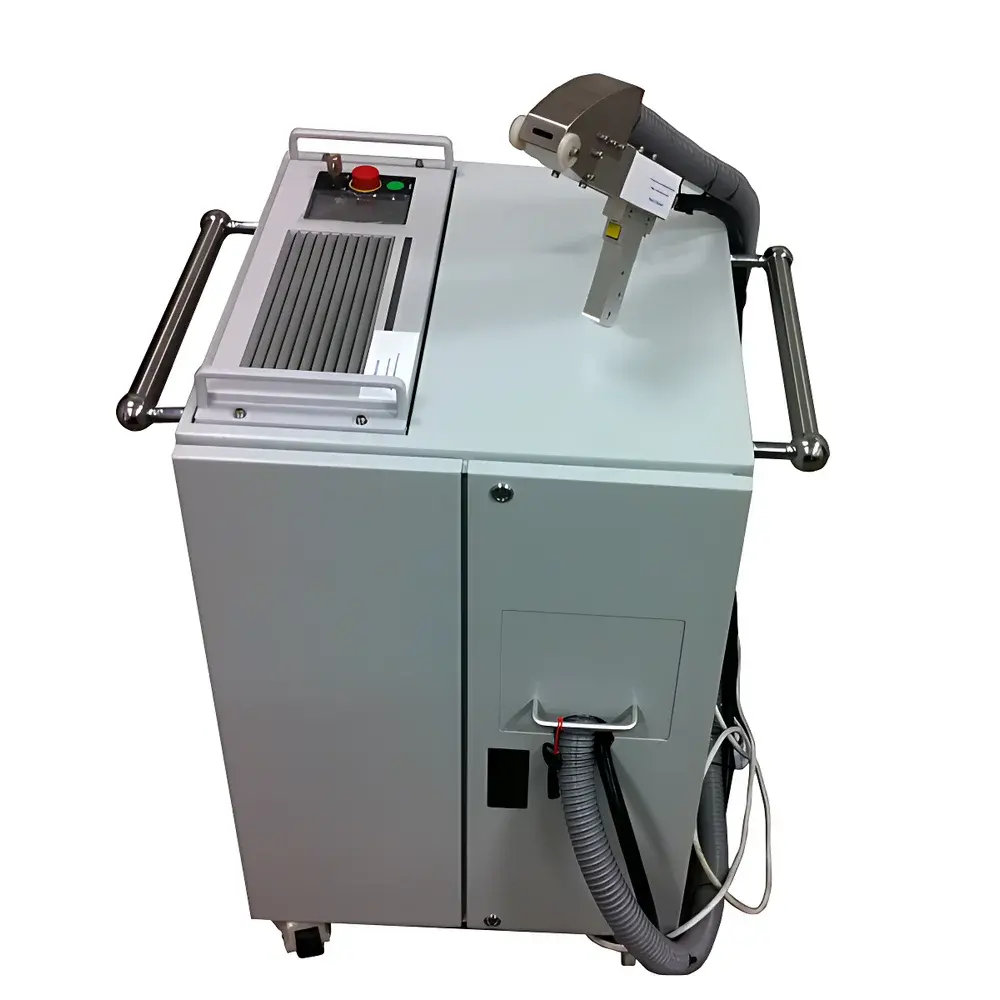
German-Imported Portable Laser Cleaning System for Precision Surface Decontamination
| Origin | Germany |
|---|---|
| Distribution Model | Authorized Distributor |
| Import Status | Imported |
| Heating Power Range | 20–1000 W |
| Cleaning Medium | Pulsed Fiber Laser (1064 nm) |
| External Dimensions (L×W×D) | 50 × 50 × 70 cm (Mobile Configuration) |
| Cooling Method | Air-Cooled (≤600 W) |
| Control Interface | Touchscreen HMI |
Overview
The German-imported Portable Laser Cleaning System is an industrial-grade, non-contact surface decontamination instrument engineered for selective ablation of contaminants from metallic, ceramic, and glass substrates using pulsed fiber laser technology (1064 nm wavelength). Unlike conventional chemical or mechanical cleaning methods, this system operates on the principle of laser-induced plasma ablation—where short-duration, high-peak-power laser pulses generate localized thermal stress sufficient to vaporize or dislodge oxides, paints, resins, oils, adhesives, and particulate residues without damaging the underlying base material. Its design adheres to fundamental photothermal interaction models used in precision surface engineering, enabling sub-micron layer removal with minimal heat-affected zone (HAZ). The system is purpose-built for applications demanding zero consumables, no secondary waste generation, and full compliance with dry-process requirements in regulated manufacturing environments—including aerospace MRO, medical device component finishing, and heritage conservation workflows.
Key Features
- Modular power architecture supporting scalable output from 20 W (backpack-integrated) to 1000 W (cart-mounted), enabling optimization for both handheld precision tasks and high-throughput industrial cleaning
- Air-cooled laser source (standard up to 600 W) ensures operational portability and reduced infrastructure dependency; water-cooling integration available for sustained high-duty-cycle operation
- Intuitive touchscreen human-machine interface (HMI) with preloaded parameter libraries for common substrate-contaminant combinations (e.g., Al alloy + oxide, stainless steel + weld slag, tempered glass + organic film)
- Optical delivery system featuring adjustable spot size (50–500 µm), pulse frequency (1–200 kHz), and energy density control (0.1–5 J/cm²), facilitating reproducible process tuning per ISO 20473:2021 guidelines for laser-material interaction
- Robust aluminum-alloy chassis with IP54-rated enclosure, certified for operation in ambient temperatures ranging from 5 °C to 40 °C and relative humidity ≤80% non-condensing
- Expandable platform architecture compatible with robotic arm mounting kits and CNC-integrated motion controllers for future automation upgrades under IEC 61508 functional safety framework
Sample Compatibility & Compliance
This laser cleaning system demonstrates validated compatibility across a broad spectrum of materials: ferrous and non-ferrous metals (including aluminum alloys, titanium Grade 5, and austenitic stainless steels), borosilicate and soda-lime glass, granite, limestone, and fired ceramic surfaces. It meets essential safety and performance benchmarks including EN 60825-1:2014 (laser product safety), EN ISO 12100:2010 (machinery risk assessment), and conforms to EU Machinery Directive 2006/42/EC. For regulated industries, the system supports audit-ready documentation packages aligned with FDA 21 CFR Part 11 (electronic records integrity) when paired with optional data logging modules. No chemical solvents, abrasives, or aqueous media are required—eliminating VOC emissions, wastewater discharge liabilities, and corrosion risks associated with wet cleaning processes.
Software & Data Management
The embedded firmware includes real-time monitoring of laser diode temperature, pulse stability, and beam alignment diagnostics. Optional PC-based software (Windows 10/11 compatible) enables full parameter logging, time-stamped event recording, and export of CSV-formatted cleaning logs for quality assurance traceability. Process parameters can be saved as encrypted project files with user-defined access permissions, supporting GLP-compliant workflow management. Integration with LabVantage LIMS or Siemens Desigo CCMS is achievable via OPC UA protocol, allowing centralized monitoring within enterprise-level laboratory informatics ecosystems.
Applications
- Aerospace maintenance: Removal of thermal barrier coatings, anodized layers, and corrosion products from turbine blades and airframe components without dimensional deviation
- Automotive tooling: In-situ cleaning of tire molds, die-casting inserts, and injection molding cavities to restore surface fidelity and extend service life
- Electronics manufacturing: Precision deburring and flux residue ablation from PCB edge connectors and semiconductor packaging substrates
- Cultural heritage preservation: Non-invasive soiling removal from historic bronze statues, marble facades, and archaeological stonework without altering patina or microtopography
- Food-grade equipment sanitation: Elimination of biofilm, protein deposits, and lubricant residues from stainless-steel processing vessels and conveyor components—validated per EHEDG Guideline Doc. 8
FAQ
Does this system require consumables or process chemicals?
No. The laser cleaning process is entirely dry and consumable-free—only electrical power and ambient air (for air-cooled units) or deionized water (for water-cooled configurations) are needed.
Can it be integrated into existing production lines?
Yes. The modular mechanical interface and open communication protocols (RS-485, Ethernet/IP) support seamless integration with PLC-controlled assembly systems and robotic workcells.
Is operator training required for safe use?
Yes. Certified laser safety officer (LSO) training per ANSI Z136.1 is mandatory. The system includes built-in interlocks, Class 4 laser hazard labeling, and emergency stop functionality compliant with IEC 60204-1.
What surface roughness changes occur after laser cleaning?
Typical Ra variation remains within ±0.1 µm for most metallic substrates when operated within recommended fluence thresholds—verified by profilometry per ISO 4287.
Is validation documentation provided for GMP-regulated facilities?
Yes. IQ/OQ documentation templates, calibration certificates traceable to PTB (Physikalisch-Technische Bundesanstalt), and risk assessment reports are available upon request.



