
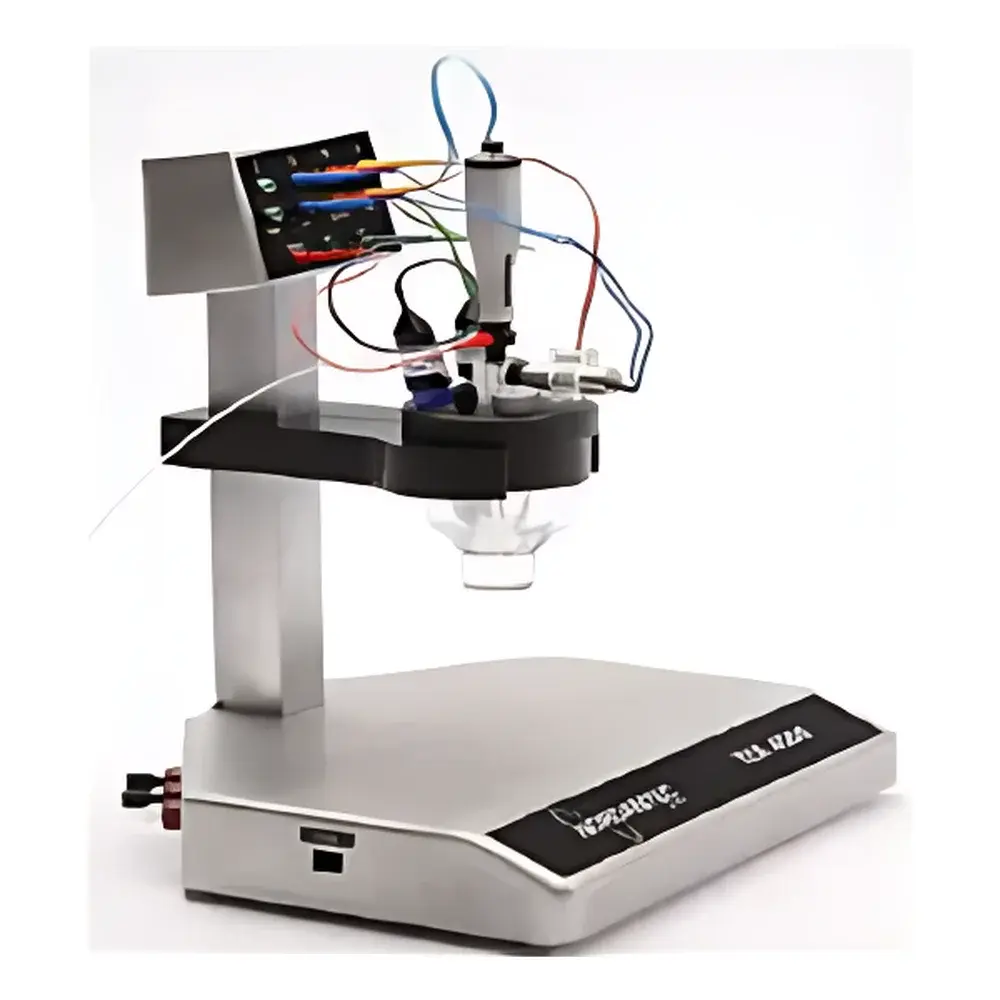
German TEA4000 Polarographic Analyzer
| Brand | — |
|---|---|
| Origin | Germany |
| Manufacturer Type | Authorized Distributor |
| Origin Category | Imported |
| Model | TEA4000 |
| Pricing | Upon Request |
Overview
The German TEA4000 Polarographic Analyzer is a dedicated benchtop electrochemical instrument engineered for trace-level quantitative analysis of metal ions and selected organic compounds in aqueous matrices. Based on classical direct current (DC) polarography and differential pulse polarography (DPP), the system employs a static mercury drop electrode (SMDE) as its working electrode—offering high sensitivity, excellent reproducibility, and inherent resistance to surface fouling. Unlike rotating disk or hanging mercury drop electrodes (HMDE), the TEA4000’s proprietary mercury dosing mechanism delivers precisely timed, size-controlled mercury drops without pneumatic pressure or mechanical contact, ensuring stable diffusion-controlled current response and minimizing baseline drift. Designed for routine laboratory analysis, environmental monitoring, food safety screening, and academic electrochemistry research, the instrument meets the technical demands of trace metal quantification down to 1 µg/L (ppb) in water, beverages, biological fluids, and digested food samples—fully aligned with regulatory expectations under ISO 17294-2, EPA Method 200.8, and EU Directive 2006/118/EC for groundwater quality.
Key Features
- Static Mercury Drop Electrode (SMDE) with integrated capillary (135 × 6 mm, 0.1 mm bore) — enables fully automated, pressure-free mercury dispensing and exceptional drop-to-drop reproducibility
- Dual-channel gas inlet/outlet porting on the electrode probe block — supports controlled deoxygenation (N₂ or Ar) and inert-atmosphere measurements
- Triple-electrode configuration: Ag/AgCl (sat. KCl) reference electrode, Pt wire counter electrode, and SMDE working electrode — optimized for low-noise potentiostatic control
- High-speed analog front-end: ±12 V potential range, ±10 mA current compliance, <10 µs response time for fast-scan voltammetry
- 6-range programmable current amplifier (±20 nA to ±2 mA full scale) with 600 ms adjustable filtering — balances signal-to-noise ratio and temporal resolution
- 12-bit bipolar successive-approximation ADC and 16-bit bipolar DAC — ensures precise waveform generation and digitization fidelity per IEC 61000-4-30 compliance requirements
- Z80-A microprocessor (4 MHz) with 32 KB battery-backed CMOS RAM — retains calibration parameters and method files during power interruption (6-month backup)
- RS-232C serial interface (600–9600 baud) with full handshake protocol (RTS/CTS/DCD/DTR) — enables bidirectional communication with Windows-based acquisition software
Sample Compatibility & Compliance
The TEA4000 accommodates liquid samples requiring minimal pretreatment: clarified aqueous extracts, acid-digested environmental solids, ultrafiltered biological fluids, and standardized food leachates. It supports standard addition, calibration curve, and standardless semi-quantitative modes. All electrochemical measurements comply with fundamental principles outlined in ASTM D3692 (Standard Test Methods for Polarographic Analysis), ISO 8692 (Water quality — Guidelines for polarographic determination of heavy metals), and USP for pharmaceutical trace metal testing. The instrument architecture supports audit-trail-capable data logging when paired with validated third-party software, facilitating GLP-compliant reporting and FDA 21 CFR Part 11 readiness through user authentication and electronic signature integration.
Software & Data Management
The TEA4000 operates with dedicated Windows-compatible acquisition and processing software that provides real-time voltammogram visualization, peak identification (first-derivative detection), background subtraction (polynomial or linear), and concentration calculation via internal standard or external calibration. Raw data are stored in ASCII-compatible .CSV format with timestamp, instrument metadata, and parameter settings embedded. Software modules support batch processing of up to 99 sequential runs, automatic report generation (PDF/Excel), and export to LIMS via ODBC drivers. Firmware updates and method templates are distributed via secure FTP—no cloud dependency or vendor-hosted infrastructure required.
Applications
- Environmental: Quantification of Pb²⁺, Cd²⁺, Zn²⁺, Cu²⁺, Ni²⁺, and As(III) in drinking water, wastewater, and soil leachates
- Food & Beverage: Screening for toxic metals in fruit juices, dairy products, infant formula, and seafood extracts
- Clinical Research: Measurement of trace Cu/Zn ratios in serum and cerebrospinal fluid for neurodegenerative disease biomarker studies
- Industrial QA/QC: Monitoring metal impurities in ultrapure water used in semiconductor fabrication and pharmaceutical excipient production
- Academic Electrochemistry: Teaching fundamental concepts of diffusion-controlled currents, Ilkovič equation validation, and electrode kinetics modeling
FAQ
What types of samples require deoxygenation prior to analysis?
Dissolved oxygen interferes with reduction waves below −0.2 V vs. Ag/AgCl; therefore, all samples intended for cathodic scans (e.g., Cd, Pb, Zn analysis) must be purged with nitrogen or argon for ≥10 minutes before measurement.
Is the mercury capillary field-replaceable without recalibration?
Yes—the 0.1 mm glass capillary is designed as a consumable component; replacement requires only physical insertion and confirmation of drop formation via visual inspection—no hardware recalibration is necessary.
Does the TEA4000 support square-wave or anodic stripping voltammetry?
No—the instrument implements DC polarography and differential pulse polarography only; it does not generate square-wave or staircase waveforms required for SWV or ASV.
Can the system be integrated into an automated sample handling platform?
Yes—via RS-232 command set (SCPI-like syntax), the TEA4000 accepts remote start/stop, parameter upload, and data polling commands, enabling synchronization with autosamplers and robotic liquid handlers.
What is the typical lifetime of the Ag/AgCl reference electrode?
Under normal use (≤8 hours/day, saturated KCl filling solution refreshed weekly), the reference electrode maintains stable potential (<±1 mV drift/week) for 12–18 months before replacement is recommended.





