
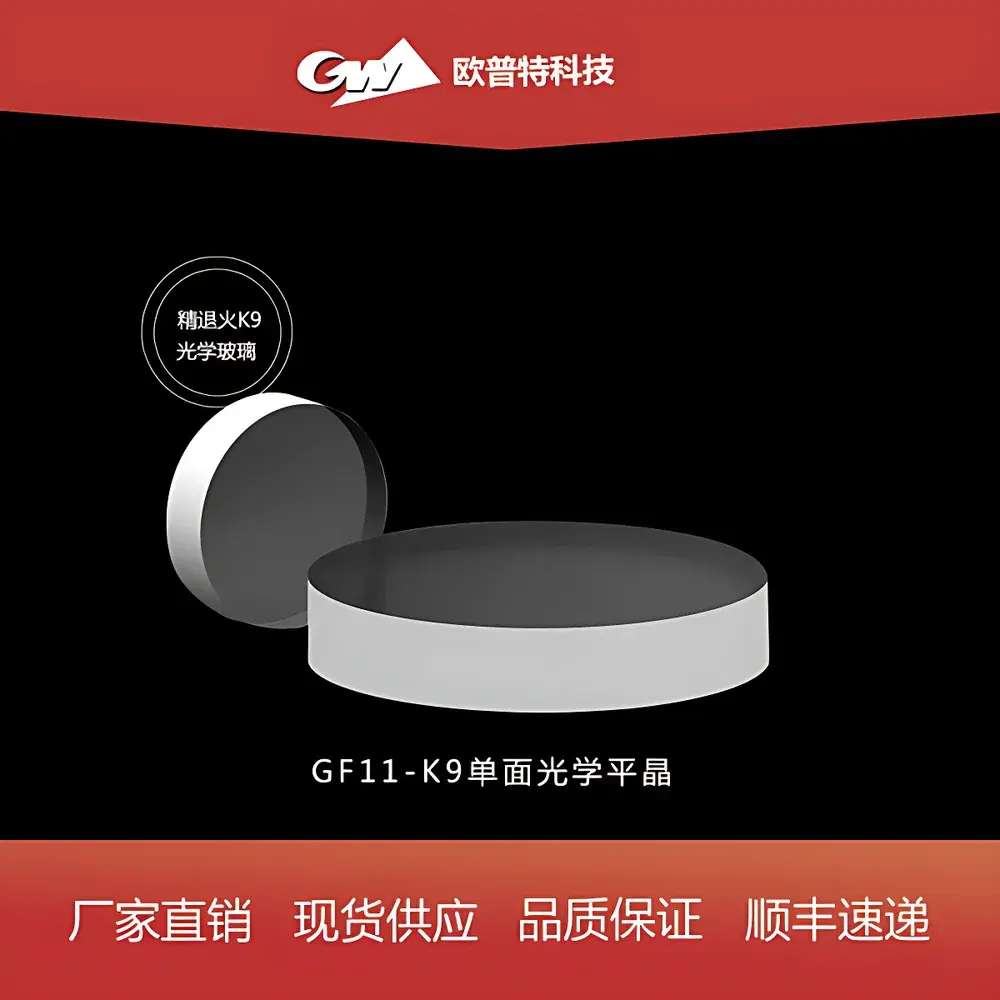
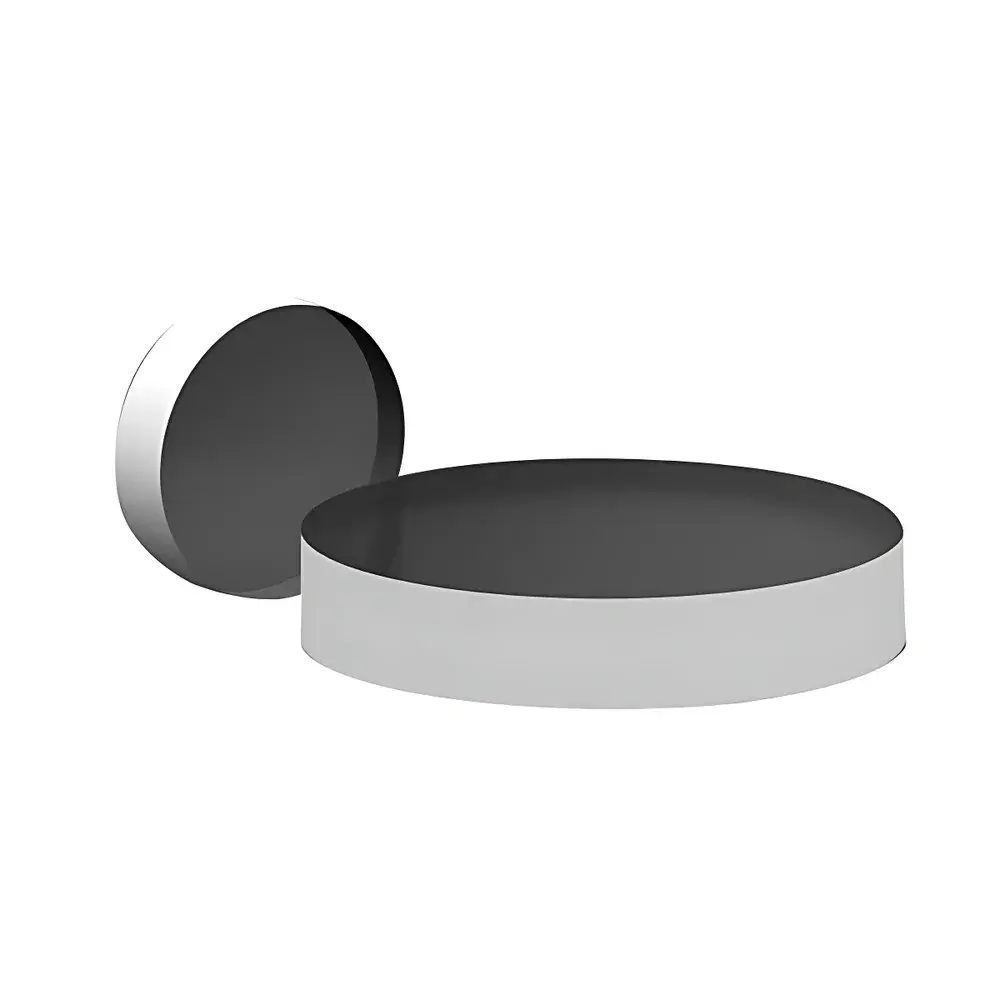
GF11 Single-Sided Optical Flat
| Origin | Beijing |
|---|---|
| Manufacturer Type | Distributor |
| Origin Category | Domestic (China) |
| Model | GF11 |
| Price Range | USD 0.15–75 |
| Component Category | Optical Element |
| Material | Precision-Annealed K9 Optical Glass |
| Surface Figure | λ/20 or λ/10 @ 633 nm |
| Parallelism | < 1 arcminute |
| Surface Quality | 3–4 Grade (per MIL-PRF-13830B) |
| Back Surface | Fine Ground |
| Diameter Tolerance | ±0.2 mm |
| Thickness Tolerance | ±1 mm or ±2 mm (model-dependent) |
| Edge Treatment | Protective 45° Chamfer, 0.2–0.5 mm |
| Coating | Optional Custom Anti-Reflection or High-Reflectivity Coating per Customer Specification |
Overview
The GF11 Single-Sided Optical Flat is a precision reference surface engineered for quantitative interferometric evaluation of flatness, surface figure error, and optical contact (optical polishing “ring” assessment) in high-quality optical components and precision mechanical surfaces. Fabricated from stress-free, precision-annealed K9 borosilicate crown glass, the GF11 exhibits exceptional homogeneity, low birefringence, and thermal stability—critical prerequisites for reliable null testing in monochromatic interferometry (e.g., using He–Ne lasers at 633 nm). Unlike double-sided flats, the GF11 features a single optically finished surface paired with a fine-ground, non-reflective back—eliminating spurious interference fringes from rear-surface reflections and enabling unambiguous interpretation of Newton’s rings or Fizeau fringe patterns. Its surface figure accuracy is certified to λ/20 or λ/10 (RMS or peak-to-valley, as specified) at 633 nm wavelength, meeting metrology-grade requirements for ISO 10110-5 and ANSI/OEOSC OP1.002 standards.
Key Features
- Precision-annealed K9 optical glass substrate ensures minimal residual stress and long-term dimensional stability under laboratory environmental fluctuations.
- Optically polished front surface with surface figure tolerance of λ/20 or λ/10 @ 633 nm—traceable to NIST-traceable interferometric calibration reports upon request.
- Parallelism maintained below 1 arcminute between polished surface and mounting plane—enabling accurate tilt-compensated flatness measurement.
- Surface quality rated to 3–4 grade per MIL-PRF-13830B (equivalent to 60–40 scratch-dig), suitable for Class 100 cleanroom handling and high-precision assembly.
- Protective 45° chamfer (0.2–0.5 mm) applied to all edges to prevent chipping during handling, cleaning, and mounting.
- Custom thin-film coatings available—including broadband AR (400–700 nm), V-coat at 532 nm or 633 nm, or high-reflectivity dielectric stacks—designed for specific laser wavelengths and polarization states.
- Diameter range spans 25.4 mm to 304.8 mm; thickness options scaled proportionally (12.7 mm to 38.1 mm) to maintain rigidity and minimize flexure-induced figure error.
Sample Compatibility & Compliance
The GF11 is compatible with standard optical interferometers (Zygo MetroPro, 4D AccuFiz, or DIY Fizeau configurations), surface profilers, and manual Newton’s ring inspection setups. It supports measurement of fused silica, sapphire, silicon wafers, ground granite reference plates, and polished metal surfaces (e.g., stainless steel gauge blocks). All units comply with ISO 10110-5 (surface form tolerances), ISO 14999-2 (interferometric flatness verification methods), and GB/T 28313–2012 (Chinese national standard for optical flats). Calibration certificates include traceability statements aligned with ISO/IEC 17025 requirements when ordered with metrology documentation.
Software & Data Management
While the GF11 itself is a passive optical component, its integration into automated inspection workflows is supported via compatibility with industry-standard interferogram analysis software—including Zygo MetroPro, QED Technologies QView, and open-source tools such as OpenFringe. When used with motorized rotation stages and CCD-based capture systems, the GF11 enables full-field phase-shifting interferometry (PSI) with sub-nanometer repeatability. Audit trails, calibration history, and usage logs can be maintained within laboratory information management systems (LIMS) compliant with FDA 21 CFR Part 11 when paired with validated digital acquisition hardware.
Applications
- Null testing of optical windows, prisms, and laser cavity end mirrors for surface figure deviation.
- Verification of lapping and polishing uniformity on silicon wafers and semiconductor substrates.
- Flatness qualification of precision machine tool ways, granite surface plates, and CMM reference artifacts.
- Educational demonstration of wavefront interference, coherence length effects, and surface roughness thresholds.
- Calibration transfer between primary standards (e.g., NIST-traceable master flats) and working standards in metrology labs.
- In-process QC for optical fabrication facilities adhering to ISO 9001, AS9100, or IATF 16949 quality management systems.
FAQ
What does “λ/20 @ 633 nm” mean for surface figure specification?
It indicates that the peak-to-valley surface deviation across the clear aperture is no greater than one-twentieth of the wavelength of helium–neon laser light (633 nm), i.e., ≤31.65 nm PV. This corresponds to ~1.6 nm RMS for typical Gaussian-like error distributions.
Is the GF11 suitable for vacuum or cleanroom environments?
Yes—the K9 substrate is outgassing-compliant per ASTM E595, and surface treatments meet ISO Class 5 (Class 100) cleanroom handling requirements when packaged in laminar-flow-certified containers.
Can the GF11 be mounted directly to kinematic mounts without distortion?
Yes, provided mounting force is distributed uniformly via three-point contact and clamping pressure remains below 0.5 MPa. Finite-element analysis confirms negligible deformation (<0.02λ PV) for diameters ≤150 mm under recommended fixtures.
How is surface figure verified post-manufacturing?
Each unit undergoes full-aperture Twyman–Green or Fizeau interferometry using a certified master flat and stabilized 633 nm laser source; raw interferograms and Zernike polynomial fits are archived for traceability.
Do you offer certification with uncertainty budgets?
Yes—NIST-traceable calibration reports with expanded uncertainty (k=2) covering repeatability, environmental drift, and reference standard uncertainty are available as optional add-ons.



