
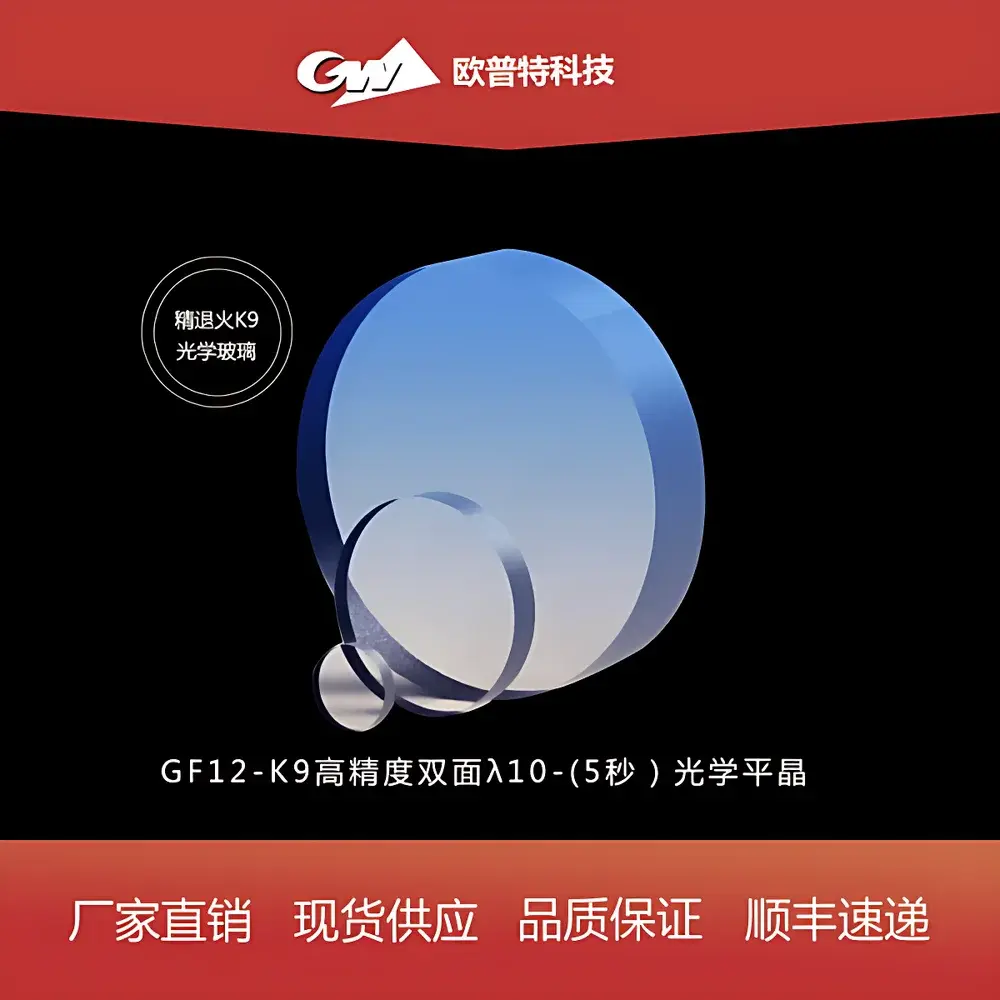
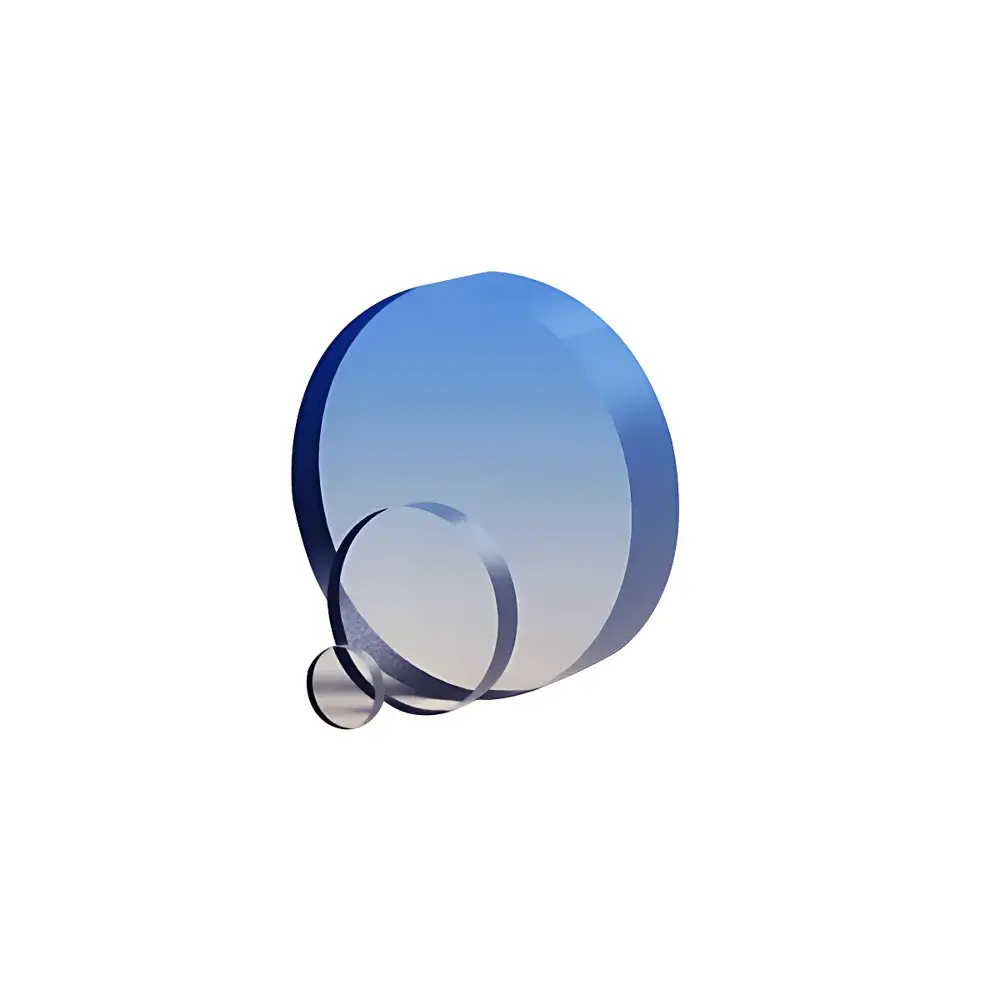
GF12 Dual-Sided Optical Flat
| Material | Precision Annealed K9 Optical Glass |
|---|---|
| Surface Figure | λ/4 @ 633 nm |
| Parallelism | <5 arcseconds (model-dependent, see part numbering) |
| Surface Quality | 3–4 scratch-dig |
| Diameter Tolerance | ±0.2 mm |
| Thickness Tolerance | ±1 mm (≤12.7 mm), ±2 mm (>12.7 mm) |
| Edge Treatment | Protective 45° chamfer, 0.2–0.5 mm |
| Coating | Uncoated (standard) |
| Compliance | ISO 10110-7, MIL-PRF-13830B |
Overview
The GF12 Dual-Sided Optical Flat is a precision reference standard engineered for quantitative assessment of surface flatness and optical contact (fringe analysis) in metrology-grade applications. Fabricated from stress-relieved, precision-annealed K9 borosilicate crown glass, it exhibits low birefringence, high homogeneity, and exceptional thermal stability—critical attributes for interferometric verification under controlled laboratory conditions. Its dual-sided λ/4 surface figure (measured at the helium–neon laser wavelength of 633 nm) ensures traceable planarity across both faces, enabling use as either a master reference or a null test plate in Fizeau or Twyman–Green interferometers. Unlike single-sided flats, the GF12’s symmetrical geometry minimizes thermal drift-induced errors during extended measurements and supports bidirectional calibration protocols required in ISO/IEC 17025-accredited labs.
Key Features
- Precision-annealed K9 optical glass substrate with verified refractive index uniformity (Δn ≤ 5 × 10⁻⁶) and bubble/inclusion grade per ISO 10110-2 Class 2
- Dual-face surface figure of λ/4 @ 633 nm, certified via phase-shifting interferometry (PSI) with NIST-traceable calibration reports available upon request
- Surface quality rated to 3–4 scratch-dig per MIL-PRF-13830B, verified by automated dark-field inspection
- Tight dimensional control: diameter tolerance ±0.2 mm; thickness tolerance ±1 mm (for t ≤ 12.7 mm) or ±2 mm (for t > 12.7 mm)
- Protective 45° edge chamfer (0.2–0.5 mm) to prevent chipping and mitigate edge-related fringe distortion in interferograms
- Uncoated standard configuration ensures broadband transmission (350–2000 nm) and compatibility with UV-visible-NIR interferometric setups
- Part-numbering system encodes critical specifications (e.g., GF12-0508-2-1 denotes Ø50.8 mm, t = 12.7 ±1 mm, λ/4 figure, uncoated)
Sample Compatibility & Compliance
The GF12 is compatible with polished metallic, ceramic, fused silica, and single-crystal substrates exhibiting surface roughness Ra < 5 nm and finish quality meeting ISO 10110-8 Class 3 or better. It is routinely deployed in cleanroom environments (ISO Class 5 or higher) for verifying flatness of gauge blocks, optical mounts, monochromator gratings, and semiconductor wafer chucks. The flat conforms to ISO 10110-7 (surface irregularity tolerancing), MIL-PRF-13830B (optical component quality), and supports compliance with ASTM E1338 (interferometric flatness measurement procedures). Its material certification includes full batch traceability to raw glass manufacturer documentation and annealing cycle logs.
Software & Data Management
While the GF12 itself is a passive optical standard, its integration into digital metrology workflows is supported through interoperability with industry-standard interferometry platforms—including Zygo MetroPro, 4D Technology AccuFiz, and PhaseShift Technologies PSI software. All certified calibration data (including Zernike polynomial coefficients, PV/RMS deviation maps, and local slope error contours) are delivered in ASCII-compatible .txt and .csv formats compliant with ASTM E2682. Audit trails for calibration history, environmental conditions during testing (temperature ±0.1°C, humidity 40–50% RH), and operator credentials are maintained per GLP requirements. Optional NIST-traceable calibration certificates include uncertainty budgets calculated per GUM (JCGM 100:2008).
Applications
- Quantitative flatness evaluation of optical components (mirrors, windows, beam splitters) using monochromatic interferometry
- Qualitative and semi-quantitative assessment of surface contact (Newton’s rings analysis) for lapping and polishing process validation
- Reference standard in ISO 10360-compliant CMM verification protocols for planar artifact calibration
- Alignment reference in ultra-precision assembly of laser cavities, X-ray optics, and synchrotron beamline components
- Educational use in undergraduate and graduate optics laboratories for teaching wavefront analysis, coherence theory, and error separation techniques
- Supporting FDA 21 CFR Part 11–compliant manufacturing environments where documented metrological traceability is mandated
FAQ
What does “λ/4 @ 633 nm” mean in practical metrology terms?
It specifies that the peak-to-valley surface deviation across the entire clear aperture does not exceed one-quarter of the wavelength of a 633 nm HeNe laser—approximately 158 nm. This corresponds to a typical RMS flatness of ~30–40 nm and is suitable for Grade 0 flatness verification per ISO 10110-7.
Can the GF12 be used with green or UV lasers?
Yes—the uncoated K9 substrate transmits effectively from 350 nm to 2 µm. However, surface figure is certified at 633 nm; thermal expansion effects may shift effective flatness slightly at non-standard wavelengths, particularly above 100 mW average power.
Is custom coating available?
Yes—anti-reflection (AR) coatings optimized for 532 nm, 355 nm, or broadband VIS-NIR ranges can be applied upon request. Coated versions require separate surface figure re-certification and are designated with suffix “-C” in the part number.
How should the GF12 be cleaned and handled?
Use only Class 100 cleanroom-grade acetone and spectroscopic-grade methanol with lint-free polyester wipes. Avoid direct finger contact; always wear powder-free nitrile gloves and handle by the chamfered edge. Store vertically in inert-gas-purged, desiccated cabinets.
Does the GF12 require periodic recalibration?
Per ISO/IEC 17025, annual recalibration is recommended for accredited use. For non-critical R&D applications, recalibration is advised after any mechanical shock, thermal cycling beyond ±5°C, or visible surface damage.




