
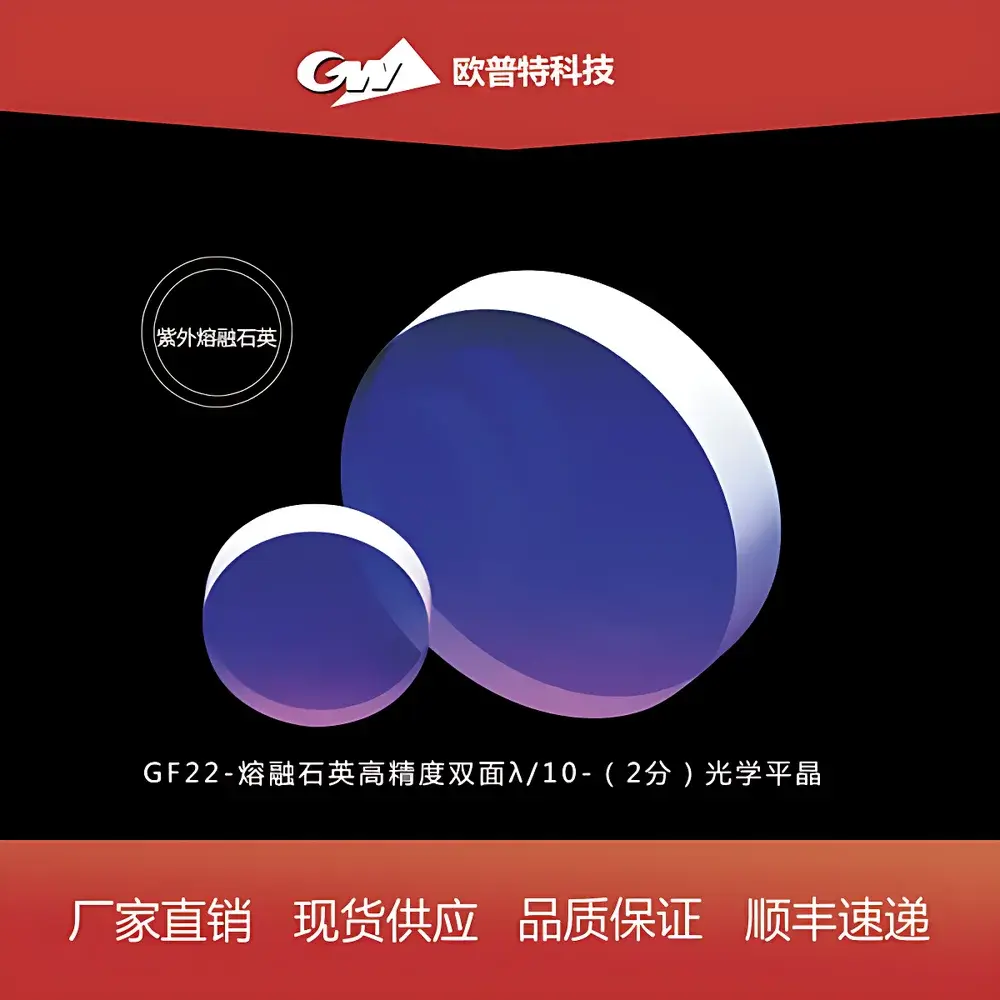
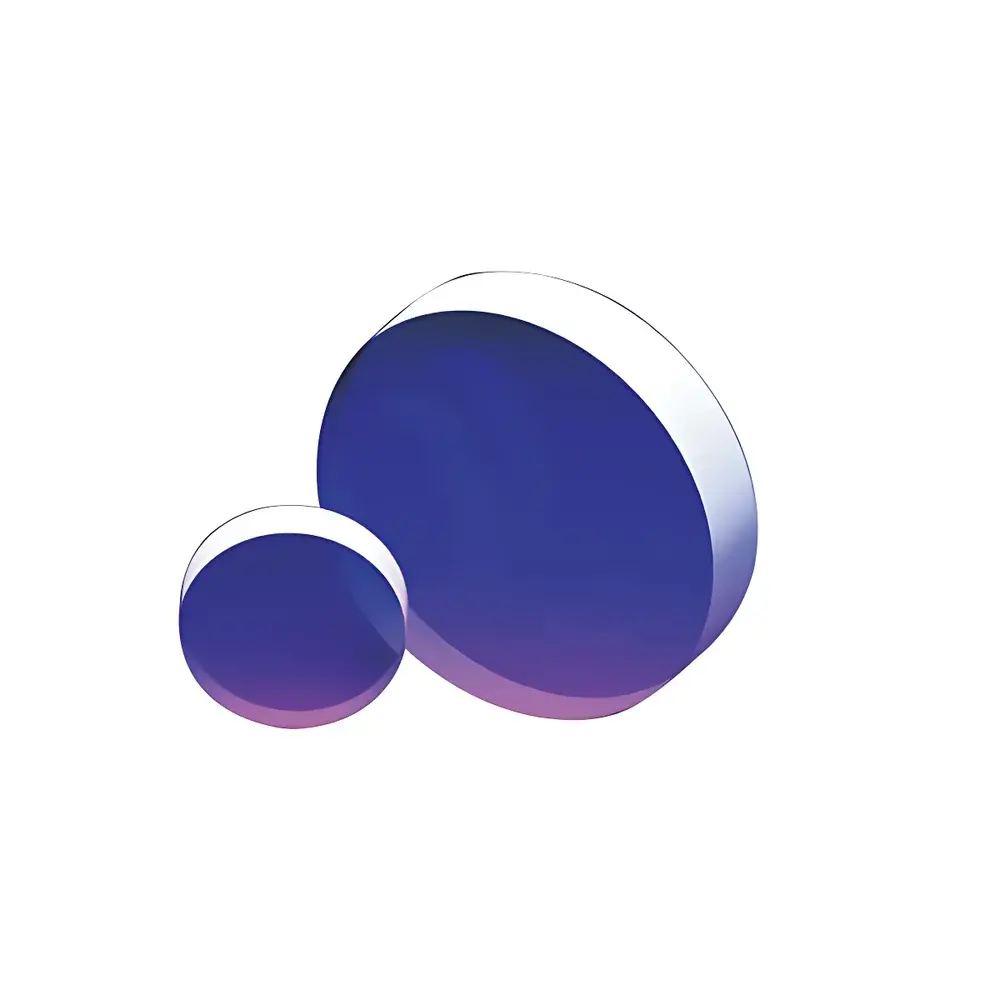
GF22 Dual-Sided Optical Flat
| Material | UV-grade fused silica |
|---|---|
| Surface figure | λ/20 @ 633 nm |
| Parallelism | <5 arcseconds (standard), optional <1 arcsecond or 2′ ±30″ |
| Surface quality | 3–4 scratch-dig |
| Diameter tolerance | ±0.2 mm |
| Thickness tolerance | ±1 mm (for ≤12.7 mm), ±2 mm (for ≥25.4 mm) |
| Edge treatment | Protective 45° chamfer, 0.2–0.5 mm |
| Coating | Uncoated |
| Compliance | ISO 10110-7, MIL-PRF-13830B |
Overview
The GF22 Dual-Sided Optical Flat is a precision reference standard engineered for interferometric flatness verification and optical contact testing in metrology laboratories, optical fabrication facilities, and R&D environments. Constructed from UV-grade fused silica, it exhibits exceptional thermal stability (CTE ≈ 0.55 × 10⁻⁶ /°C), low intrinsic birefringence, and high transmission across the 185–2100 nm spectral range—making it suitable for both visible and near-UV applications. Its dual-sided optical finish enables bidirectional use as a master reference surface, supporting null testing of plano-optics such as windows, mirrors, and substrates. The flat operates on the principle of optical interference: when brought into near-contact with a test surface under monochromatic illumination (typically 633 nm He–Ne laser), Newton’s rings or fringes reveal deviations from ideal planarity at λ/20 accuracy—equivalent to ~31.6 nm peak-to-valley deviation over the full aperture.
Key Features
- High-fidelity surface figure: λ/20 @ 633 nm (typical), traceable to NIST-traceable interferometric calibration reports upon request
- Dual polished faces meeting ISO 10110-7 specifications for surface irregularity and MIL-PRF-13830B for scratch-dig (3–4 level)
- Controlled parallelism options: standard <5 arcseconds; premium grades available at <1 arcsecond or 2′ ±30″ for ultra-precision alignment tasks
- Robust edge geometry: protective 45° chamfer (0.2–0.5 mm) minimizes chipping risk during handling and mounting
- Dimensional stability: thickness tolerances held to ±1 mm (for t ≤ 12.7 mm) or ±2 mm (for t ≥ 25.4 mm); diameter tolerance ±0.2 mm ensures compatibility with standard kinematic mounts and interferometer stages
- Uncoated substrate: preserves broadband performance and avoids phase-shift artifacts inherent in anti-reflection coatings during fringe analysis
Sample Compatibility & Compliance
The GF22 series accommodates optical components ranging from 25.4 mm to 304.8 mm in diameter and 12.7 mm to 38.1 mm in thickness. Each flat is supplied with individual serialized identification and optional calibration documentation compliant with ISO/IEC 17025 requirements. Surface figure and parallelism data are verified using Zygo Verifire™ or similar phase-shifting interferometers calibrated per ISO 10110-5. The fused silica material complies with ASTM F796 for optical grade quartz and meets USP particulate limits when cleaned per ISO 14644-1 Class 5 protocols. For GMP-regulated optical assembly lines, batch-level certificates of conformance—including raw material lot traceability and interferometric test records—are available upon order specification.
Software & Data Management
While the GF22 flat itself is a passive reference standard, its integration into automated metrology workflows is supported via standardized digital documentation. Calibration reports include Zernike polynomial coefficients (up to 36 terms), PV/RMS surface error maps, and interferogram metadata (wavelength, aperture, environmental conditions). These reports are delivered in PDF/A-1b and ASCII .dat formats compatible with MATLAB, Python (via OpenCV or scikit-image), and commercial optical design platforms (Zemax OpticStudio, CODE V). All delivered files include embedded audit trails satisfying FDA 21 CFR Part 11 requirements for electronic records—enabling secure archiving, version control, and GLP-compliant reporting in regulated environments.
Applications
- Interferometric flatness verification of optical flats, prisms, and laser cavity mirrors
- Qualitative and quantitative assessment of lapping/polishing uniformity in precision optics manufacturing
- Null testing of aspheric null lenses and compensators
- Calibration of coordinate measuring machines (CMMs) and optical profilers (e.g., white-light interferometers)
- Research-grade surface contact mechanics studies using optical levers or capacitive gap sensing
- Alignment reference for high-stability optical benches and gravitational wave detector prototypes
FAQ
What wavelength is used for the stated λ/20 surface figure specification?
The λ/20 rating is referenced to 633 nm (He–Ne laser wavelength), consistent with ISO 10110-5 definitions for surface irregularity.
Can the GF22 flat be used in vacuum or UHV environments?
Yes—UV-grade fused silica has negligible outgassing (per ASTM E595 TC/SC <1.0%) and maintains dimensional integrity below 10⁻⁹ Torr.
Is custom diameter or thickness available beyond the listed configurations?
Custom dimensions are available with minimum order quantities; lead time extends by 4–6 weeks for non-standard geometries.
Do you provide interferometric calibration certificates with Zernike analysis?
Yes—certificates conforming to ISO/IEC 17025 are optionally available at additional cost and include full Zernike decomposition and uncertainty budgets.
How should the GF22 flat be cleaned and stored to preserve surface integrity?
Use Class 100 cleanroom protocols: solvent rinse (acetone → methanol → IPA), nitrogen blow-off, and storage in inert-gas-purged desiccators with soft silicone gasket mounts.



