
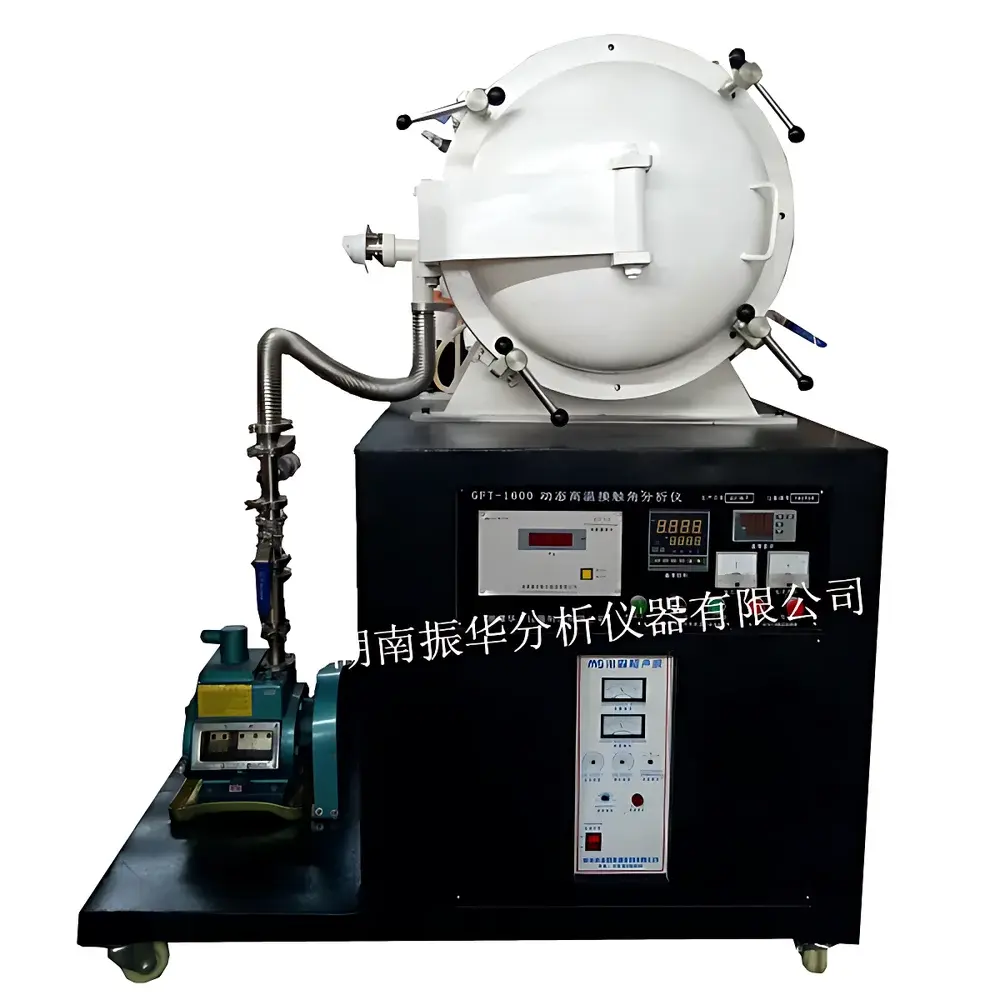
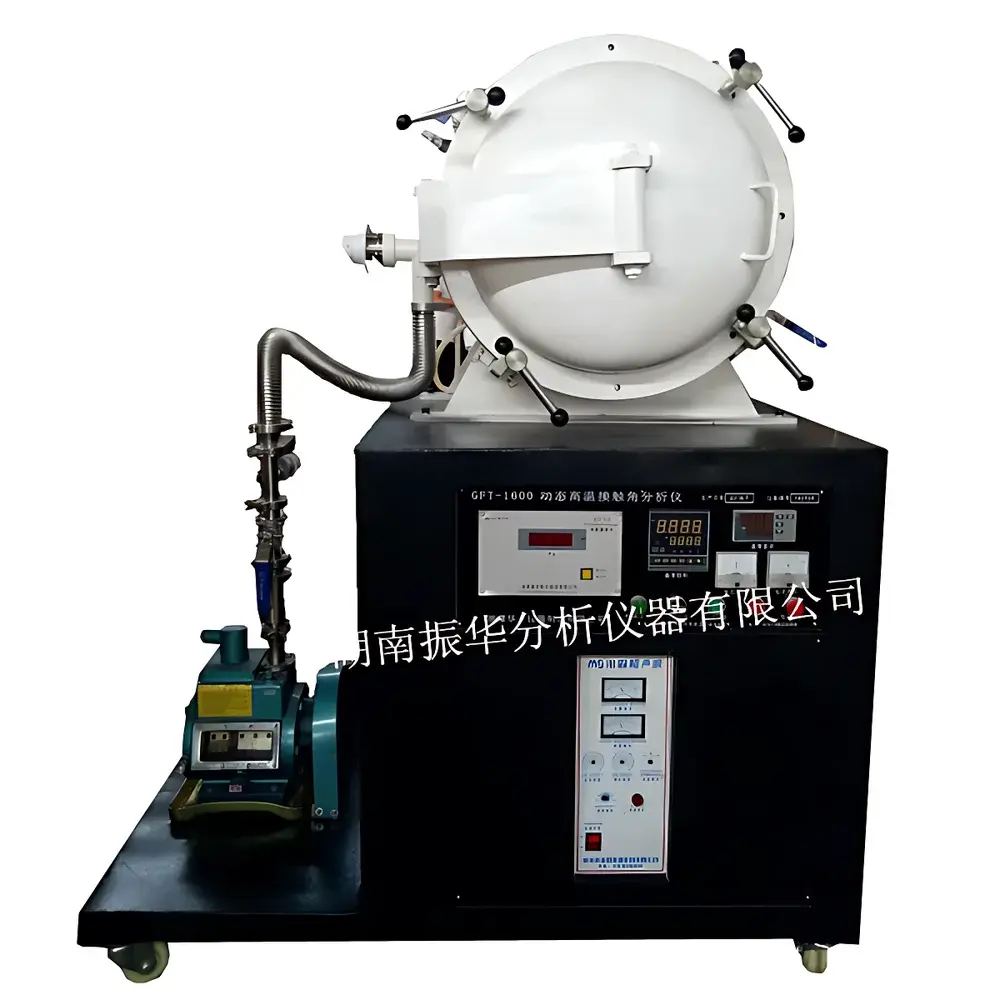
GFT-1600 High-Temperature Contact Angle Analyzer
| Origin | Hunan, China |
|---|---|
| Manufacturer Type | Authorized Distributor |
| Origin Category | Domestic (China) |
| Model | GFT-1600 |
| Pricing | Available Upon Request |
| Temperature Range | RT to 1700 °C (continuous operation ≤1600 °C) |
| Temperature Accuracy | ±2 °C (full scale) |
| Temperature Resolution | ±1 °C |
| Heating Element | Molybdenum-Rhodium (Mo-Rh) wire furnace (1.5 mm diameter) |
| Thermocouple | Type B, embedded in furnace wall |
| Control System | Microprocessor-based programmable temperature controller with pre-set ramp/soak profiles or manual mode |
| Imaging System | Industrial USB 2.0 CCD camera (≥5 MP, 25 fps), 0.7–4.5× continuous zoom lens (effective magnification 20–200×), optical resolution 2048 × 1536 px |
| Illumination | Adjustable LED monochromatic cold light source (6 V / 30 W equivalent spectral output) |
| Microscope | Manual focus (X/Y/Z + tilt adjustment), 0.7–4.5× zoom, 50–318 px/mm image magnification |
| Safety Features | Dual overtemperature and overcurrent protection |
| Power Supply | Single-phase 220 VAC, 50 Hz |
| Software | Dedicated contact angle analysis suite for dynamic contour extraction, sessile drop/bubble analysis, surface tension derivation, and time–temperature–contour data synchronization |
Overview
The GFT-1600 High-Temperature Contact Angle Analyzer is an engineered optical-thermal instrumentation platform designed for quantitative interfacial characterization of solid–liquid and solid–gas systems under controlled elevated temperatures. It operates on the principle of real-time silhouette imaging combined with high-precision thermal profiling, enabling direct measurement of contact angle, surface tension, and dynamic wetting behavior during thermal transitions—including sintering, softening, melting, and full liquefaction. Unlike ambient-contact-angle systems, the GFT-1600 integrates a vacuum-compatible Mo-Rh resistance furnace with a coaxially aligned optical path, permitting transmission-mode observation of sample contours through transparent or semi-transparent crucibles or substrates. This configuration ensures minimal parallax error and optimal edge-detection fidelity for automated droplet/bubble boundary segmentation across temperature ramps from room temperature to 1700 °C. The system is calibrated for ASTM E2917 (Standard Practice for Measuring Contact Angles at Elevated Temperatures) and supports traceable thermometric validation per ISO/IEC 17025 requirements when used with certified reference materials.
Key Features
- Robust Mo-Rh wire heating furnace (1.5 mm diameter) rated for continuous operation up to 1600 °C and peak excursions to 1700 °C (air) or 1750 °C (inert gas), with integrated Type B thermocouple embedded directly into the furnace wall for minimized thermal lag.
- High-fidelity imaging subsystem comprising a 5-megapixel USB 2.0 industrial CCD camera (25 fps capture rate), 0.7–4.5× continuously variable zoom lens, and precision manual XYZ+tilt stage—enabling stable, vibration-damped acquisition of sessile drops, pendant bubbles, or spreading fronts under thermal stress.
- Optimized illumination architecture using a monochromatic LED cold light source with adjustable intensity, eliminating thermal radiation interference while ensuring consistent contrast for edge detection algorithms.
- Programmable microprocessor temperature controller supporting multi-segment ramp-and-soak profiles; optional manual override mode for rapid thermal testing protocols.
- Dual hardware safety interlocks: independent overtemperature cutoff (setpoint-based) and overcurrent monitoring, compliant with IEC 61000-4-5 surge immunity standards.
- Full digital data synchronization: each captured frame is timestamped and annotated with concurrent furnace temperature, stage position, and illumination settings—ensuring audit-ready metadata for GLP/GMP-regulated environments.
Sample Compatibility & Compliance
The GFT-1600 accommodates diverse sample geometries including metallic alloys (e.g., Ni-based superalloys, Cu–Sn brazes), refractory oxides (Al2O3, ZrO2), carbides (SiC, WC), and mixed-phase ceramics. Samples are mounted on high-purity graphite or alumina platforms within the vacuum-rated furnace chamber, compatible with argon, nitrogen, or hydrogen atmospheres (optional gas inlet kit). The system meets mechanical and electrical safety requirements per CE EN 61010-1 and supports documentation packages required for FDA 21 CFR Part 11 compliance when deployed with validated software versioning and electronic signature modules. All thermal calibration records adhere to ISO/IEC 17025 traceability chains via NIST-traceable reference thermocouples.
Software & Data Management
The proprietary GFT-Analyze software provides fully automated contact angle computation using tangent-fit, circle-fit, and Young–Laplace fitting algorithms. It supports batch processing of time-series image stacks, dynamic contact angle tracking (advancing/receding), surface tension calculation via pendant drop analysis, and export of raw data in CSV, TIFF, and HDF5 formats. Audit trails record all user actions—including parameter modifications, calibration events, and report generation—with immutable timestamps. Exported datasets include synchronized temperature–time–contact-angle triplets suitable for integration into LIMS or statistical process control (SPC) platforms. Software validation documentation (IQ/OQ/PQ protocols) is available upon request for regulated laboratory deployment.
Applications
- Metallurgical R&D: Quantifying wettability of molten metals on ceramic substrates during brazing, infiltration, or additive manufacturing preform sintering.
- Ceramic processing: Monitoring interfacial reactions between liquid phase sintering aids and refractory matrices under controlled pO2.
- Nuclear fuel development: Assessing uranium dioxide–zirconium alloy interactions at operational temperatures exceeding 1500 °C.
- Coal ash fusibility analysis: Determining deformation, hemisphere, and flow temperatures per ASTM D1857 and ISO 540.
- Thermal barrier coating research: Evaluating molten CMAS (calcium–magnesium–alumino–silicate) droplet spreading kinetics on YSZ surfaces.
FAQ
What atmospheres can be used inside the furnace chamber?
The standard configuration supports inert (Ar, N2) and reducing (H2/N2) atmospheres up to 10−3 mbar base pressure; vacuum operation requires optional turbomolecular pump integration.
Is the system compatible with automated sample changers?
No—sample loading is manual due to high-temperature mechanical constraints; however, the software supports sequential analysis of multiple pre-loaded image sequences.
Can the GFT-1600 measure advancing and receding contact angles dynamically?
Yes—via programmed temperature ramps coupled with real-time droplet volume modulation using external syringe pumps (not included but interface-ready).
Does the system provide uncertainty budgets for contact angle measurements?
Yes—the software includes built-in uncertainty propagation based on pixel resolution, thermal gradient modeling, and edge-detection confidence metrics per ISO 21320-1 guidelines.
What maintenance intervals are recommended for the Mo-Rh furnace?
Annual visual inspection and thermocouple recalibration are advised; Mo-Rh elements typically exceed 2000 operational hours at 1600 °C under inert conditions.



