
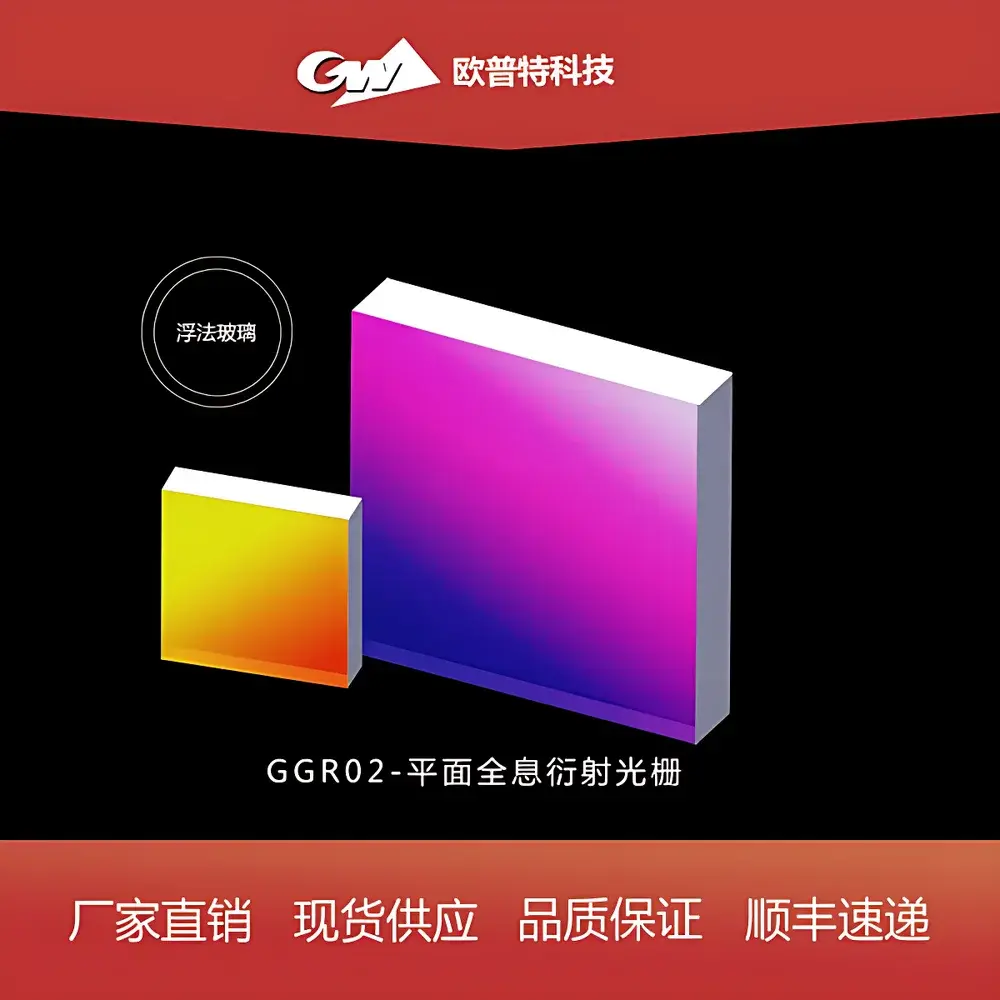
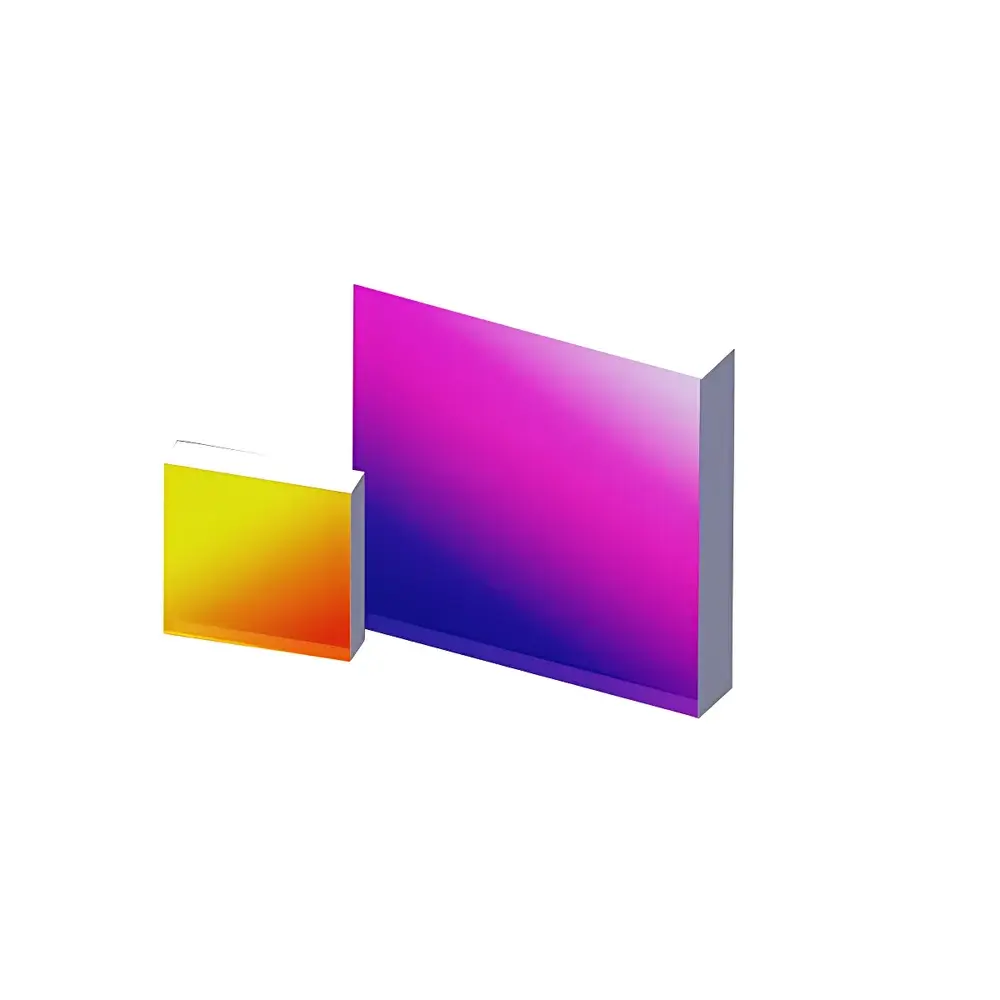
GGR02 Planar Holographic Diffraction Grating
| Origin | Beijing |
|---|---|
| Manufacturer Type | Distributor |
| Origin Category | Domestic (China) |
| Model | GGR02 |
| Price Range | USD 70–140 |
| Component Category | Optical Element |
| Dimensions (typical) | 12.5 × 25 × 9.5 mm to 50 × 50 × 9.5 mm |
| Groove Density Options | 600–3600 lines/mm |
| Optimized Spectral Ranges | UV (200–400 nm) and VIS (400–700 nm) |
| Typical Blaze Configurations | Sinusoidal (holographic) and Blazed (replicated) profiles |
| Dispersion | 0.25–1.67 nm/mrad @ specified wavelength |
| Substrate Material | Fused silica or BK7 (standard), custom options available |
Overview
The GGR02 Planar Holographic Diffraction Grating is a high-precision optical component engineered for spectral dispersion in ultraviolet (UV) and visible (VIS) wavelength regimes. Unlike mechanically ruled gratings, the GGR02 is fabricated using laser interference lithography: two coherent beams intersect on a photosensitive coating applied to an optically polished substrate (typically fused silica for UV applications or BK7 for VIS), generating a sinusoidal intensity pattern. This results in a periodic modulation of refractive index or surface relief—depending on replication method—that defines the grating structure. The absence of ruling tool marks and mechanical artifacts yields inherently low stray light (< 0.1% typical), making the GGR02 especially suitable for high-dynamic-range spectroscopy, monochromator design, and UV-sensitive instrumentation where scatter-induced background noise must be minimized.
Key Features
- Holographically generated groove profile ensures uniform line spacing and minimal groove irregularity—critical for high spectral fidelity and reduced higher-order diffraction artifacts.
- Multiple groove densities available: 600, 1200, 1800, 2400, and 3600 lines/mm—each optimized for specific resolution and dispersion requirements across UV and VIS bands.
- Standard substrates include UV-grade fused silica (for 200–400 nm operation) and optical crown glass (BK7) for VIS applications; custom substrates (e.g., CaF₂, UVFS with AR coatings) are available upon request.
- Replicated blazed variants (e.g., GGR02-xx-12VIS) provide enhanced efficiency at designated blaze wavelengths (e.g., 500 nm), while sinusoidal holographic versions (e.g., GGR02-xx-06UV) prioritize broadband flat response and polarization insensitivity.
- Dimensional tolerances conform to ISO 10110-7: ±0.1 mm in length/width, ±0.05 mm in thickness; surface quality meets λ/10 @ 633 nm (scratch-dig 20–10 per MIL-PRF-13830B).
- Each grating is individually tested and supplied with a traceable calibration report specifying measured groove density, diffraction efficiency curve (TE/TM polarization), and wavefront error (RMS ≤ 0.05λ).
Sample Compatibility & Compliance
The GGR02 is compatible with standard kinematic mounting fixtures (e.g., Thorlabs GRATING, Newport 561-xxxx series holders) and integrates seamlessly into Czerny–Turner, Ebert–Fastie, and Littrow-configured spectrometers. Its fused silica variants comply with ASTM E430–22 for UV transmittance stability and meet ISO 9022-3 environmental testing standards for thermal cycling (−20 °C to +60 °C, 5 cycles). All coated versions undergo adhesion testing per MIL-C-48497A and humidity resistance validation (95% RH, 24 h). For regulated environments—including GLP-compliant analytical labs—the GGR02 supports full traceability via serialized lot documentation and optional NIST-traceable certification packages.
Software & Data Management
While the GGR02 is a passive optical element, its performance parameters are fully integrable into optical design platforms including Zemax OpticStudio, CODE V, and FRED. Manufacturer-provided Zemax-compatible .DAT files include measured groove density, blaze angle (where applicable), and polarization-dependent efficiency data across 200–700 nm. For spectral system validation, users may import calibrated diffraction efficiency curves into LabVIEW or Python-based acquisition pipelines (e.g., PyVISA + OceanInsight SDK) to correct raw detector counts. Audit trails for calibration certificates are maintained per ISO/IEC 17025:2017 requirements, and digital records support FDA 21 CFR Part 11 compliance when hosted on validated document management systems.
Applications
- UV-VIS spectrophotometers requiring low stray light and high photometric accuracy (e.g., pharmaceutical assay validation per USP ).
- Laser pulse compression and stretcher–compressor setups in ultrafast optics (e.g., Ti:sapphire CPA systems operating at 800 nm).
- Plasma diagnostics and emission spectroscopy in fusion research, where signal-to-noise ratio depends critically on grating scatter suppression.
- Miniaturized OEM spectrometers for portable environmental monitoring (e.g., NO₂, O₃ detection in ambient air).
- Educational optics laboratories—used in undergraduate and graduate experiments on diffraction theory, Rayleigh criterion verification, and grating equation derivation.
FAQ
What distinguishes holographic gratings from ruled gratings in terms of optical performance?
Holographic gratings exhibit lower groove irregularity and negligible periodic errors from ruling machinery, resulting in significantly reduced scattered light and suppressed ghost orders—particularly advantageous in UV applications where detector dark current limits dynamic range.
Can the GGR02 be used in vacuum or UHV environments?
Yes—fused silica substrates with dielectric overcoatings (e.g., Al+MgF₂) are rated for UHV compatibility (≤10⁻⁹ mbar); outgassing rates are documented per ESA ECSS-Q-ST-70-02C and certified upon request.
Is custom groove density or substrate material available?
Custom groove densities between 300–4800 lines/mm and substrates including CaF₂, MgF₂, or sapphire can be quoted with lead times of 8–12 weeks; minimum order quantity applies.
How is diffraction efficiency measured and reported?
Efficiency is measured using a calibrated double-monochromator setup per ISO/DIS 14270, reporting TE/TM polarization curves at ±1° incidence angles; data includes ±2σ uncertainty bounds and wavelength sampling intervals ≤0.5 nm.
Do you provide mounting hardware or alignment fixtures?
Standard kinematic mounts (e.g., SM1-threaded grating plates) and adjustable rotation stages are available as optional accessories; OEM integration kits include alignment fiducials and torque-spec fasteners.




