
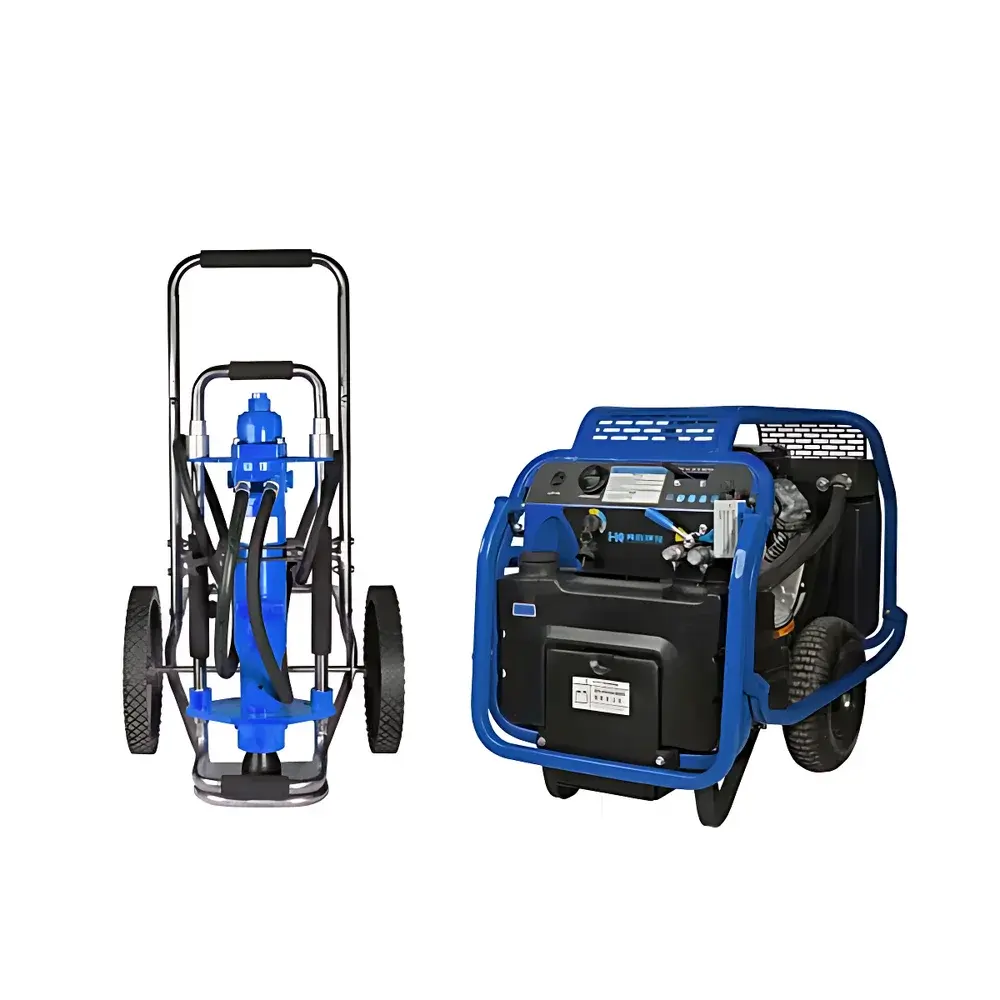
GHD-CY300Y HUANKONG Hydraulic Soil Sampler
| Brand | HUANKONG |
|---|---|
| Origin | Shandong, China |
| Manufacturer Type | Direct Manufacturer |
| Country of Origin | China |
| Model | GHD-CY300Y |
| Pricing | Available Upon Request |
| Sampling Method | Percussion-Driven |
| Drive System | Hydraulic |
| Max Sampling Depth | 15 m (standard soil), up to 20 m (soft soil) |
| Penetration Rate | Up to 1.5 m/min |
| Sample Preservation | Integrated Liner Tube Design |
| Mobility | Equipped with Mobile Trolley |
Overview
The GHD-CY300Y Hydraulic Soil Sampler is an engineered field-deployable percussion-type sampling system designed for high-fidelity, in-situ soil collection across heterogeneous geological profiles. Unlike auger or rotary coring systems that induce shear deformation and sample disturbance, this instrument employs a controlled hydraulic percussion mechanism—delivering discrete axial impact energy to drive the sampling tube into the ground while minimizing lateral displacement and compaction. This principle ensures structural integrity of the soil column, preserving natural stratification, moisture distribution, pore geometry, and undisturbed fabric critical for geotechnical analysis, contaminant migration studies, and regulatory compliance sampling (e.g., ASTM D1586, ISO 22475-1). The system operates without water injection or lubrication, eliminating dilution artifacts and enabling representative sampling of low-permeability clays, silts, and partially saturated layers.
Key Features
- Hydraulic Percussion Drive: High-torque, variable-pressure hydraulic power unit delivers consistent impact force, enabling reliable penetration through dense gravelly soils, compacted fill, and weathered bedrock interfaces where manual or pneumatic samplers fail.
- Depth-Optimized Sampling: Rated for routine sampling to 15 meters in cohesive and cohesionless soils; achieves up to 20 meters in soft alluvial, peat-rich, or highly plastic clay deposits—validated under field conditions per ASTM D1587 practice for thin-walled tube sampling.
- Liner Tube Integration: Stainless steel outer barrel with disposable polymer (polyethylene or polycarbonate) liner tubes ensures contamination-free retrieval. Samples remain sealed within the liner post-extraction, eliminating handling-induced compaction or desiccation during transport to the laboratory.
- On-Site Efficiency: Average penetration rate of 1.5 meters per minute reduces total site time, enhances crew safety, and supports high-density sampling grids required for environmental site assessments (ESAs) and remedial investigation work plans (RIWPs).
- Modular Mobility System: Integrated trolley with pneumatic tires, locking casters, and foldable frame enables rapid repositioning between borehole locations—even on uneven terrain or paved access roads—without crane or vehicle support.
Sample Compatibility & Compliance
The GHD-CY300Y accommodates standard 50.8 mm (2-inch) and 76.2 mm (3-inch) diameter sampling liners, compatible with widely adopted lab protocols for physical testing (e.g., Atterberg limits, Proctor compaction), chemical analysis (e.g., TCLP extraction, heavy metal speciation), and microbiological assays. Its percussion-based methodology conforms to ISO 22475-1:2006 (Sampling methods for geotechnical investigations – Part 1: General principles), and supports data traceability requirements under EPA SW-846 Method 5035A (soil sampling for volatile organics). While not certified to GLP or ISO/IEC 17025 as a standalone device, its operational consistency and documented field procedures enable integration into QA/QC frameworks aligned with US EPA Region 9 QA/G-5 and ASTM E2500-13 (verification of sampling equipment performance).
Software & Data Management
The GHD-CY300Y is a hardware-only field instrument with no embedded digital control unit or onboard data logging. All operational parameters—including hydraulic pressure readings, stroke count, depth markers (via calibrated winch encoder), and time-stamped location metadata—are recorded manually or via third-party field data capture platforms (e.g., ESRI Field Maps, Avenza PDF Maps, or custom Android/iOS apps using Bluetooth-connected pressure transducers). Users are advised to maintain standardized electronic field logs compliant with 21 CFR Part 11 when used in regulated environmental investigations requiring audit trails. Calibration certificates for auxiliary pressure gauges and depth encoders must be retained per project QA plan.
Applications
- Phase I/II Environmental Site Assessments (ESAs) under ASTM E1527 and E1903
- Groundwater plume delineation and vadose zone characterization
- Regulatory soil screening at brownfield redevelopment sites
- Geotechnical profiling for foundation design and slope stability analysis
- Long-term monitoring well installation support (pre-drilling verification of lithology)
- Agricultural soil health surveys requiring intact horizon sampling
FAQ
Does the GHD-CY300Y require drilling mud or water during operation?
No. It operates exclusively via dry percussion impact, eliminating fluid introduction that may alter soil moisture content or leach soluble constituents.
Can it collect samples from rocky or gravelly strata?
Yes—its hydraulic percussion energy exceeds typical hand-operated or pneumatic samplers, enabling penetration through granular layers with up to 30% gravel fraction (≤75 mm), though bedrock contact requires pre-boring or alternative methods.
Is the liner tube system compatible with VOC analysis?
When using certified VOC-clean polyethylene or fused-silica-lined liners and following EPA Method 5035A chain-of-custody protocols, yes—provided field blanks and trip blanks are concurrently collected.
What maintenance is required for the hydraulic power unit?
Daily inspection of hydraulic fluid level and filter condition; biannual servicing of pump seals and pressure relief valve calibration per manufacturer’s technical bulletin GHD-CY300Y-MNT-Rev.3.
Is operator certification required?
While no proprietary certification is mandated, OSHA 29 CFR 1926 Subpart P (excavation safety) and ANSI/ASSP Z117.1-2021 (confined space entry) training are recommended for crews working at depths exceeding 1.2 m.
Related Products







