
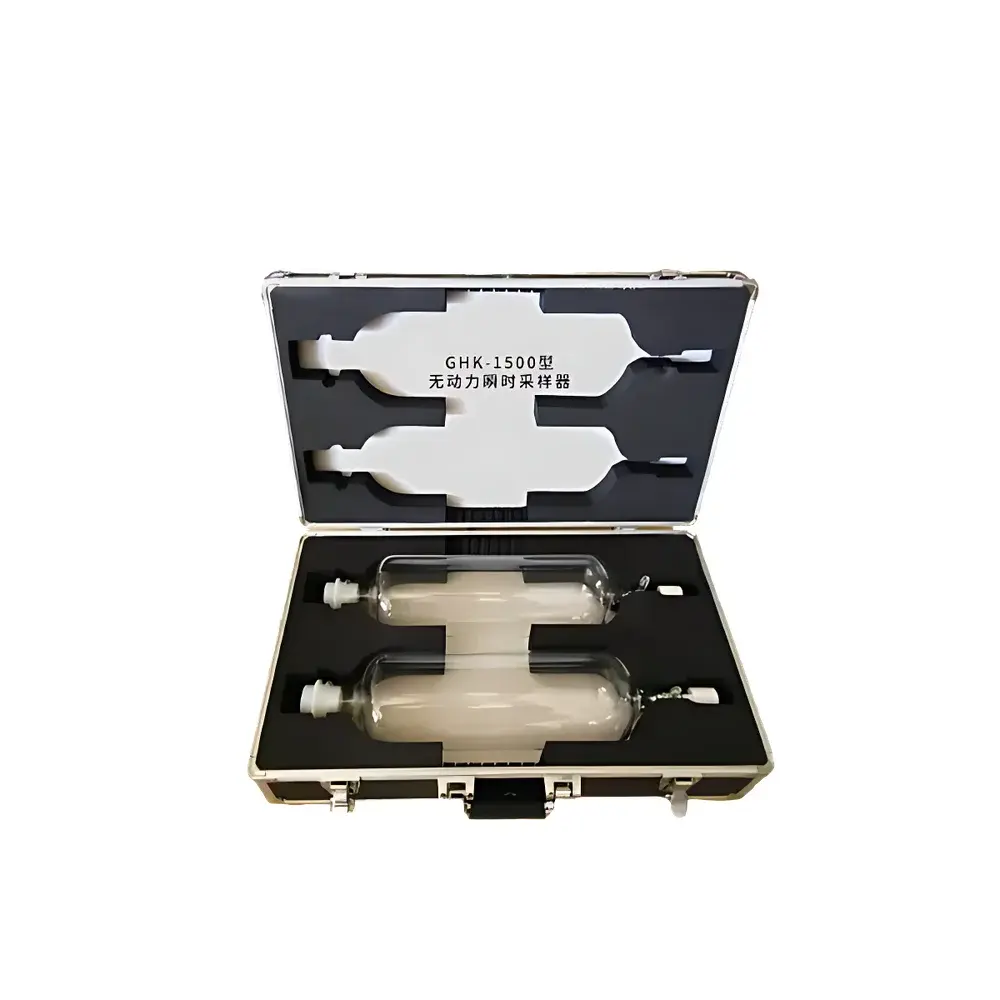
GHK-1500 Passive Instantaneous Air Sampler
| Brand | HUANKONG |
|---|---|
| Origin | Shandong, China |
| Manufacturer Type | OEM Manufacturer |
| Country of Origin | China |
| Model | GHK-1500 |
| Instrument Type | Handheld Passive Air Sampler |
| Configuration | Single-Channel Gas Sampling Device |
| Compliance | HJ 1262–2022, HJ 905–2017 |
| Construction Material | Thick-Walled Quartz Glass Body with PTFE Valve |
| Standard Volumes | 1 L, 3 L, 5 L, 10 L |
| Accessories | Silicone Stopper, PTFE Valve, Pressure Gauge, Sampling Cap |
| Operational Principle | Passive Vacuum-Driven Sampling |
Overview
The GHK-1500 Passive Instantaneous Air Sampler is an engineered field instrument designed specifically for compliant odor sampling in ambient air and unorganized emission sources, in strict accordance with the Chinese national standards HJ 1262–2022 (“Determination of Odor Concentration in Ambient Air and Exhaust Gas—Three-Point Comparative Olfactometry Method”) and HJ 905–2017 (“Technical Specification for Odor Monitoring”). Unlike active sampling systems requiring external power or continuous vacuum pumps, the GHK-1500 operates on a passive pressure-differential principle: upon rapid valve actuation, ambient air is drawn into the evacuated quartz sampling vessel via transient negative pressure—enabling true instantaneous capture of odorant-laden air without flow-rate dependency or pump-induced turbulence. This design eliminates mechanical interference with volatile organic compound (VOC) partitioning and preserves the original odor intensity profile critical for olfactometric analysis. The sampler’s core function is to serve as a standardized, transportable, and traceable sample containment system—not a measurement device—and is intended exclusively for subsequent laboratory-based dynamic dilution olfactometry.
Key Features
- Passive operation: No electrical connection, battery, or external pump required during sampling—reducing field complexity and operator error.
- Instantaneous acquisition: Full-volume sampling completed within <2 seconds after valve release, minimizing temporal averaging and capturing transient odor peaks.
- Chemically inert sampling chamber: Constructed from thick-walled fused quartz (≥5 mm wall thickness), offering exceptional UV transparency, thermal stability (up to 800 °C), and resistance to adsorption or catalytic degradation of sulfur-containing compounds (e.g., H2S, mercaptans) and nitrogenous odorants.
- Sealing integrity: Precision-machined polytetrafluoroethylene (PTFE) valve with elastomer-free sealing surface ensures zero leaching, low outgassing (<10−9 g/s/cm²), and compatibility with ozone and chlorine species.
- Modular volume options: Interchangeable calibrated vessels available in 1 L, 3 L, 5 L, and 10 L nominal capacities—each certified to ±1.5% volumetric accuracy at 25 °C and 101.3 kPa.
- Field-ready accessories: Includes pressure-rated silicone stoppers (ASTM D2000 BRM class), analog Bourdon-tube pressure gauges (0–100 kPa, Class 1.6), and threaded PTFE-coated sampling caps for leak-tight transport and storage.
Sample Compatibility & Compliance
The GHK-1500 is validated for use with ambient air, stack effluents, landfill boundary gases, wastewater treatment off-gases, and agricultural emission plumes. Its quartz-PTFE architecture ensures minimal analyte loss for polar and reactive odorants—including aldehydes, short-chain fatty acids, indoles, skatoles, and reduced sulfur compounds—under ISO 16000-6 and ASTM D5197 sampling protocols. All units are supplied with individual calibration certificates referencing NIM (National Institute of Metrology, China) traceable volume verification. The device conforms to GLP-aligned handling requirements for odor sampling: each vessel bears a unique laser-etched serial number, and batch documentation includes material certification (quartz purity ≥99.995%, ASTM F795), valve torque validation reports, and leak-test records (helium leak rate ≤1×10⁻⁹ mbar·L/s). It supports audit readiness for regulatory submissions under China’s MEE (Ministry of Ecology and Environment) odor monitoring programs.
Software & Data Management
As a passive sampling device, the GHK-1500 does not incorporate embedded electronics, firmware, or data logging capabilities. Sample metadata—including collection time, location (GPS-tagged via companion mobile app), ambient temperature/pressure/humidity, and operator ID—is recorded manually or via standardized field forms aligned with HJ 905–2017 Annex A. Laboratories utilizing the sampler may integrate its usage into LIMS platforms through barcode-scannable vessel labels (optional add-on). All accessories comply with ISO/IEC 17025 documentation requirements: pressure gauges are calibrated annually per JJG 52–2013; PTFE valves undergo quarterly functional testing per internal SOP-ODOR-04. No software validation is applicable; however, the physical design enables full 21 CFR Part 11–compatible chain-of-custody documentation when paired with electronic lab notebooks (ELN) that support digital signature and audit trail features.
Applications
- Regulatory odor compliance monitoring at industrial fence lines per HJ 1262–2022 Section 6.2.
- Baseline odor characterization during environmental impact assessments (EIAs) for new facilities.
- Source identification studies using spatially distributed sampling grids around composting sites or rendering plants.
- Method validation exercises comparing passive vs. active sampling recovery rates for key odorants (e.g., dimethyl sulfide, trimethylamine).
- Educational use in university environmental engineering labs for teaching olfactometry fundamentals and sampling uncertainty analysis.
- Emergency response deployment during accidental chemical releases where rapid, equipment-minimal sampling is critical.
FAQ
Is the GHK-1500 suitable for quantitative VOC analysis by GC-MS?
No—it is purpose-built for olfactometric assessment only. For instrumental VOC quantification, active sorbent tube or canister-based methods (e.g., EPA TO-15) are required.
Can the quartz vessel be reused?
Yes, provided it undergoes validated cleaning per HJ 905–2017 Section 7.3: sequential rinsing with high-purity water, acetone, and nitrogen purge, followed by thermal conditioning at 120 °C for 2 hours under inert gas flow.
What vacuum level is required before sampling?
A minimum pre-evacuation pressure of ≤5 kPa absolute (≥95 kPa vacuum) is recommended to ensure sufficient driving force for instantaneous fill across all volumes.
Does the sampler meet international odor standards such as EN 13725?
While designed for Chinese regulatory alignment, its dimensional tolerances, material specifications, and procedural logic are technically compatible with EN 13725 sampling workflows—subject to local method validation.
How is leakage verified prior to field use?
Each unit is factory-tested using helium mass spectrometry; end users should perform a gross leak check via pressure hold test (maintain ≤10 kPa vacuum for 5 minutes; allowable decay ≤0.5 kPa).
Related Products







