
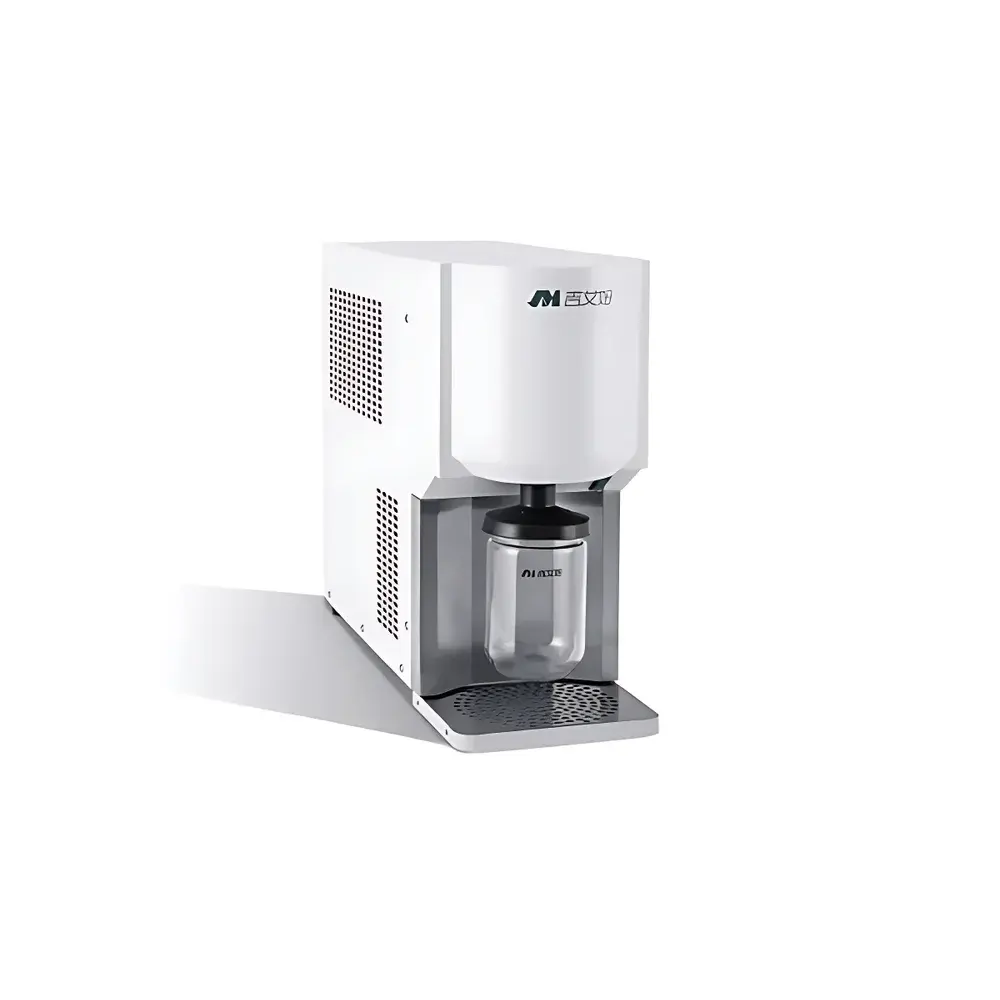
GiAim JM50 High-Efficiency Low-Temperature Cold Trap
| Brand | GiAim |
|---|---|
| Origin | Beijing, China |
| Manufacturer Type | Authorized Distributor |
| Country of Origin | China |
| Model | JM50 |
| Pricing | Upon Request |
| Minimum Operating Temperature | −50 °C |
| Temperature Display | Integrated Digital LED |
| Condensate Collection Bottle Capacity | 600 mL |
| Total Power Consumption | 450 W |
| Dimensions (L×W×H) | 590 mm × 210 mm × 430 mm |
| Weight | 33 kg |
| Power Supply | AC 220 V, 50/60 Hz, 10 A |
| Refrigerant | R404a (non-ozone-depleting, HFC blend) |
| Precooling Time to −50 °C | ≤20 min |
| Vacuum Port Compatibility | Standard KF-25 and NW25 flanges (adaptable to common vacuum pump interfaces) |
Overview
The GiAim JM50 High-Efficiency Low-Temperature Cold Trap is a compact, purpose-engineered condensation device designed for solvent vapor capture and recovery in vacuum-based sample preparation workflows. It operates on the principle of cryogenic condensation—utilizing a closed-cycle refrigeration system to cool an internal evaporator coil to −50 °C, thereby enabling efficient phase transition of volatile organic solvents (e.g., ethanol, acetone, chloroform, ethyl acetate) from vapor to liquid state within the vacuum path. By intercepting solvent vapors upstream of the vacuum pump, the JM50 protects pump integrity, extends service intervals, improves ultimate vacuum stability, and significantly accelerates rotary evaporation or centrifugal vacuum concentration processes. Its integration is particularly critical in laboratories performing high-throughput sample preparation under GLP-compliant or regulated environments where solvent loss, pump contamination, and process reproducibility are key performance indicators.
Key Features
- Compact footprint: Only 210 mm wide—engineered for benchtop deployment in space-constrained analytical or preparative labs.
- Internally mounted high-surface-area condenser coil: Positioned directly in the vapor stream path for maximum heat exchange efficiency and minimal pressure drop (<0.5 mbar additional resistance at 50 L/min flow).
- Dual-vacuum interface design: Equipped with standard KF-25 (ISO-K) and NW25 (DIN 28413) ports, enabling seamless coupling to diaphragm, scroll, or oil-sealed rotary vane pumps without adapter dependency.
- European-sourced hermetic refrigeration unit: Uses environmentally compliant R404a refrigerant; achieves stable −50 °C operation with <45 dB(A) acoustic emission during continuous duty cycle.
- Externally accessible 600 mL wide-mouth borosilicate glass collection bottle: Enables real-time visual monitoring of condensate volume and facilitates rapid, residue-free emptying without system venting or disassembly.
- Rapid thermal stabilization: Reaches operational temperature (−50 °C) within 20 minutes from ambient startup—verified per IEC 61000-4-30 voltage fluctuation tolerance testing.
Sample Compatibility & Compliance
The JM50 is compatible with a broad spectrum of low-to-medium boiling point solvents commonly used in life science, pharmaceutical, and environmental sample preparation—including but not limited to methanol (BP 65 °C), acetonitrile (BP 82 °C), dichloromethane (BP 40 °C), and hexane (BP 69 °C). It is not recommended for use with highly corrosive vapors (e.g., concentrated HCl, HF) or peroxides without prior compatibility assessment. The unit complies with CE marking requirements (2014/30/EU EMC Directive and 2014/35/EU LVD Directive), meets RoHS 2011/65/EU restrictions on hazardous substances, and supports audit-ready documentation for ISO/IEC 17025-accredited laboratories. When deployed in conjunction with validated vacuum concentrators (e.g., CV100–CV600 series), the combined system supports traceable solvent recovery records aligned with FDA 21 CFR Part 11 data integrity expectations when paired with compliant software logging.
Software & Data Management
The JM50 operates as a standalone hardware module with no embedded microcontroller or digital communication interface. Temperature is monitored via a calibrated NTC thermistor and displayed on a front-panel LED readout (±1 °C accuracy, 0.1 °C resolution). While it does not feature USB, RS-232, or Ethernet connectivity, its analog temperature output signal (0–5 V DC proportional to −50 to +30 °C range) can be integrated into third-party lab automation systems or SCADA platforms for centralized thermal logging. Users implementing electronic lab notebooks (ELNs) or LIMS may manually record cold trap status, precooling duration, and condensate volume as part of batch metadata—supporting full traceability in GxP-regulated workflows.
Applications
- Vacuum centrifugal concentration of nucleic acid, protein, and metabolite extracts—reducing processing time by up to 35% compared to cold trap–free configurations.
- Rotary evaporation of heat-sensitive natural product fractions under reduced pressure.
- Lyophilization pre-concentration steps where solvent removal precedes freeze-drying.
- Environmental analysis workflows involving EPA Method 525.3 (purge-and-trap GC/MS) requiring cold trap–assisted VOC trapping.
- QC/QA laboratories performing routine solvent recovery validation per internal SOPs or ASTM D1296-19 (Standard Test Method for Volatility of Solvents).
FAQ
What vacuum pump types are compatible with the JM50?
The JM50 supports direct connection to diaphragm, scroll, and two-stage rotary vane vacuum pumps rated for ≤10−2 mbar base pressure and ≥25 L/min pumping speed.
Can the JM50 be used with corrosive solvents like trifluoroacetic acid (TFA)?
No—TFA and other strong acids or halogenated oxidizers require specialized passivated stainless-steel or PTFE-lined cold traps; the JM50’s aluminum evaporator coil and standard glassware are not chemically resistant to such agents.
Is the 600 mL collection bottle autoclavable?
The borosilicate glass bottle is autoclavable at 121 °C for 20 minutes; however, repeated sterilization cycles may degrade the silicone O-ring seal—replacement rings are available as spare part #JM50-OR-01.
Does the JM50 meet UL or CSA safety certification?
It carries CE marking for EMC and safety compliance; UL/CSA listing is not currently held but may be pursued upon request for North American institutional procurement.
How often should the refrigerant charge be serviced?
Under normal laboratory use (≤8 hrs/day, 5 days/week), the sealed R404a system requires no scheduled refrigerant replenishment over a 10-year service life—verified through accelerated aging tests per ISO 5171.



