
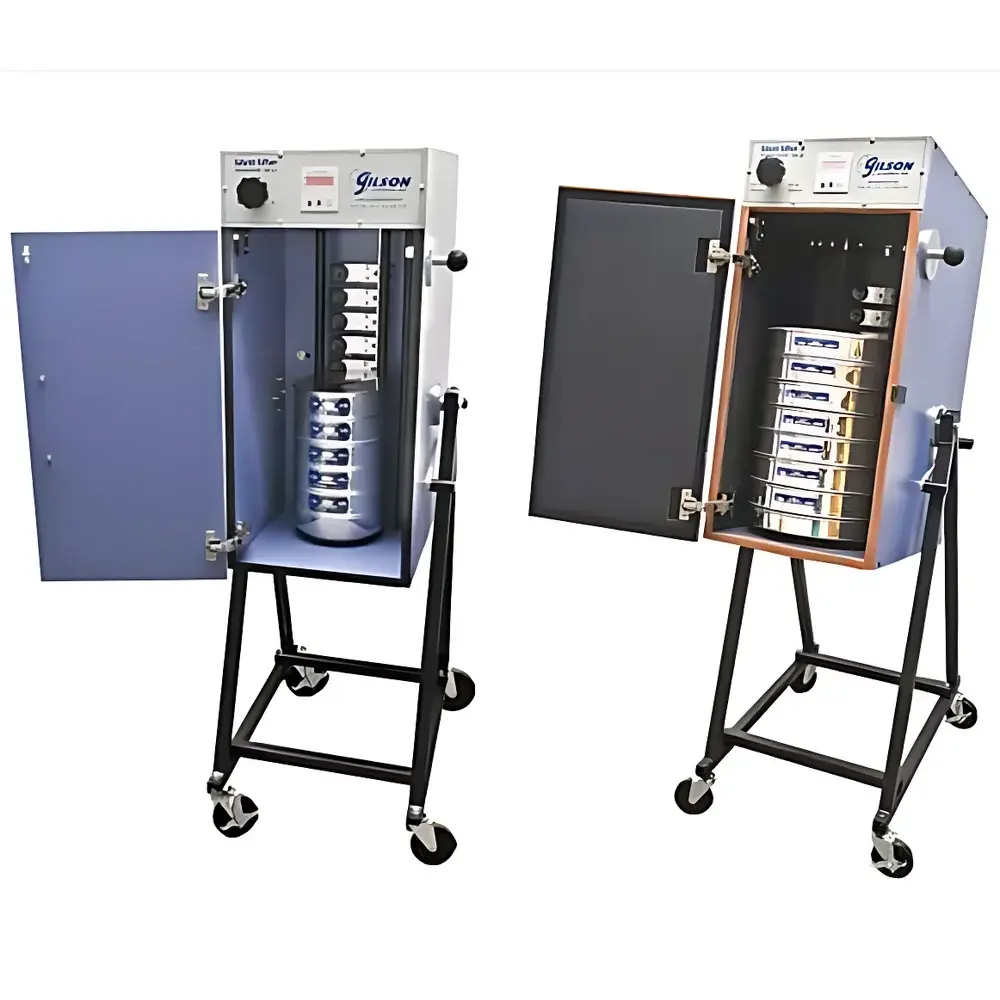
Gilson SS-22F Silent Sifter® II Rotational Sieve Shaker with Integrated Sieve Stack Enclosure
| Origin | USA |
|---|---|
| Voltage/Frequency | 230 V / 50 Hz |
| Motor | 1/4 HP continuous-duty |
| Noise Reduction | 16–18 dB(A) vs. conventional rotary sifters |
| Sieve Compatibility | ASTM E11 & ISO 3310-1 compliant |
| Max Stack Capacity | 20 × 8" (203 mm) half-height sieves or 6 × 12" (305 mm) full-height sieves |
| Particle Size Range | 25 mm to 20 µm (No. 1 to No. 635) |
| Timing Accuracy | ±1 s over 0–99 min |
| Drive Mechanism | Dual rubber-coated stainless steel rollers with tapping action |
| Enclosure | MDF cabinet with powder-coated ASTM A513 steel frame, gasketed lever-latched door |
| Hammer Assembly | 6061 aluminum shaft + UHMW-PE impact head |
| Dimensions (W×D×H) | 483 × 610 × 1473 mm |
| Net Weight | 111.13 kg |
Overview
The Gilson SS-22F Silent Sifter® II is a precision-engineered rotational sieve shaker designed for standardized particle size distribution analysis in compliance with ASTM C136/C136M, ASTM D6913, ASTM D7928, ISO 13320, and ISO 3310-1. Unlike conventional vibratory or mechanical shakers, the SS-22F employs a dual-mode motion profile—continuous rotational agitation combined with controlled mechanical tapping—optimized to maximize particle stratification and sieve penetration while minimizing agglomerate retention. Its acoustic architecture integrates multi-layered sound-dampening materials, a fully sealed MDF enclosure with compression-gasketed lever-latched access, and vibration-isolated drive components, achieving a certified noise reduction of 16–18 dB(A) relative to standard rotary sifters and 8–10 dB(A) below the earlier SS-21F model. This engineering directly supports occupational health compliance under OSHA 29 CFR 1910.95 and EU Directive 2003/10/EC, particularly during prolonged operation with respirable crystalline silica (RCS), quartz, or other airborne particulates.
Key Features
- Acoustically optimized enclosure: Dense MDF housing with integrated acoustic lining and ASTM A513 heavy-gauge steel frame ensures structural rigidity and long-term dimensional stability under repeated mechanical load.
- Dual-drive roller system: Two rubber-coated stainless steel rollers rotate the sieve stack at constant angular velocity while applying calibrated tapping force via eccentric cam interaction—enhancing separation efficiency for cohesive or fine-grained materials.
- Ergonomic operator interface: Lever-actuated latching mechanism enables tool-free access; no clamps or torque tools required for stack loading/unloading.
- Precision digital timer: Large 12.6 mm (0.5 in) LED display with ±1 second accuracy across 0–99 minute range; includes pause/resume functionality and audible 5-second alert upon cycle completion.
- Modular sieve compatibility: Supports ASTM E11 and ISO 3310-1 test sieves in diameters of 203 mm (8″) and 305 mm (12″), with full-height, half-height, and intermediate-height configurations—enabling up to 20 half-height 8″ sieves or 6 full-height 12″ sieves per stack.
- Respirable dust containment: Fully enclosed cabinet limits fugitive emissions into operator breathing zones, supporting laboratory adherence to NIOSH RELs and OSHA PELs for silica and other hazardous particulates.
Sample Compatibility & Compliance
The SS-22F accommodates dry granular, powdered, and friable solid samples across geotechnical, aggregate, pharmaceutical, mineral processing, and environmental testing workflows. It is validated for use with ASTM E11 standard test sieves (woven wire mesh) and ISO 3310-1 equivalents, covering nominal aperture sizes from 25.0 mm (No. 1) down to 20 µm (No. 635). The UHMW-PE hammer head and 6061 aluminum shaft ensure non-contaminating, corrosion-resistant impact delivery—critical for QA/QC applications requiring trace metal integrity. All electrical components comply with IEC 61000-6-3 (EMC emission standards) and IEC 61000-6-2 (immunity), and the unit is CE-marked for use in EU laboratories. Optional audit-trail-capable controllers (SSA-76) support 21 CFR Part 11-compliant data recording when integrated with LIMS environments.
Software & Data Management
While the SS-22F operates as a standalone electromechanical instrument, its timing module (SSA-76 replacement controller) supports analog output signals (0–10 VDC) for external data acquisition systems. When paired with Gilson’s optional G-DataLink™ software suite (sold separately), users can log timestamped operational parameters—including elapsed time, pause events, and cycle completion status—into CSV or SQL-compatible databases. The system maintains full GLP/GMP traceability through user-defined operator IDs, instrument serial logging, and electronic signature fields. No proprietary cloud dependency or subscription model is required; all firmware updates are delivered via USB flash drive with SHA-256 checksum verification.
Applications
- Aggregate gradation analysis per ASTM C136 for concrete and asphalt specification compliance.
- Fine soil particle size distribution per ASTM D6913 in geotechnical classification (USCS, AASHTO).
- Pharmaceutical granule sizing per USP and EP 2.9.32 for content uniformity and dissolution predictability.
- Mineral concentrate liberation assessment in metallurgical process development.
- Environmental sediment characterization per EPA Method 1684 for particle-bound contaminant fractionation.
- Quality control of catalyst powders, toners, and ceramic feedstocks where electrostatic cohesion impedes conventional sieving.
FAQ
What voltage and frequency options are available for the SS-22F?
The SS-22F is configured exclusively for 230 V / 50 Hz operation, with a rated current draw of 5.4 A.
Does the SS-22F require calibration certification?
Per ASTM E323 and ISO/IEC 17025, periodic verification of timer accuracy (±1 s), rotational speed consistency, and tapping force repeatability is recommended annually or after major maintenance; Gilson provides traceable calibration checklists and NIST-traceable stopwatch validation protocols.
Can the SS-22F be used with wet sieving?
No. The SS-22F is engineered exclusively for dry-sieving applications. Wet sieving requires dedicated equipment with fluid-handling seals, corrosion-resistant construction, and drainage provisions not present in this model.
Is the enclosure compatible with fume hood integration?
Yes—the unit’s footprint (483 × 610 mm) and rear service clearance allow installation within standard 1200 mm-wide laboratory fume hoods; however, the internal fanless design means no ducting is required unless local ventilation codes mandate it for secondary dust capture.
What maintenance intervals are recommended?
Lubrication of roller bearings every 1,000 operating hours; visual inspection of UHMW-PE hammer heads and gasket integrity before each shift; and verification of door latch torque every 6 months using a calibrated torque wrench (spec: 12–15 N·m).





