
GKINST Customizable Time- and Space-Resolved Absorption-Emission Spectrometer
| Brand | GKINST |
|---|---|
| Origin | Anhui, China |
| Manufacturer Type | Authorized Distributor |
| Product Origin | Domestic (China) |
| Model | Customizable |
| Pricing | Available Upon Request |
| Absorption Wavelength Range | 200–1100 nm |
| Emission Wavelength Range | 350–1100 nm |
| Excitation Laser Wavelength | 350–800 nm |
| Spatial Spot Size | 10 µm – 1 mm (continuously adjustable) |
Overview
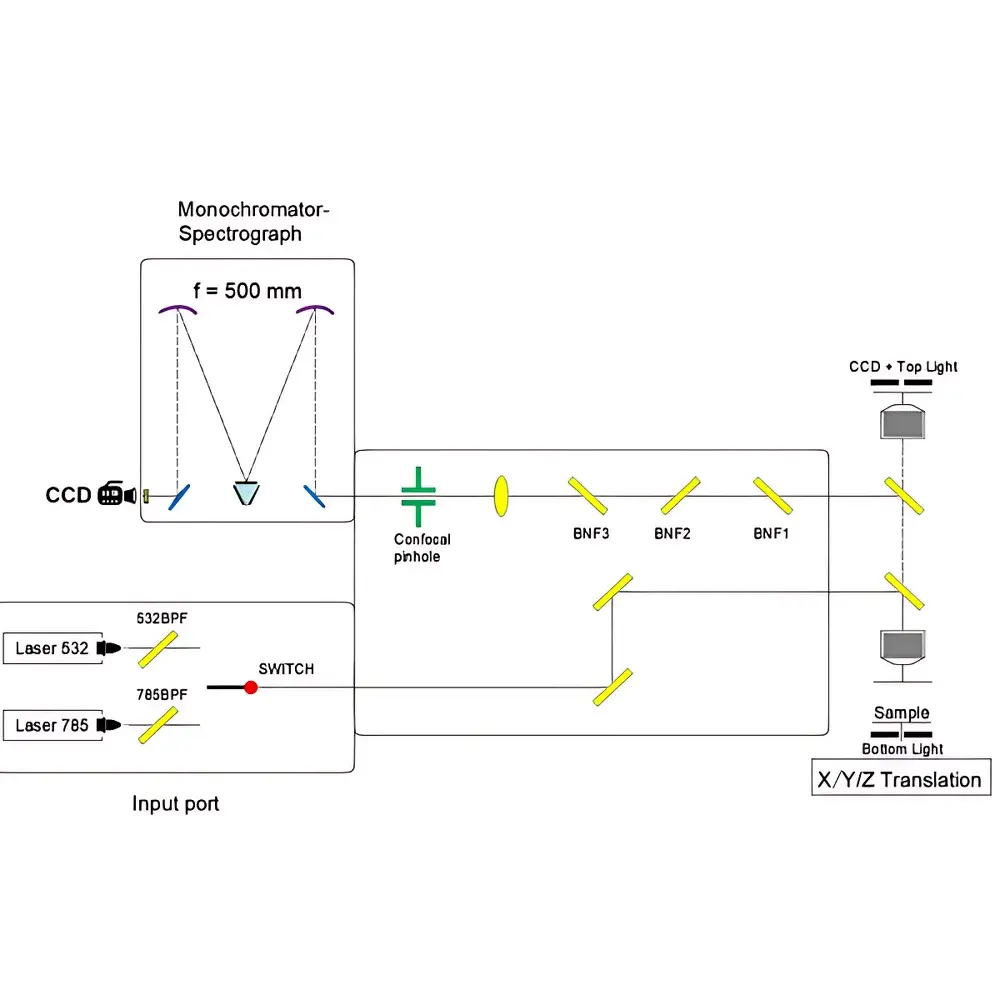
The GKINST Customizable Time- and Space-Resolved Absorption-Emission Spectrometer is an integrated dual-mode spectroscopic platform engineered for concurrent, co-localized acquisition of absorption and photoluminescence (PL) spectra from the same microscopic sample region. Unlike conventional benchtop spectrometers—where absorption and emission measurements require separate optical configurations, distinct sample alignments, and sequential data collection—the GKINST system employs a shared optical path architecture with synchronized temporal gating and high-precision spatial scanning. Its core measurement principle combines broadband dispersive spectroscopy with confocal excitation geometry and time-resolved detection, enabling correlation of electronic transitions (via absorption) with radiative recombination dynamics (via emission) at sub-millimeter spatial resolution. Designed for fundamental research and applied R&D in optoelectronic materials, environmental sensing, and life sciences, the instrument supports both steady-state and time-gated spectral acquisition, making it suitable for probing carrier lifetime, exciton diffusion, defect-state distribution, and heterogeneous reaction kinetics.
Key Features
- Simultaneous absorption and emission spectral acquisition from identical spatial coordinates, eliminating misregistration errors and reducing measurement uncertainty in heterogenous samples.
- Continuously adjustable excitation spot size from 10 µm to 1 mm—achievable via motorized beam expansion optics and precision pinhole selection—enabling flexible trade-offs between spatial resolution and signal-to-noise ratio.
- Broad spectral coverage: absorption detection across 200–1100 nm (UV-VIS-NIR), emission detection from 350–1100 nm, compatible with common semiconductor bandgaps and biological fluorophores.
- Excitation source tunability: integrated or external laser systems operating between 350–800 nm, supporting resonant, above-bandgap, and two-photon excitation protocols.
- Modular optical design accommodating optional add-ons including liquid nitrogen cryostats (77 K), electrochemical cells, gas-tight sample chambers, and polarization-resolved detection modules.
- Rugged mechanical stage with closed-loop piezoelectric positioning (±50 nm repeatability) and automated XYZ scanning for mapping applications.
Sample Compatibility & Compliance
The spectrometer accommodates solid thin films, powder pellets, liquid solutions, suspended nanoparticles, tissue sections, and micro-patterned devices without requiring destructive sample preparation. Sample holders comply with standard 25 mm × 75 mm microscope slide dimensions and support vacuum-, inert-gas-, or ambient-environment operation. All optical components meet ISO 10110 surface quality specifications, and the instrument’s firmware implements audit-trail logging per GLP/GMP-aligned workflows. While not pre-certified to FDA 21 CFR Part 11, the system supports third-party validation packages—including electronic signature implementation, user role-based access control, and immutable raw-data archiving—for regulated environments such as pharmaceutical QC laboratories or contract research organizations (CROs).
Software & Data Management
Control and analysis are executed via GKINST SpectraSuite™ v4.x—a cross-platform application built on Qt and Python (PyQt5, NumPy, SciPy). The software provides real-time spectral preview, multi-channel time-stamping, batch map acquisition scripting (Python API), and export to HDF5, CSV, and JCAMP-DX formats. Advanced processing tools include baseline correction (Asymmetric Least Squares), peak deconvolution (Voigt fitting), spectral unmixing (non-negative matrix factorization), and time-resolved decay modeling (multi-exponential fitting with χ² minimization). Raw spectral datasets retain full metadata: excitation wavelength, integration time, grating position, slit width, detector gain, and spatial coordinates—ensuring traceability and reproducibility across instrument platforms and user sessions.
Applications
- Optoelectronic Materials: Spatially resolved mapping of quantum efficiency gradients in perovskite solar cell absorbers, defect luminescence in GaN LEDs, and carrier diffusion length in organic semiconductor blends.
- Environmental Monitoring: Quantitative speciation of heavy-metal complexes in aqueous effluents using differential absorption/emission fingerprinting under controlled pH and redox conditions.
- Biomedical Research: Label-free discrimination of cellular subpopulations via intrinsic NADH/FAD autofluorescence coupled with cytochrome c absorption shifts during apoptosis.
- Catalysis & Reaction Kinetics: In situ monitoring of photocatalytic degradation pathways by correlating transient absorption bleaches with concurrent PL quenching dynamics on TiO₂ nanoparticle surfaces.
- Forensic & Cultural Heritage Analysis: Non-invasive pigment identification in historical manuscripts through micro-spectral library matching of absorption edge positions and emission vibronic progressions.
FAQ
Is this system capable of time-resolved measurements?
Yes—the spectrometer supports nanosecond- to millisecond-scale time-gated detection via external trigger synchronization with pulsed lasers or LED drivers. Optional TCSPC modules extend resolution to picosecond domains.
Can the instrument be integrated into existing vacuum or glovebox systems?
Yes—optical ports conform to CF-63 or KF-40 flange standards, and custom feedthroughs for electrical, fluidic, and motion-control lines are available upon request.
Does GKINST provide application support for method development?
Yes—qualified application scientists offer remote and on-site assistance for experimental design, spectral interpretation, and regulatory documentation (e.g., IQ/OQ/PQ protocols).
What level of customization is supported beyond spot size and wavelength range?
Full OEM integration is possible—including bespoke grating configurations, hybrid detector arrays (Si + InGaAs), embedded machine learning inference engines for real-time spectral classification, and compliance-ready firmware upgrades.
Are calibration certificates traceable to NIST or equivalent national metrology institutes?
Yes—wavelength and radiometric calibrations are performed using NIST-traceable tungsten-halogen and mercury-argon reference sources, with certificates issued per ISO/IEC 17025 requirements.




