
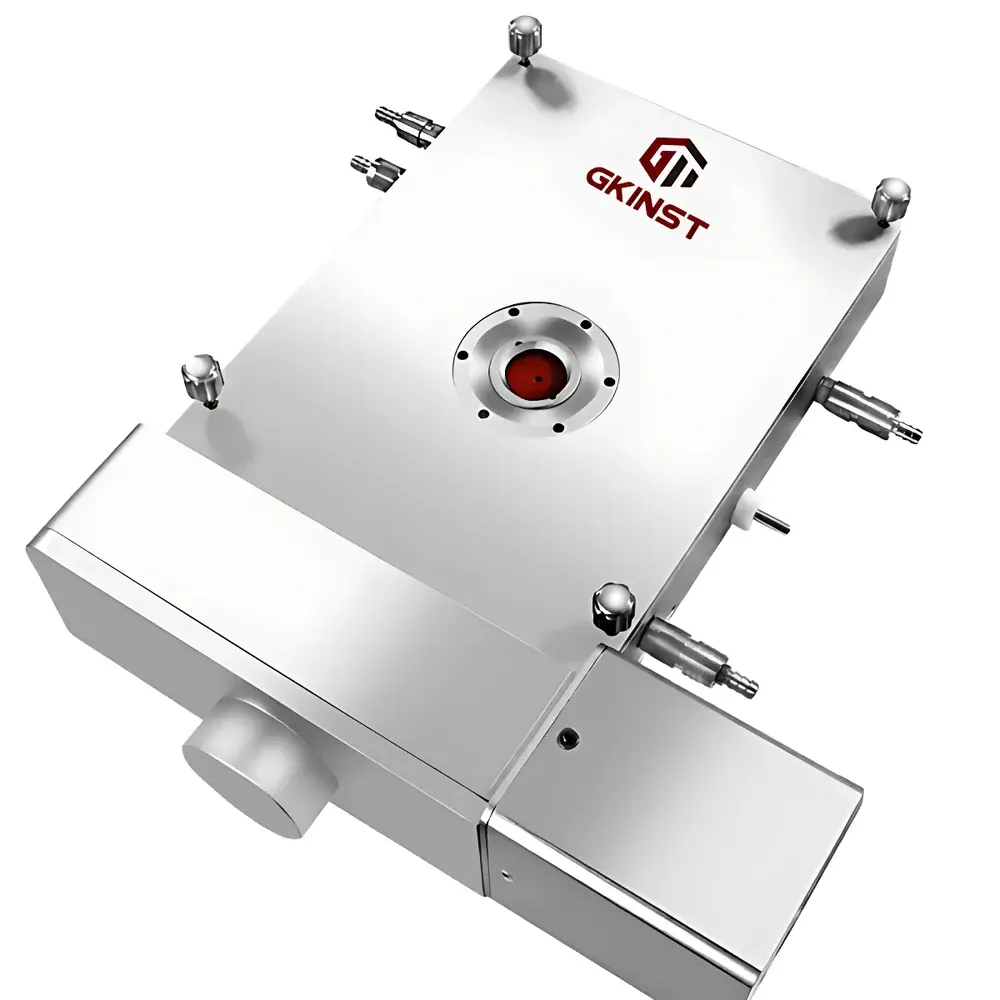
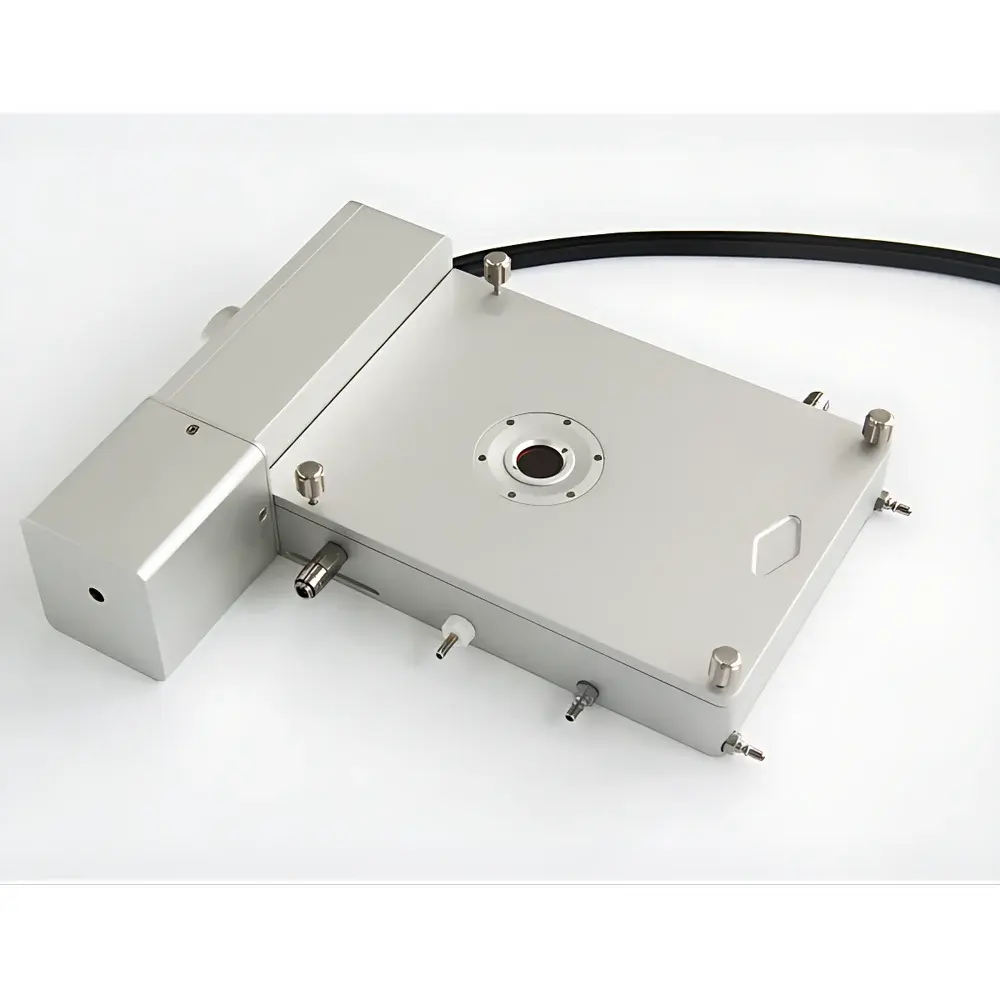
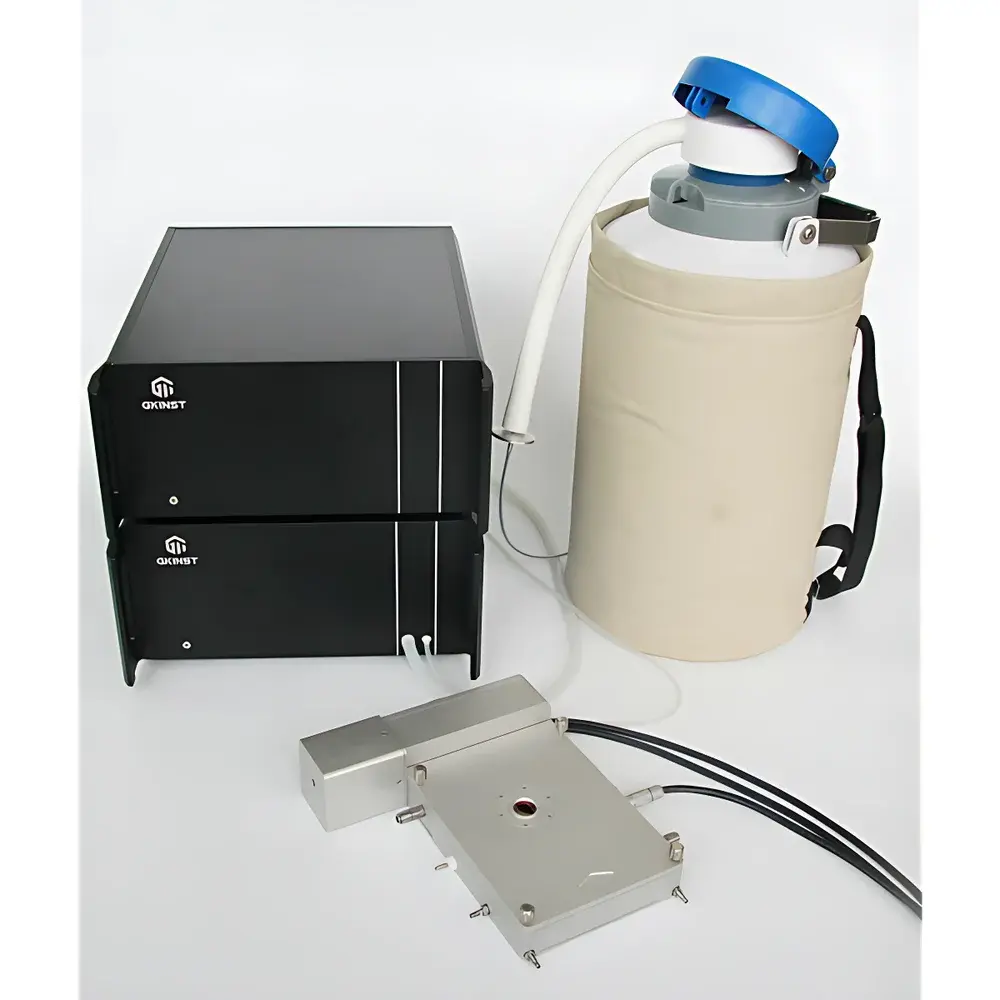
GKInst GK-GTS500/200/20 In-Situ Optical Heating-Cooling Tensile Stage
| Brand | GKInst |
|---|---|
| Model | GK-GTS500/200/20 |
| Force Range | 0–500 N / 0–200 N / 0–20 N |
| Force Resolution | 0.01 N |
| Max. Extension | 80 mm |
| Displacement Resolution | 0.01 mm |
| Displacement Speed | 1–1000 µm/s |
| Force Control Modes | Constant Velocity, Constant Load, Position Hold, Jog, Cyclic Loading |
| Vacuum Compatibility | Customizable for Ultra-High Vacuum (≤10⁻⁵ Pa) |
Overview
The GKInst GK-GTS500/200/20 is an in-situ optical heating-cooling tensile stage engineered for synchrotron X-ray diffraction (XRD), laboratory-based microfocus X-ray scattering, and optical microscopy platforms. It enables real-time, quantitative mechanical testing under precisely controlled thermal conditions — from cryogenic to elevated temperatures — while maintaining full optical and X-ray beam access. The stage operates on a dual-actuator architecture: one high-resolution piezoelectric or stepper-driven actuator controls uniaxial tensile displacement with sub-micrometer repeatability; the second integrated load cell delivers calibrated force measurement across three interchangeable ranges (20 N, 200 N, and 500 N), ensuring optimal signal-to-noise ratio for diverse material classes. Its modular design supports integration into vacuum chambers, gloveboxes, and environmental enclosures, making it suitable for studies requiring inert atmospheres or ultra-high vacuum (UHV) environments down to 10⁻⁵ Pa.
Key Features
- Triple-range force sensing (20 N / 200 N / 500 N) with 0.01 N resolution and <±0.5% full-scale accuracy, traceable to national metrology standards
- High-precision linear motion system with 0.01 mm displacement resolution and programmable speed control from 1 µm/s to 1000 µm/s
- Thermal control compatibility: interfaces with external liquid nitrogen cryostats, resistive heating stages, or Peltier-based thermal modules (not included)
- Optically transparent aperture (≥25 mm clear diameter) accommodating transmission XRD, SAXS/WAXS, and simultaneous optical imaging
- UHV-compatible construction using non-outgassing materials (316L stainless steel, ceramic insulators, metal-sealed feedthroughs)
- Modular mounting interface (standard M4/M6 tapped holes) for rapid integration onto goniometers, sample changers, or custom beamline endstations
Sample Compatibility & Compliance
The GK-GTS500/200/20 accommodates specimens up to 80 mm in gauge length and 15 mm in width, including free-standing films, fiber bundles, laminated heterostructures, and thin-film-on-substrate configurations. Sample clamping employs low-stress, pneumatically assisted or manual wedge grips with replaceable serrated jaws to minimize edge damage. All mechanical and thermal subsystems comply with ISO 17025-accredited calibration practices for force and displacement metrology. When operated within certified UHV chambers, the stage meets ASTM E595 outgassing requirements for space-qualified instrumentation. Its control electronics support hardware-level interlocks compatible with facility-wide safety protocols (e.g., beam shutter synchronization, emergency stop cascading).
Software & Data Management
The stage is controlled via GKInst’s GKS-TensileControl software (Windows 10/11), which provides synchronized acquisition of force, displacement, temperature (via external thermocouple or RTD input), and time-stamped metadata. Raw data exports in HDF5 and ASCII formats include embedded calibration coefficients and instrument configuration logs. Software architecture supports scripting (Python API) for automated test sequences aligned with X-ray detector triggers (TTL/USB). Audit trails record all parameter changes, user logins, and calibration events — fulfilling documentation requirements for GLP-compliant laboratories and FDA 21 CFR Part 11–aligned workflows where electronic signatures and data integrity are mandated.
Applications
- In-situ synchrotron XRD/SAXS studies of phase evolution during tensile deformation of shape-memory alloys and ferroelectric oxides
- Real-time tracking of crack nucleation and propagation in polymer electrolyte membranes under thermal cycling
- Mechanical hysteresis analysis of stretchable conductors and 2D-material heterostructures at sub-ambient temperatures
- Quantification of interfacial delamination kinetics in multilayer thin-film stacks under combined thermal–mechanical stress
- Correlation of lattice strain (from Bragg peak shifts) with macroscopic stress–strain response in nanocomposites
FAQ
Is the stage compatible with commercial X-ray diffractometers (e.g., Bruker D8, Rigaku SmartLab)?
Yes — mechanical footprints and mounting patterns follow ISO 9001-aligned dimensional templates; electrical interfaces use standard DB9 and SMA connectors.
Can temperature control be fully automated alongside force–displacement profiling?
Yes — external temperature controllers (e.g., Lakeshore 336, Janis ST-100) integrate via analog voltage inputs and digital I²C/RS-485; temperature ramps can be synchronized with mechanical loading profiles.
What is the maximum allowable thermal gradient across the sample during operation?
When used with symmetric heating/cooling fixtures, axial gradients remain ≤2 °C/mm at steady state up to ±150 °C; cryogenic operation requires customized thermal anchoring.
Does GKInst provide application-specific validation reports for regulated environments?
Upon request, GKInst issues IQ/OQ documentation packages, including as-delivered calibration certificates, material traceability records, and UHV bakeout validation summaries.
Are replacement load cells and grip sets available as spare parts?
Yes — all sensor modules, clamping assemblies, and thermal interface kits are cataloged under GKInst’s spare parts program with documented recalibration intervals.




