
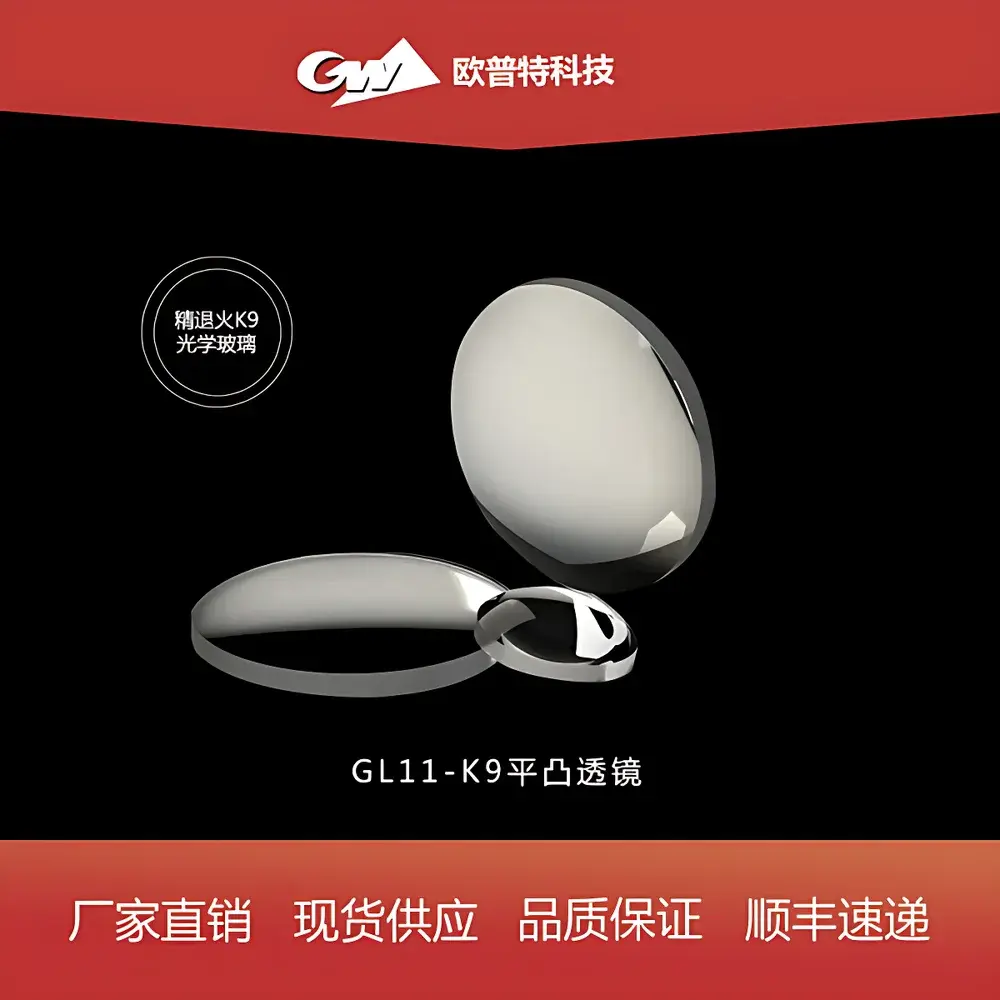
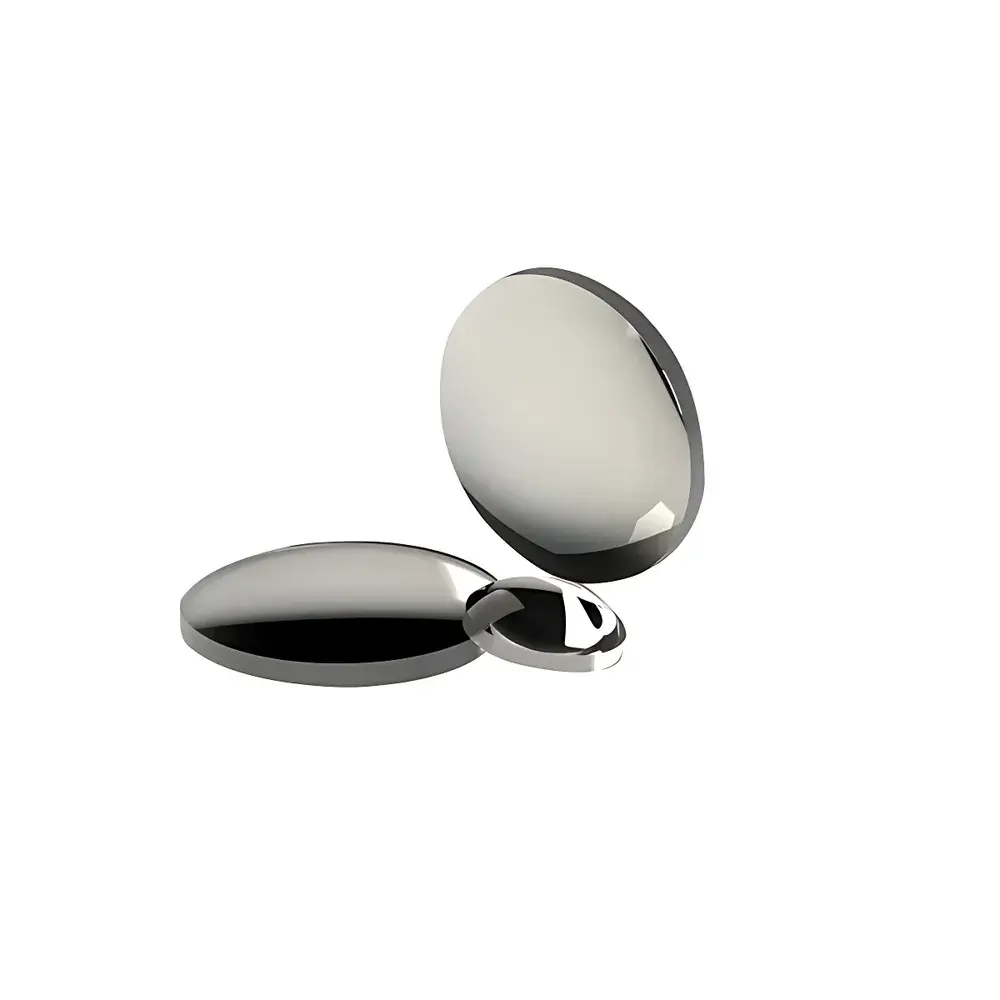
GL11-NIR K9 Plano-Convex Lens with Broadband Anti-Reflective Coating for Near-Infrared (3–100 mm Diameter)
| Origin | Beijing |
|---|---|
| Manufacturer Type | Distributor |
| Origin Category | Domestic (China) |
| Model | GL11-NIR |
| Price Range | USD 0.15–75.00 (per piece, volume-dependent) |
| Component Category | Optical Element |
| Material | Precision-Annealed K9 Optical Glass |
| Design Wavelength | 587.6 nm |
| Diameter Tolerance | +0.0 / −0.1 mm |
| Center Thickness Tolerance | ±0.2 mm |
| Surface Irregularity | λ/4 @ 632.8 nm |
| Effective Focal Length (EFL) Tolerance | ±2% |
| Lens Centration Error | ≤3 arcminutes |
| Surface Quality | 3–4 scratch-dig |
| Edge Treatment | 0.2 mm × 45° chamfer |
| Coating Type | Broadband AR for NIR (650–1050 nm) |
Overview
The GL11-NIR K9 Plano-Convex Lens is a precision optical component engineered for high-performance beam manipulation in near-infrared (NIR) spectral applications. Fabricated from precision-annealed K9 borosilicate crown glass—a material widely specified in ISO 10110 and MIL-PRF-174B for its excellent homogeneity, low bubble/inclusion content, and predictable thermal and mechanical behavior—the lens adheres to stringent metrological tolerances essential for alignment-critical optical systems. Its plano-convex geometry delivers positive focal power, enabling collimation, focusing, imaging, and beam expansion functions. The broadband anti-reflective (BBAR) coating is optimized for the 650–1050 nm wavelength range, achieving average reflectance <0.5% per surface across the band—critical for minimizing ghosting, stray light, and insertion loss in multi-element NIR assemblies such as spectrometers, fiber-coupled sensors, laser diode collimators, and OCT illumination paths.
Key Features
- Precision-annealed K9 optical glass substrate meeting ISO 10110-3 surface quality (3–4 scratch-dig) and homogeneity class H3
- Surface irregularity controlled to λ/4 @ 632.8 nm (verified via interferometric testing per ISO 10110-5)
- Diameter tolerance of +0.0 / −0.1 mm ensures repeatable mounting in kinematic or threaded lens holders
- Center thickness tolerance of ±0.2 mm supports accurate paraxial modeling and Zemax/OpticStudio integration
- Effective focal length (EFL) accuracy of ±2%, traceable to NIST-traceable interferometric calibration protocols
- Centration error ≤3 arcminutes—validated via autocollimator-based wedge measurement—enabling use in telecentric and high-NA relay systems
- 0.2 mm × 45° protective chamfer applied to all edges per ISO 10110-7, mitigating chipping during handling and assembly
- BBAR coating deposited via ion-assisted e-beam evaporation, qualified for >10⁷ shot durability at 1064 nm (10 ns, 10 Hz, 5 J/cm²) per ISO 21254-1
Sample Compatibility & Compliance
The GL11-NIR lens is compatible with standard SM-threaded mounts (e.g., SM1, SM2), cage systems (e.g., Thorlabs 30 mm and 60 mm), and custom machined lens cells. It complies with RoHS Directive 2011/65/EU and REACH Annex XVII restrictions on hazardous substances. While not certified to IEC 61000-4-x EMC standards (as a passive component), its material composition and coating process conform to ISO 9022-1 environmental test categories for optical instruments—including storage at −40 °C to +70 °C and operation at 5–95% RH non-condensing. The BBAR coating meets MIL-C-48497A requirements for adhesion (tape test per ASTM D3359) and abrasion resistance (CS-10 wheel, 1000 cycles, ΔT < 0.2% per ISO 9211-4).
Software & Data Management
As a passive optical element, the GL11-NIR lens does not incorporate embedded electronics or firmware. However, full metrological documentation—including interferometric surface maps, spectral transmittance curves (200–2000 nm), and coating performance reports—is provided in machine-readable formats (CSV, .ZMX, .SDF) for direct import into optical design platforms (Zemax OpticStudio, CODE V, FRED). All delivered lenses are serialized; batch-level certification packages include ISO/IEC 17025-accredited test reports issued by third-party labs (CNAS-registered), supporting GLP/GMP traceability in regulated R&D environments.
Applications
- NIR spectroscopy systems requiring minimal insertion loss between 650–1050 nm (e.g., agricultural moisture analyzers, biomedical oximeters)
- Laser diode collimation optics for 785 nm, 808 nm, 850 nm, and 980 nm sources in industrial sensing and LIDAR seed lasers
- Beam shaping in free-space optical interconnects and photonic integrated circuit (PIC) coupling interfaces
- Objective and relay elements in compact NIR endoscopes and hyperspectral imaging engines
- Reference optics in metrology-grade NIR interferometers and cavity ring-down setups
- Education and research laboratories where reproducible, calibrated NIR transmission components are required for teaching wavefront analysis and Gaussian beam propagation
FAQ
What is the damage threshold of the NIR coating?
The BBAR coating has been tested to >5 J/cm² (10 ns pulse, 1064 nm, 10 Hz repetition rate) per ISO 21254-1. For continuous-wave applications, the coating withstands power densities up to 500 W/cm² without degradation.
Can this lens be used outside the specified NIR band?
Transmission remains usable from ~600 nm to 1150 nm, but reflectance increases beyond 1050 nm; for SWIR applications (1000–1650 nm), specify the GL11-SWIR variant with matched coating design.
Is custom diameter or focal length available?
Yes—standard diameters span 3 mm to 100 mm in 1 mm increments; EFL options range from 3 mm to 1000 mm. Custom specifications require minimum order quantities and extended lead times.
Do you provide mounting hardware or alignment fixtures?
Standard SM1-threaded lens tubes, kinematic mounts, and adjustable lens positioners are available separately under part series LM-GL11 and AM-K9.
Are Zemax or Code V prescription files supplied with purchase?
Yes—each shipment includes a .ZMX file containing exact surface data, coating stack definition, and material dispersion (Schott N-K9 reference data), compliant with ISO 10110-12 modeling conventions.




