
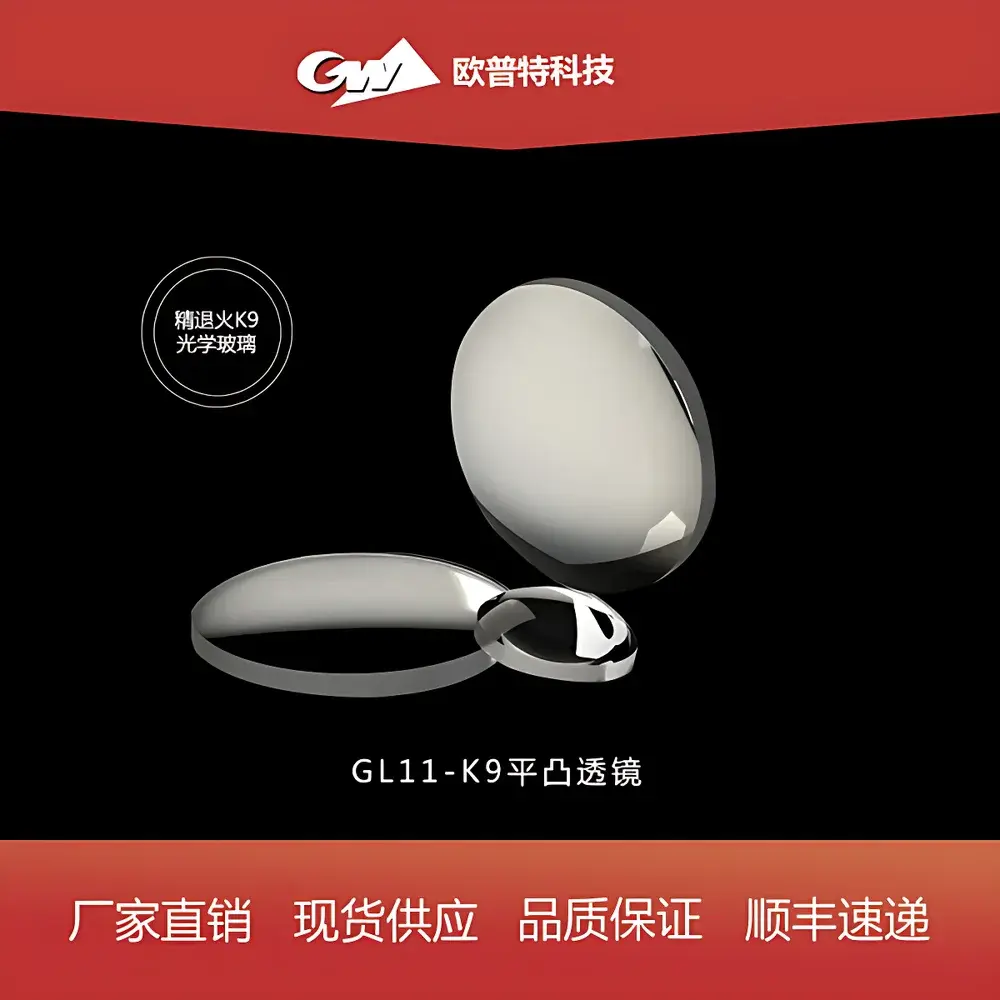
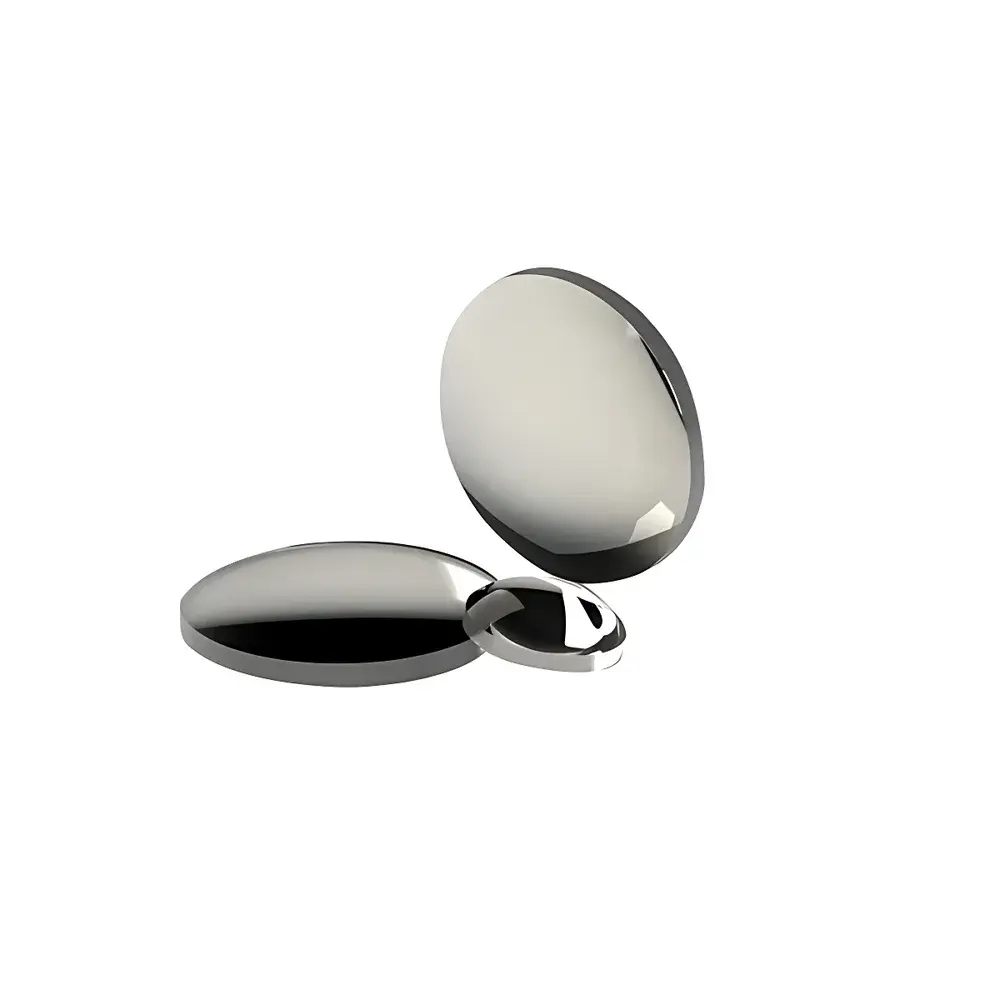
GL11-VIS K9 Plano-Convex Lens with Broadband Antireflection Coating (400–700 nm)
| Material | Precision-Annealed K9 Optical Glass |
|---|---|
| Design Wavelength | 587.6 nm |
| Diameter Tolerance | +0.0 / −0.1 mm |
| Center Thickness Tolerance | ±0.2 mm |
| Surface Irregularity | λ/4 @ 632.8 nm |
| EFL Tolerance | ±2% |
| Centration Error | 3 arcmin |
| Surface Quality | 3–4 Scratch-Dig |
| Edge Treatment | 0.2 mm × 45° Chamfer |
| Coating | Broadband AR (400–700 nm) |
Overview
The GL11-VIS K9 Plano-Convex Lens is a precision optical component engineered for high-transmission performance across the visible spectrum (400–700 nm). Fabricated from precision-annealed K9 borosilicate crown glass—a material widely specified in ISO 10110 and MIL-PRF-174B for its excellent homogeneity, low bubble/inclusion content, and predictable thermal and mechanical behavior—the lens adheres to stringent manufacturing tolerances essential for laboratory-grade optical alignment, beam shaping, and imaging applications. Its plano-convex geometry provides a positive effective focal length (EFL), making it suitable for collimation, focusing, and image relay tasks where minimal spherical aberration is critical. The broadband antireflection coating reduces average surface reflectance to <0.5% per surface over the VIS band, thereby maximizing throughput and minimizing ghosting or stray light in multi-element systems.
Key Features
- Precision-annealed K9 optical glass substrate compliant with ISO 10110-3 (surface irregularity ≤ λ/4 @ 632.8 nm) and ISO 10110-5 (surface quality 3–4 scratch-dig)
- Tight dimensional control: diameter tolerance +0.0 / −0.1 mm; center thickness tolerance ±0.2 mm; EFL tolerance ±2%
- Optimized centration accuracy of ≤3 arcminutes—critical for axial alignment in laser cavities and interferometric setups
- Standard 0.2 mm × 45° protective chamfer on all edges per ISO 10110-7, preventing chipping during handling and mounting
- Broadband antireflection coating deposited via ion-assisted e-beam evaporation, verified by spectrophotometric measurement across 400–700 nm
- Available in diameters from 3 mm to 100 mm, with corresponding EFLs scaled to maintain consistent f-number options for system integration
Sample Compatibility & Compliance
The GL11-VIS lens is designed for integration into optomechanical assemblies compliant with standard 30 mm and 60 mm cage systems (Thorlabs, Newport), as well as kinematic mounts meeting ISO 9001-certified assembly protocols. Its K9 substrate exhibits a coefficient of thermal expansion (CTE) of 7.1 × 10⁻⁶ /K and refractive index stability of ±5 × 10⁻⁶ over 20–30 °C ambient range—enabling stable performance in temperature-controlled lab environments. All coatings are qualified per MIL-C-48497A for adhesion, humidity resistance (95% RH, 48 h), and abrasion resistance (Taber CS-10 wheel, 100 cycles). The lens meets RoHS Directive 2011/65/EU and is documented with full traceability to raw material lot, annealing batch, and coating run for GLP-compliant optical validation workflows.
Software & Data Management
While the GL11-VIS is a passive optical element, its metrological specifications are fully compatible with industry-standard optical design and tolerancing software—including Zemax OpticStudio (v23+), CODE V (v12+), and FRED (v18+). Each lens shipment includes a digital calibration certificate (PDF) containing measured surface irregularity maps (interferometric data), spectral transmission curves (UV-Vis-NIR spectrophotometer traceable to NIST SRM 2036), and centration verification reports. These files conform to ASTM E2918-20 for optical component documentation and support FDA 21 CFR Part 11-compliant electronic record retention when stored within validated LIMS or QMS platforms.
Applications
- Laser beam conditioning in DPSS and diode-pumped systems (e.g., Nd:YAG at 532 nm, HeNe at 632.8 nm)
- Focusing optics in fluorescence microscopy illumination paths and confocal scanning units
- Collimation of LED sources in machine vision lighting engines operating in the visible band
- Objective and relay lens elements in compact spectrometer designs (Czerny-Turner, Offner configurations)
- Alignment reference optics in photolithography mask inspection tools requiring high wavefront fidelity
- Education and research labs conducting aberration analysis, Fourier optics experiments, or Gaussian beam propagation studies
FAQ
What is the damage threshold for the GL11-VIS broadband AR coating under continuous-wave laser exposure?
The coating is rated for ≤500 W/cm² at 532 nm (CW, 10.6 mm beam diameter, 1/e² intensity profile) when mounted on a thermally conductive mount with adequate heat sinking. Pulsed operation requires separate LIDT evaluation per ISO 21254-2.
Can this lens be used in vacuum environments?
Yes—K9 glass and the oxide-based AR coating exhibit negligible outgassing (<1 × 10⁻⁹ Torr·L/s·cm² per ASTM E595), qualifying the lens for UHV-compatible optical benches up to 10⁻⁷ Torr.
Is custom focal length or diameter available beyond the standard catalog range?
Custom diameters (up to 150 mm) and EFLs (±0.5% tolerance) are available under OEM agreements with full ISO 10110 test reporting and coating spectral re-optimization.
How does the lens perform outside the 400–700 nm design band?
Transmission remains >85% from 380 nm to 750 nm; however, reflectance increases beyond 700 nm due to coating dispersion—NIR-optimized variants (GL11-NIR) are recommended for >700 nm applications.
Do you provide mounting adapters or kinematic cells for this lens?
Standard SM-threaded lens mounts (SM05, SM1, SM2 series), retaining rings, and adjustable tilt platforms are available separately and dimensionally matched to GL11-VIS mechanical datums per ISO 10110-17.





