
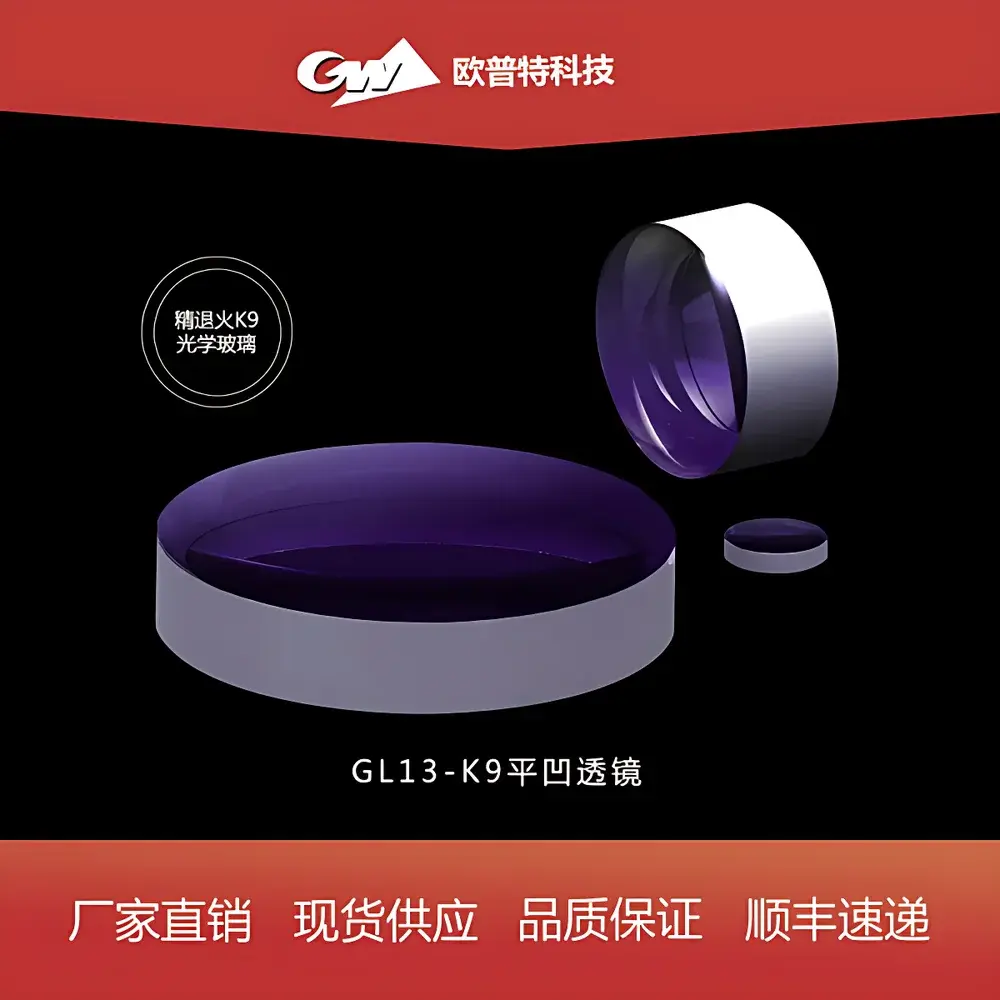
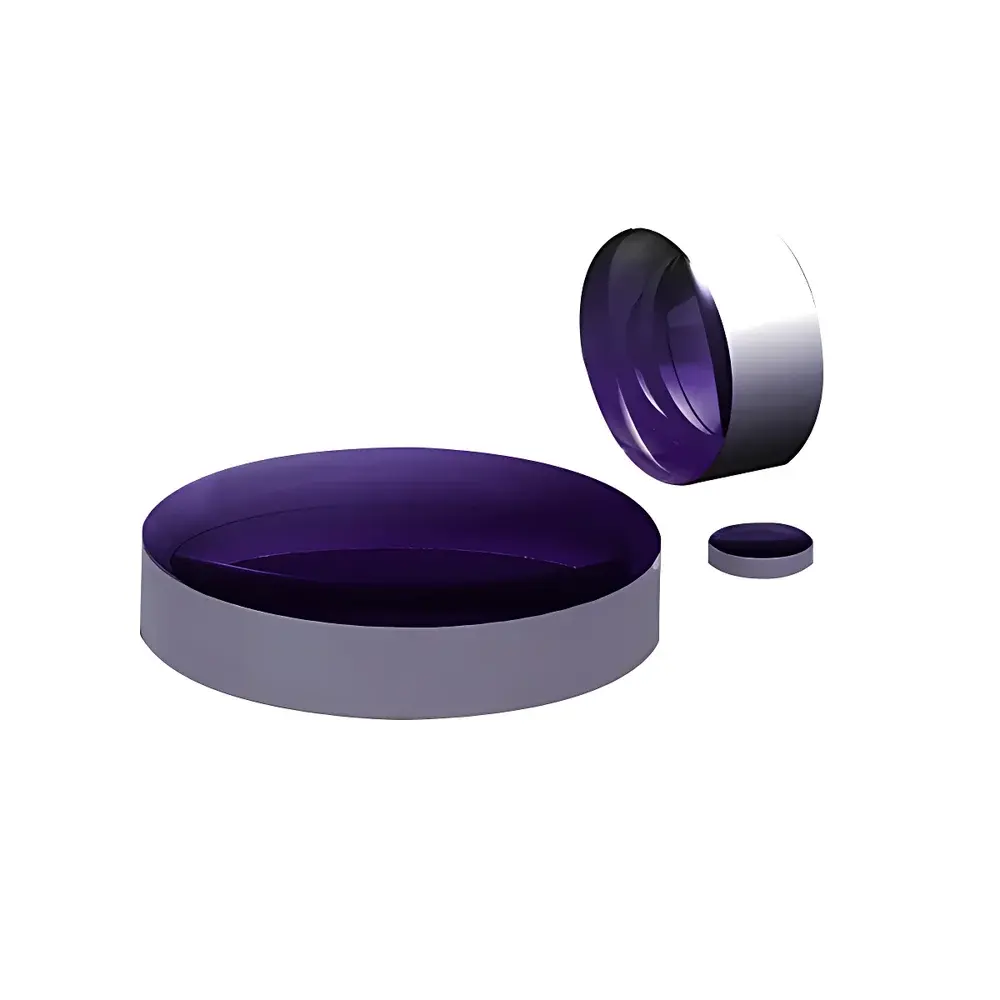
GL13-SWIR Plano-Concave Lens with Broadband Anti-Reflection Coating for Short-Wave Infrared (SWIR)
| Origin | Beijing, China |
|---|---|
| Manufacturer Type | Authorized Distributor |
| Regional Origin | Domestic (China) |
| Model | GL13-SWIR |
| Price Range | USD 0.15–75.00 per unit |
| Component Category | Optical Element |
| Diameter Range | 4–50 mm |
| AR Coating | SWIR broadband (1000–1650 nm) and NIR broadband (650–1050 nm) options available |
Overview
The GL13-SWIR Plano-Concave Lens is a precision optical component engineered for demanding short-wave infrared (SWIR) and near-infrared (NIR) applications in spectroscopy, laser beam shaping, optical sensing, and industrial imaging systems. Designed according to classical Gaussian optics principles, this lens operates on the principle of negative focal power by introducing controlled wavefront divergence via its concave spherical surface. Its plano-concave geometry ensures minimal spherical aberration when used with collimated input beams or as a beam expander in reverse configuration. The lens is fabricated from high-homogeneity optical-grade fused silica (SiO₂) or N-BK7 glass—material selection optimized for transmission stability across 650–1650 nm, low thermal expansion, and resistance to environmental aging. All surfaces undergo precision polishing to λ/4 surface flatness (per ISO 10110-3) and scratch-dig compliance per MIL-PRF-13830B.
Key Features
- Two standardized anti-reflection coating options: NIR broadband (650–1050 nm, R < 0.5% avg.) and SWIR broadband (1000–1650 nm, R < 0.5% avg.), deposited via ion-assisted e-beam evaporation for high laser-induced damage threshold (LIDT > 5 J/cm² at 1064 nm, 10 ns pulse)
- Diameter range from 4 mm to 50 mm, enabling integration into compact OEM modules as well as large-aperture laboratory setups
- Focal lengths spanning −5 mm to −500 mm, with corresponding back focal lengths (BFL), radii of curvature (R₁), center thicknesses (T₁), and edge thicknesses (T₂) precisely specified per part number for deterministic optical design
- Compliant with ISO 9001-certified manufacturing protocols; each batch traceable to raw material lot, coating run ID, and interferometric verification report
- Available with optional mounting compatibility—designed to interface directly with standard SM-threaded lens mounts (e.g., Thorlabs SM05, SM1, SM2 series) and kinematic lens holders per DIN 73000
Sample Compatibility & Compliance
The GL13-SWIR lens family supports both air-spaced and cemented doublet configurations in multi-element assemblies. Its substrate materials meet RoHS Directive 2011/65/EU and REACH Annex XVII restrictions on hazardous substances. Coating durability conforms to ISO 9211-4:2013 for abrasion resistance (tested via CS-10 wheel, 1000 cycles), humidity resistance (95% RH, 40 °C, 240 h), and adhesion (ASTM D3359 Tape Test, Class 5A). For regulated environments—including medical device optical subsystems and aerospace sensor calibration—lens documentation includes full metrology data sheets (surface figure, transmitted wavefront error, spectral transmittance curves) and can be supplied with Certificate of Conformance (CoC) or Certificate of Analysis (CoA) upon request.
Software & Data Management
While the GL13-SWIR is a passive optical element, its performance parameters are fully integrated into industry-standard optical design software libraries. Zemax OpticStudio (v23+), CODE V (v12.2+), and Synopsys LightTools include native support for the GL13-SWIR part numbers via downloadable .ZMX and .SEQ files containing exact surface prescriptions, dispersion data (Sellmeier coefficients), and coating stack models. All product data—including dimensional tolerances (±0.05 mm diameter, ±1% EFL), surface quality (20–10 scratch-dig), and coating spectral curves—is published in machine-readable JSON and CSV formats through our API-accessible component database, supporting automated BOM validation and optical simulation pipeline integration.
Applications
- Laser diode collimation and beam expansion in SWIR-based free-space communication systems (1310 nm, 1550 nm)
- Optical path correction in Fourier-transform infrared (FTIR) spectrometers and hyperspectral imagers operating in the 1000–1650 nm band
- Thermal imaging relay optics where chromatic aberration control across extended NIR/SWIR bands is critical
- Alignment reference optics in semiconductor wafer inspection tools utilizing 1064 nm or 1310 nm illumination
- Custom achromatic doublets when paired with matched convex lenses from the GL12 series, enabling diffraction-limited performance over >600 nm bandwidth
FAQ
What is the difference between the NIR and SWIR AR coatings?
The NIR coating (650–1050 nm) minimizes reflectance across visible red to short-wave IR, ideal for silicon-based detectors. The SWIR coating (1000–1650 nm) targets extended infrared response, optimized for InGaAs sensors and fiber-coupled systems.
Can these lenses be used in vacuum or high-humidity environments?
Yes—fused silica variants are rated for operation in 10⁻⁶ Torr vacuum and 95% RH environments when properly sealed; N-BK7 versions require conformal coating for prolonged humid exposure.
Do you provide custom focal lengths or diameters outside the listed range?
Custom diameters up to 75 mm and EFLs from −3 mm to −1000 mm are available under NRE-supported engineering services, subject to minimum order quantity and lead time confirmation.
Is coating LIDT data available for pulsed laser applications?
Yes—full LIDT test reports (ISO 21254-1:2018 compliant) are provided for common pulse durations (10 ps–10 ns) and wavelengths (1064 nm, 1310 nm, 1550 nm) upon request.
How are tolerances verified prior to shipment?
Each lens undergoes interferometric surface testing (Zygo GPI XP), spectral photometry (PerkinElmer Lambda 1050+), and mechanical metrology (Mitutoyo CMM) — all results archived and accessible via unique serial-number lookup.





