
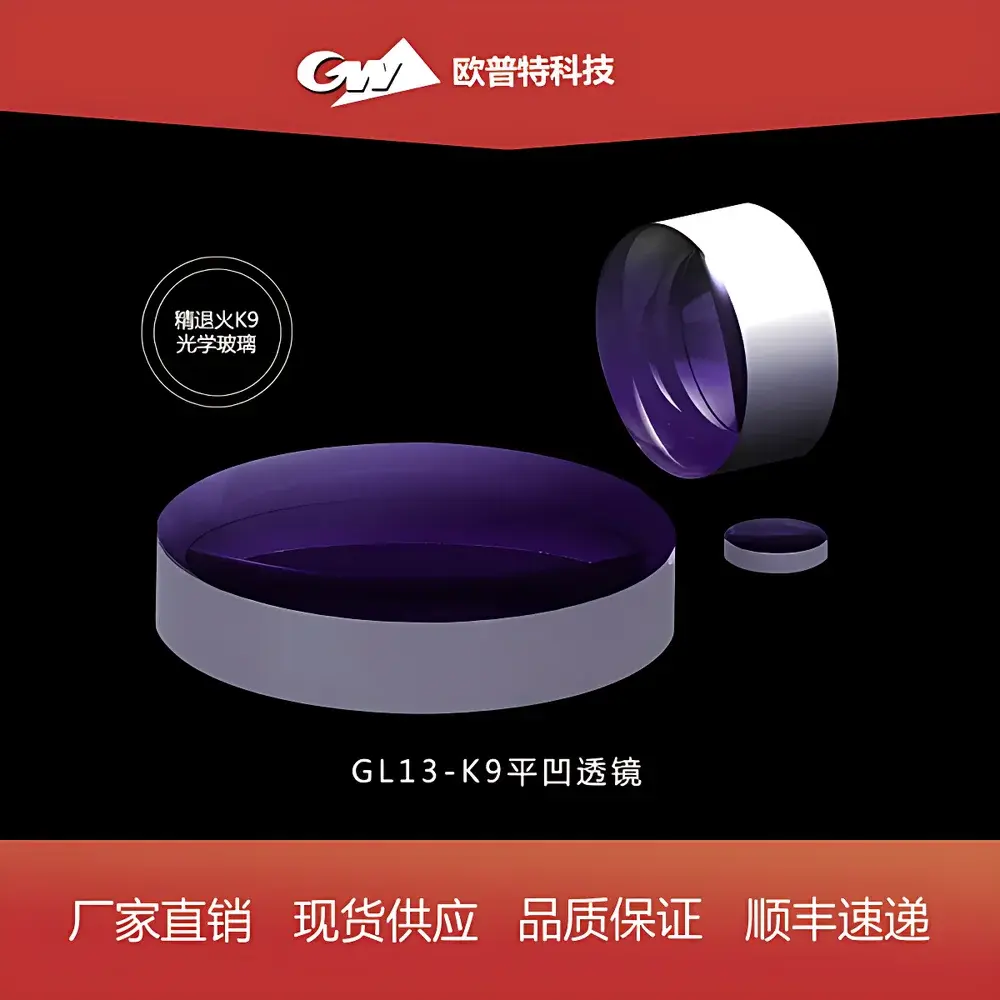
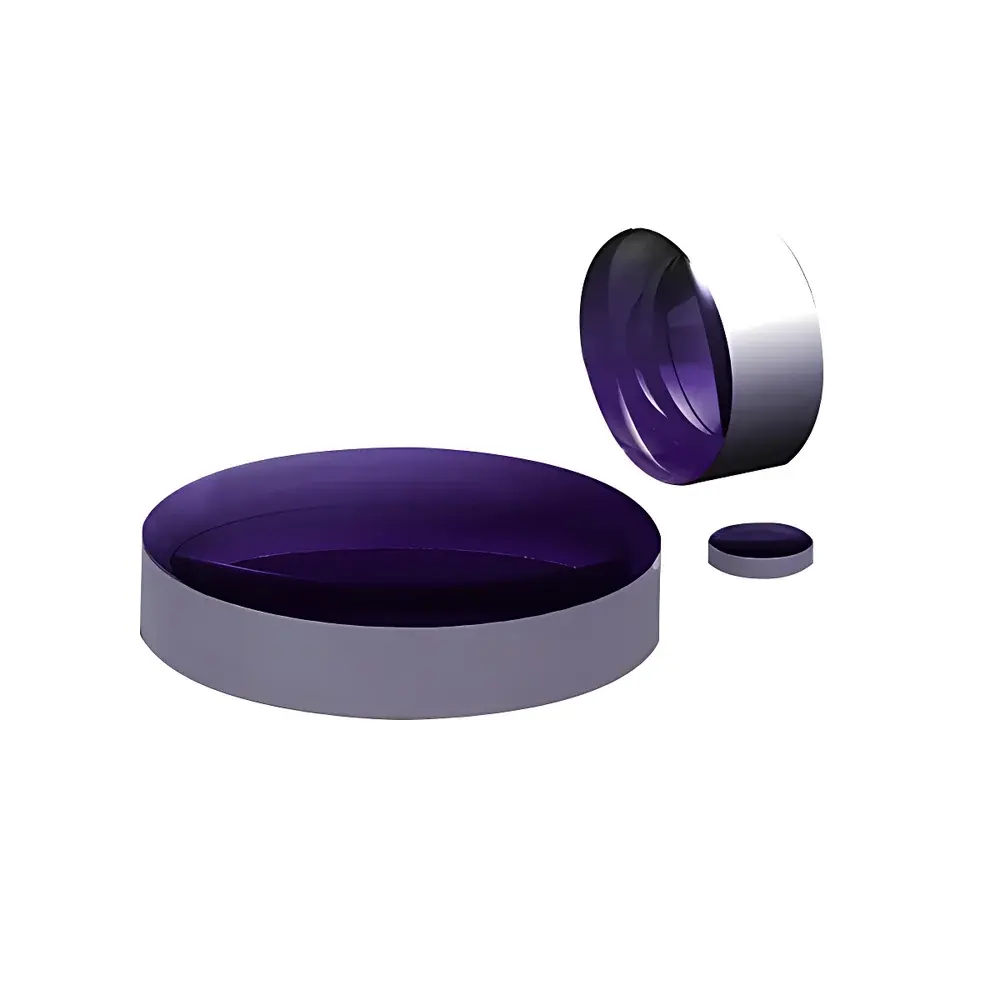
GL13-VIS K9 Plano-Concave Lens with Broadband Anti-Reflection Coating (400–700 nm)
| Origin | Beijing, China |
|---|---|
| Manufacturer Type | Distributor |
| Regional Origin | Domestic (China) |
| Model | GL13-VIS |
| Component Category | Optical Element |
| Material | Precision-Annealed K9 Optical Glass |
| Design Wavelength | 587.6 nm |
| Diameter Tolerance | +0.0 / −0.1 mm |
| Center Thickness Tolerance | ±0.2 mm |
| Surface Irregularity | λ/4 @ 632.8 nm |
| Effective Focal Length (EFL) Tolerance | ±2% |
| Centration Error | 3 arcminutes |
| Surface Quality | 3–4 scratch-dig |
| Edge Treatment | 0.2 mm × 45° chamfer |
| Coating | Broadband AR (400–700 nm) |
Overview
The GL13-VIS K9 Plano-Concave Lens is a precision optical component engineered for controlled beam divergence in visible-light applications. Constructed from precision-annealed K9 borosilicate crown glass—a material standardized under ISO 10110 and widely adopted in metrology-grade optics—the lens features one plano (flat) surface and one concave spherical surface. Its negative focal length enables beam expansion, collimation correction, and focal length extension in compound optical systems. The lens is optimized for operation across the visible spectrum (400–700 nm), with a broadband anti-reflection (AR) coating applied to both surfaces to minimize Fresnel losses (<0.5% average reflectance per surface). Designed around a 587.6 nm primary reference wavelength (the helium d-line), it maintains consistent wavefront fidelity and low residual aberration when used within its specified clear aperture and angular acceptance range.
Key Features
- Precision-annealed K9 optical glass substrate meeting ISO 10110-3 surface quality and homogeneity specifications
- Broadband AR coating (400–700 nm) with <0.5% average reflectance per surface, enhancing transmission efficiency and reducing ghost imaging
- Strict dimensional tolerances: diameter tolerance of +0.0 / −0.1 mm ensures compatibility with standard SM-threaded lens mounts and kinematic optical holders
- Surface irregularity controlled to λ/4 @ 632.8 nm (HeNe wavelength), supporting interferometric alignment and low-wavefront-distortion applications
- Centration error limited to ≤3 arcminutes—critical for minimizing beam walk-off in multi-element relay systems
- Controlled edge geometry: 0.2 mm × 45° chamfer prevents chipping and facilitates safe handling and mounting
- Available in diameters from 4 mm to 50 mm, with EFL options scalable to support divergent beam shaping in laser diode collimation, fiber coupling, and illumination optics
Sample Compatibility & Compliance
The GL13-VIS lens is compatible with industry-standard optomechanical platforms including Thorlabs SM-series lens tubes, Newport Kinematic Mounts, and Edmund Optics retaining rings. It conforms to general optical manufacturing standards including ISO 10110 (optical element specification), ISO 8578 (surface imperfection grading), and MIL-PRF-13830B (scratch-dig classification). While not certified to specific regulatory frameworks such as FDA or CE for medical or safety-critical use, its material composition (K9 glass, RoHS-compliant coating materials) and process controls align with GLP-aligned laboratory procurement requirements for non-invasive optical instrumentation. No hazardous substances are employed in substrate fabrication or coating deposition (e-beam evaporation or ion-assisted deposition).
Software & Data Management
As a passive optical component, the GL13-VIS lens does not incorporate embedded electronics, firmware, or data interfaces. Its performance parameters—including transmission spectra, phase delay profiles, and polarization-dependent loss—are fully characterized via vendor-provided spectral transmittance reports (measured on PerkinElmer Lambda 950 or equivalent spectrophotometer) and interferometric surface maps (Zygo Verifire or similar). These datasets are delivered in CSV and Zemax-compatible .DAT formats upon request, enabling integration into optical design workflows (Zemax OpticStudio, CODE V, FRED) for tolerance analysis, stray light modeling, and system-level MTF prediction. Traceable calibration certificates—including EFL verification at 587.6 nm using a collimated HeNe source and autocollimator—are available for QA/QC documentation.
Applications
- Laser beam expansion in DPSS and diode laser systems requiring controlled negative power
- Collimation correction in fiber-coupled modules where input NA exceeds objective lens acceptance
- Field lens design in projection optics and Köhler illumination systems
- Reference elements in Shack-Hartmann wavefront sensors and interferometric test benches
- Optical cavity mode control in tunable external-cavity diode lasers (ECDL)
- Low-cost divergence compensation in educational optics kits and undergraduate photonics laboratories
FAQ
What is the damage threshold of the VIS-coated GL13-VIS lens?
The broadband AR coating is rated for continuous-wave (CW) laser operation up to 500 W/cm² at 532 nm and 1064 nm; pulsed laser damage threshold (LIDT) is ≥5 J/cm² for 10 ns pulses at 10 Hz repetition rate (tested per ISO 21254-1).
Can this lens be used outside the 400–700 nm range?
Transmission drops significantly below 400 nm (UV absorption onset) and above 700 nm (coating inefficiency); for NIR applications, specify GL13-NIR (650–1050 nm) or GL13-SWIR (1000–1650 nm) variants.
Is custom centration or tighter surface irregularity available?
Yes—custom orders support λ/10 surface irregularity, ≤1 arcminute centration, and optional wedge control (≤5 arcseconds); lead time and NRE apply.
Do you provide mounting solutions for these lenses?
Standard SM-threaded lens mounts (e.g., SM1A9, SM2A10) and adjustable kinematic cells are recommended; compatible retaining rings and adapter sleeves are available separately.
Are Zemax or Code V prescription files provided?
Yes—standard prescriptions include radius values, thicknesses, glass type (Schott K9, nd = 1.5163, νd = 64.2), and coating stack definitions; files are supplied in .ZMX and .SEQ formats upon order confirmation.



