
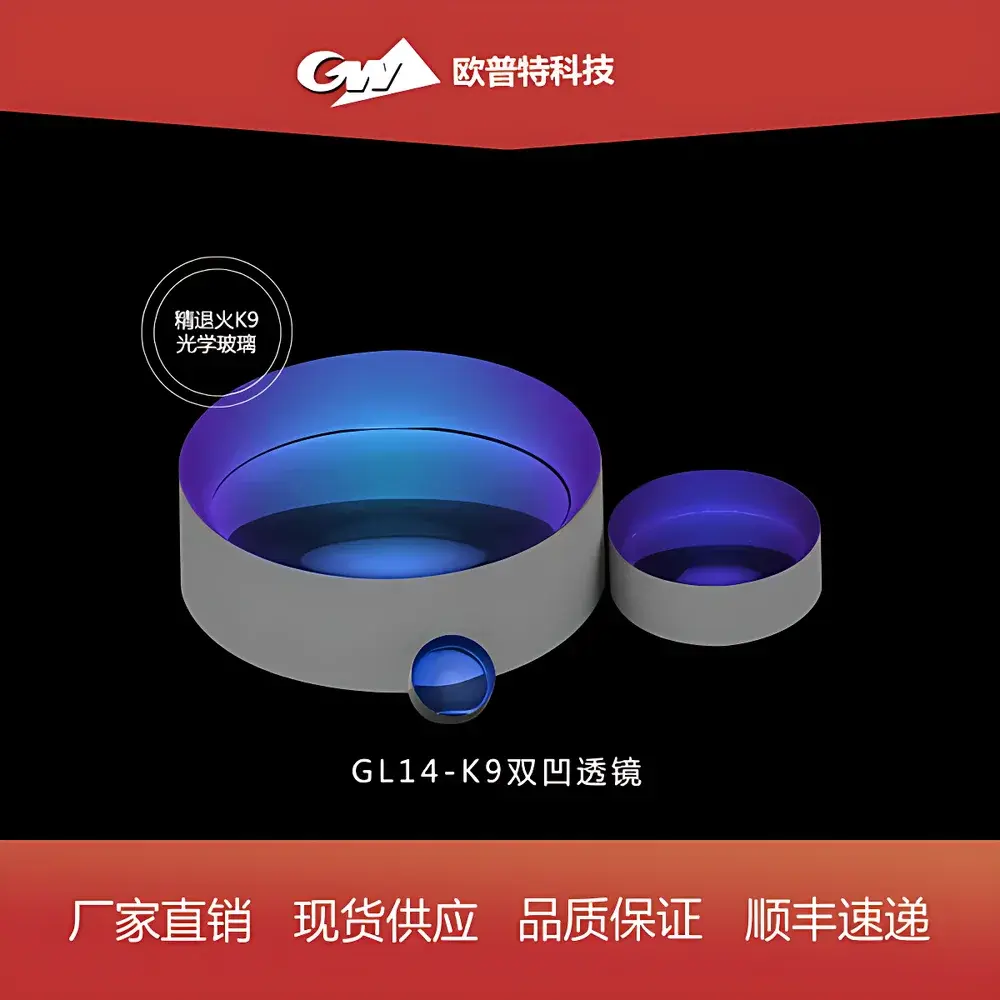
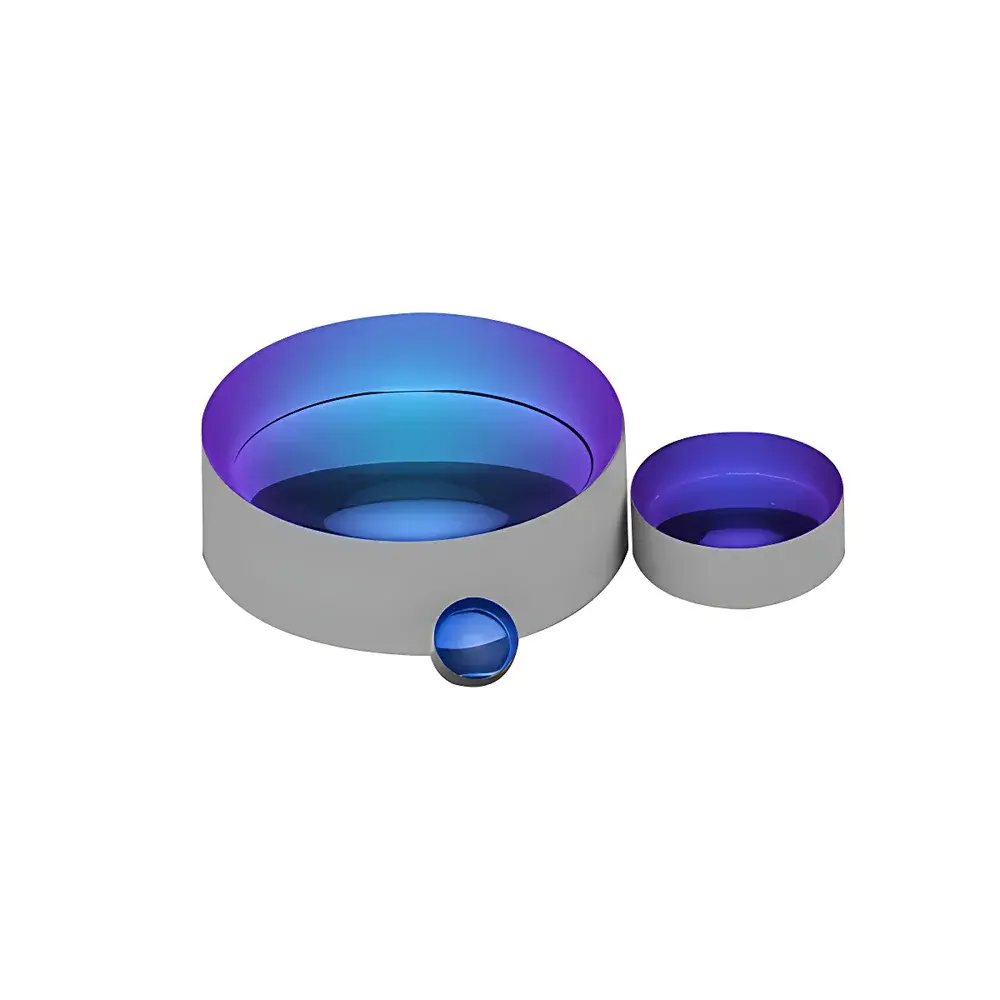
GL14-K9 Biconcave Lens with Short-Wave Infrared (SWIR) Broadband Anti-Reflection Coating
| Origin | Beijing, China |
|---|---|
| Manufacturer Type | Authorized Distributor |
| Origin Category | Domestic (China-Made) |
| Model | GL14-SWIR |
| Component Category | Optical Element |
| Coating Range | 1000–1650 nm (SWIR AR) |
Overview
The GL14-K9 Biconcave Lens is a precision optical component engineered for high-fidelity beam expansion, divergence control, and optical path length adjustment in short-wave infrared (SWIR) systems. Fabricated from high-homogeneity K9 borosilicate crown glass (Schott BK7 equivalent), this lens adheres to ISO 10110 surface quality standards (scratch-dig 60-40) and features precisely ground and polished biconcave geometry defined by two symmetric concave spherical surfaces. Its optical design follows the standard thin-lens approximation for diverging elements, with effective focal length (EFL) values ranging from −2.0 mm to −50.0 mm across 13 standardized configurations. The SWIR broadband anti-reflection coating — optimized for 1000–1650 nm — reduces average surface reflectance to <0.5% per surface over the full operational band, minimizing ghosting, etalon effects, and insertion loss in spectroscopic, laser diagnostics, and thermal imaging applications operating in the 1–1.7 µm spectral window.
Key Features
- Material: High-purity K9 optical glass (refractive index nd = 1.5168 @ 587.6 nm; Abbe number νd = 64.2), certified per MIL-O-13830A surface quality
- Geometry: Symmetric biconcave configuration with radius of curvature tolerance ±0.2% and center thickness tolerance ±0.05 mm
- Coating options: Uncoated (bare K9), VIS AR (400–700 nm), NIR AR (650–1050 nm), and SWIR AR (1000–1650 nm) — all deposited via ion-assisted e-beam evaporation
- Surface specifications: λ/4 wavefront accuracy (RMS), surface flatness ≤λ/8 over clear aperture, and surface roughness <5 Å RMS
- Mechanical stability: Coefficient of thermal expansion (CTE) 7.1 × 10⁻⁶/°C ensures minimal focal shift under ambient lab temperature fluctuations (15–30 °C)
Sample Compatibility & Compliance
The GL14-K9 series is compatible with standard kinematic and threaded lens mounts (e.g., SM1, SM2, RMS), with recommended mounting hardware referenced in the manufacturer’s catalog (Page 100). All coated variants meet ISO 9211-3:2021 requirements for durability of optical coatings, including adhesion (tape test per MIL-C-48497A), abrasion resistance (CS-10 wheel, 1000 cycles), and environmental stability (48 h at 85% RH / 85 °C). The SWIR-coated versions are qualified for use in Class 1000 cleanroom assembly and comply with RoHS 2015/863/EU restrictions on hazardous substances. No FDA or CE marking applies, as these are passive optical components exempt from medical device or low-voltage directive classification.
Software & Data Management
As a passive optical element, the GL14-K9 lens does not incorporate embedded firmware, sensors, or digital interfaces. However, its geometric and spectral performance data — including measured transmission curves (200–2000 nm), refractive index dispersion (Sellmeier coefficients), and coating reflectance maps — are provided in standardized ASCII and CSV formats compatible with Zemax OpticStudio, CODE V, and FRED optical design suites. Each product shipment includes a traceable calibration certificate referencing NIST-traceable spectrophotometric measurements (PerkinElmer Lambda 1050+ with integrating sphere). Audit-ready documentation supports GLP-compliant optical system validation workflows.
Applications
- SWIR spectroscopy: Collimation and re-imaging in Fourier-transform near-infrared (FT-NIR) and dispersive spectrometers operating beyond 1000 nm
- Laser beam conditioning: Divergence correction for 1310 nm and 1550 nm telecom lasers, quantum cascade lasers (QCLs), and supercontinuum sources
- Thermal imaging optics: Relay lenses in uncooled InGaAs and HgCdTe detector arrays requiring low chromatic aberration and high transmission in the 1–1.7 µm band
- Optical coherence tomography (OCT): Reference arm optics where group delay dispersion must be minimized — K9’s low partial dispersion supports achromatic pairing
- Educational labs: Demonstrating Gaussian beam propagation, ray tracing principles, and wavelength-dependent focal shift in advanced optics curricula
FAQ
What is the damage threshold of the SWIR-coated GL14-K9 lens?
The pulsed laser-induced damage threshold (LIDT) is ≥5 J/cm² at 1064 nm, 10 ns, 10 Hz (ISO 21254-1); for CW operation at 1550 nm, the maximum power density is 1 MW/cm² with adequate heat sinking.
Can this lens be used in vacuum environments?
Yes — K9 glass exhibits negligible outgassing (total mass loss <0.5% per ASTM E595); SWIR coatings are fully dense and non-hygroscopic, making them suitable for UHV-compatible optical benches.
Is there a version with custom focal length or diameter?
Standard configurations cover diameters from 2.0 mm to 50.0 mm and EFLs from −2.0 mm to −50.0 mm; custom geometries and coatings are available under OEM agreement with minimum order quantity (MOQ) of 50 units.
How is spectral performance verified for each batch?
Every production lot undergoes spectrophotometric verification using a calibrated PerkinElmer Lambda 1050+ UV/VIS/NIR spectrometer with 1 nm resolution; raw data and pass/fail reports accompany shipment.
Are mounting rings included with purchase?
Mounting rings are sold separately; compatible part numbers (e.g., PN35036-LM040-S) are listed in the product table and catalog Page 100 — all follow ANSI/ASME B47.1 thread standards.





