
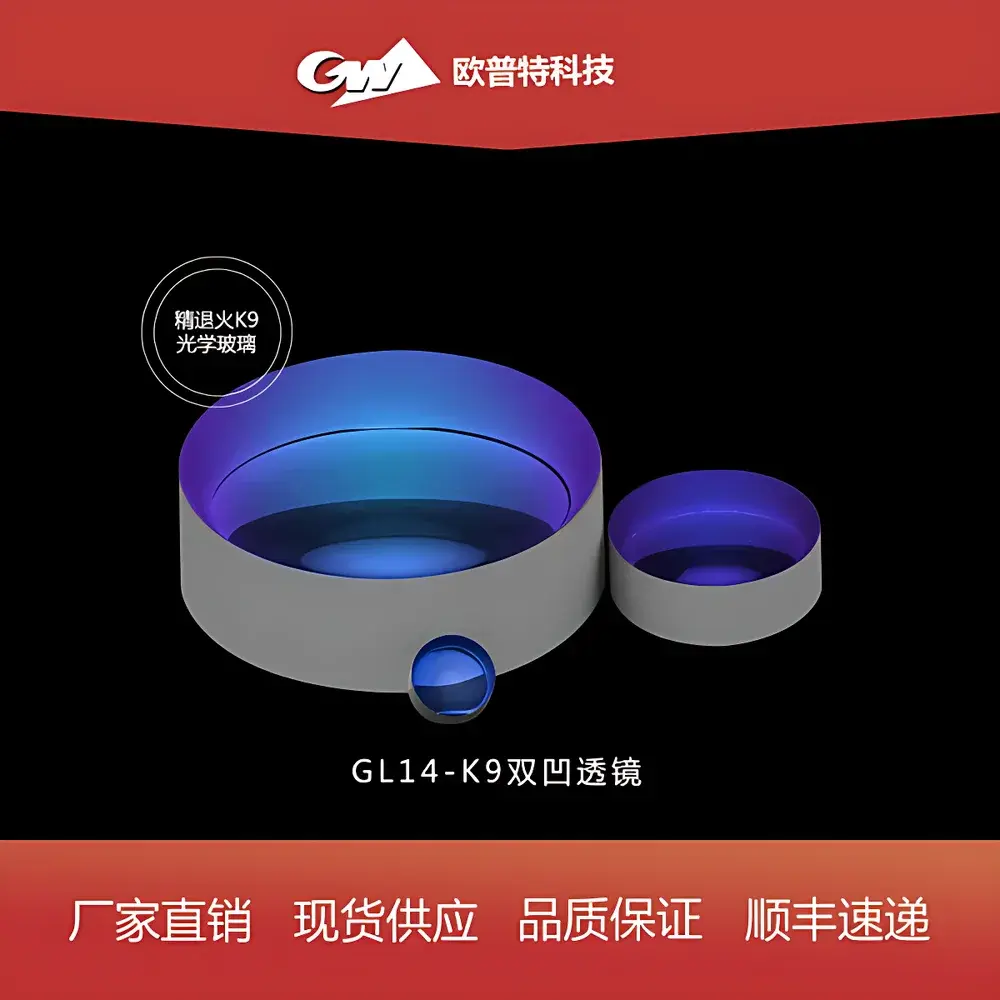
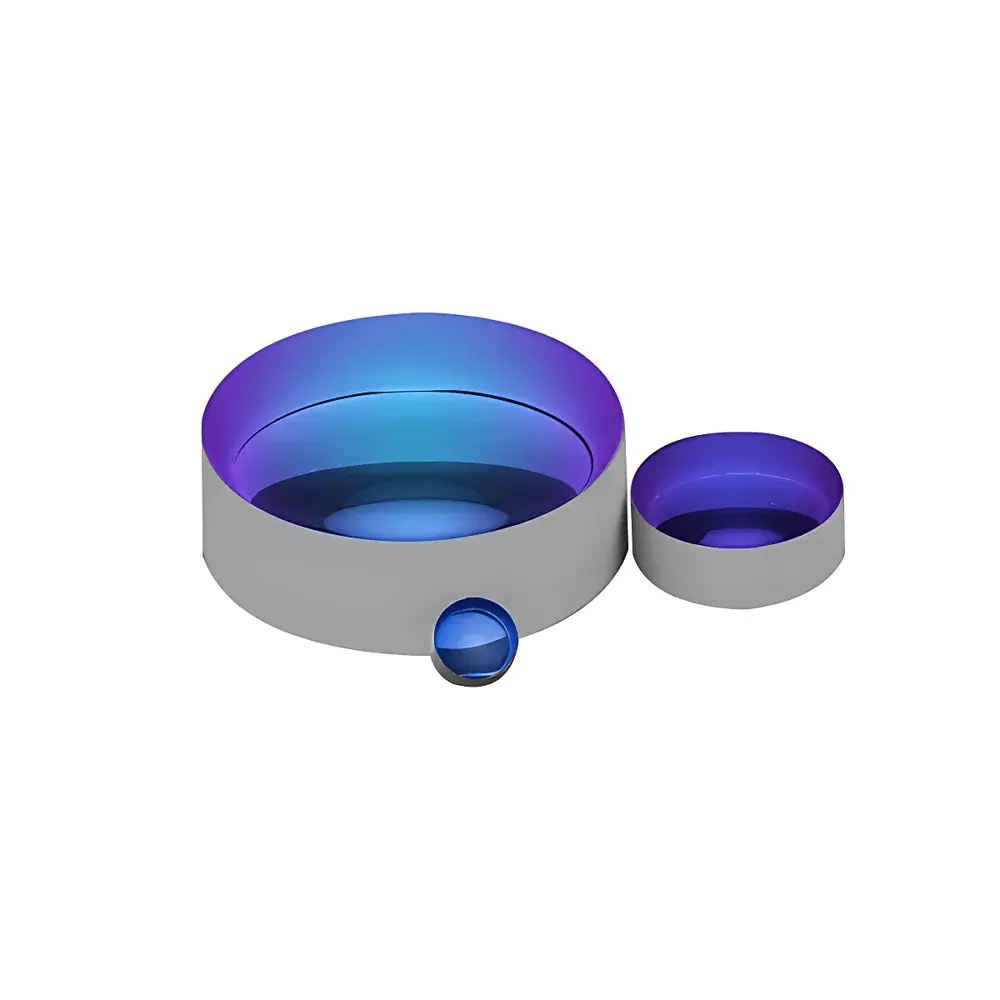
GL14-K9 Double-Concave Lens (Uncoated), Diameter 2–50 mm
| Origin | Beijing |
|---|---|
| Manufacturer Type | Distributor |
| Origin Category | Domestic (China) |
| Model | GL14 |
| Price Range | USD $0.15–75.00 (per piece, volume-dependent) |
| Component Category | Optical Element |
| Material | K9 Optical Crown Glass |
| Surface Quality | 60-40 Scratch-Dig |
| Clear Aperture | ≥90% of Diameter |
| Focal Length Tolerance | ±2% |
| Centration Error | ≤3 arcmin |
| Surface Flatness | λ/4 @ 632.8 nm |
Overview
The GL14-K9 Double-Concave Lens is a precision optical component engineered for beam expansion, divergence control, and optical system correction in laboratory, educational, and industrial applications. Fabricated from high-homogeneity K9 borosilicate crown glass (Schott N-BK7 equivalent), it exhibits excellent transmission across the visible spectrum (350–2000 nm), low bubble/inclusion content, and tight tolerances on surface figure and centration. As an uncoated element, the lens maintains intrinsic material properties without thin-film interference effects—making it suitable for applications requiring spectral neutrality, UV-VIS-NIR broadband compatibility, or subsequent custom coating deposition. Its double-concave geometry produces negative focal power, enabling collimated beam divergence, virtual image formation, and compensation of positive spherical aberration in multi-element systems.
Key Features
- Optical substrate: K9 glass (refractive index nd = 1.5163 @ 587.6 nm; Abbe number νd = 64.2)
- Uncoated surface finish: Standard polished surfaces with RMS roughness < 5 Å
- Diameter range: 2 mm to 50 mm (custom diameters available upon request)
- Focal length options: From –2.0 mm to –100 mm (standard catalog includes EFL = –2.0 mm, –2.5 mm, –5.0 mm, –10 mm, –25 mm, –50 mm)
- Surface quality: 60–40 scratch-dig per MIL-PRF-13830B
- Centration: ≤3 arcminutes (measured via autocollimation)
- Clear aperture: ≥90% of nominal diameter
- Surface flatness: λ/4 at 632.8 nm (HeNe wavelength), verified interferometrically
- Edge treatment: Fine ground or beveled edges (0.1–0.2 mm × 45° standard)
Sample Compatibility & Compliance
The GL14 series complies with ISO 10110-1:2017 (optical element drawing specifications) and adheres to dimensional and surface quality benchmarks defined in ISO 10110-7 for surface imperfections. While not inherently certified to ISO 9001 or ISO 14001, all units are traceably inspected per internal QA protocol aligned with GLP principles. The uncoated design ensures full compatibility with vacuum ultraviolet (VUV) environments where organic AR coatings may outgas, and avoids spectral artifacts induced by residual film stress or thermal drift. No RoHS or REACH non-compliance exceptions apply—K9 glass contains no restricted heavy metals beyond allowable thresholds.
Software & Data Management
As a passive optical component, the GL14-K9 lens requires no embedded firmware, drivers, or software integration. However, its geometric and material parameters are fully compatible with industry-standard optical design platforms including Zemax OpticStudio, CODE V, FRED, and LightTools. All standard part numbers (e.g., GL14-002-002, GL14-002-002-VIS) are cross-referenced in manufacturer-supplied optical property databases containing measured refractive index dispersion (Sellmeier coefficients), thermal expansion coefficient (7.1 × 10⁻⁶/K), and density (2.51 g/cm³). Traceable metrology reports—including interferometric surface maps and spectrophotometric transmission curves (200–2500 nm)—are available upon request for GMP-aligned validation workflows.
Applications
- Beam expansion in HeNe and diode laser setups
- Negative lens elements in Galilean telescope configurations
- Divergence correction in fiber-coupled optical systems
- Reference optics in interferometric alignment jigs
- Educational optics kits for ray tracing and aberration demonstration
- Substrate for custom dielectric or metallic coatings (e.g., Al+MgF₂ for UV reflectivity, Au for IR)
- Collimator components in portable spectrometers and OCT probe heads
FAQ
Is this lens suitable for UV applications below 350 nm?
Yes—uncoated K9 transmits down to ~350 nm; for deeper UV (e.g., 193 nm ArF excimer), fused silica substrates are recommended.
Can I specify tighter tolerances on focal length or centration?
Yes—custom orders support ±0.5% EFL tolerance and ≤1 arcmin centration, subject to additional metrology verification fees.
Do you provide mounting solutions for these lenses?
Standard SM-threaded lens mounts (e.g., SM05, SM1) and kinematic lens holders compatible with the GL14 series are listed in the Mechanical Components Catalog (p.100); CAD models available upon request.
What is the maximum operating temperature for uncoated K9?
Continuous use up to +120°C is permissible; thermal shock resistance supports rapid ambient-to-60°C transitions without fracture.
Are inspection reports included with shipment?
Standard orders include a Certificate of Conformance; full ISO/IEC 17025-compliant test reports (including interferometry and spectrophotometry) are available as optional add-ons.





