
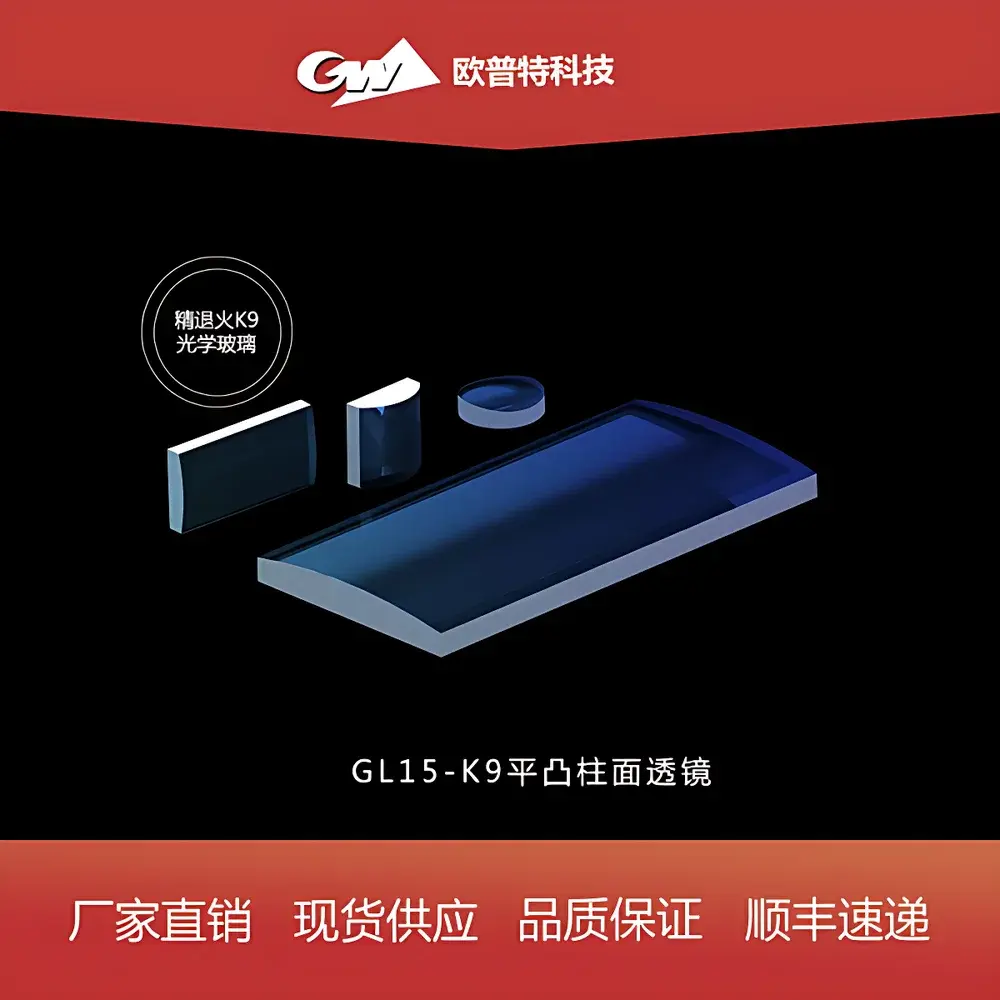
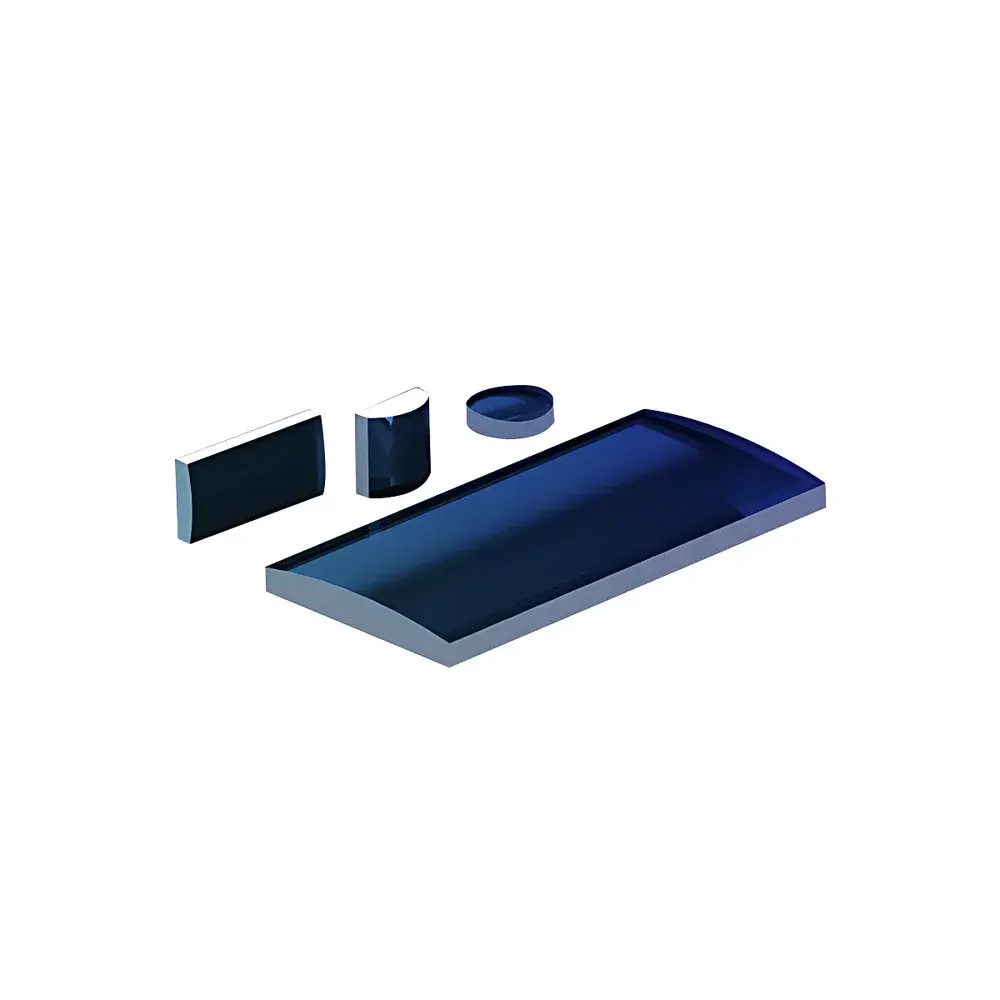
GL15-K9 Plano-Convex Cylindrical Lens with Broadband Anti-Reflection Coating for Short-Wave Near-Infrared (SWIR)
| Key | Origin: Beijing, China |
|---|---|
| Manufacturer Type | Distributor |
| Regional Category | Domestic (China) |
| Model | GL15-SWIR |
| Component Category | Optical Element |
| Coating Range | 1000–1650 nm (SWIR), 650–1050 nm (NIR) |
| Material | N-BK7 (Schott) or equivalent optical glass |
| Surface Quality | 40–20 scratch-dig |
Overview
The GL15-K9 Plano-Convex Cylindrical Lens is a precision optical component engineered for beam shaping, line generation, and astigmatic correction in short-wave near-infrared (SWIR) and visible–NIR optical systems. Unlike spherical lenses, cylindrical lenses focus light into a line rather than a point by refracting incident radiation asymmetrically along a single axis—making them essential in applications such as laser line projection, optical scanning, spectroscopic slit illumination, and anamorphic beam expansion. This series utilizes high-homogeneity optical glass (N-BK7 grade or equivalent) with stringent dimensional tolerances and certified surface quality (40–20 scratch-dig). Each lens features a broadband anti-reflection (BBAR) coating optimized for two spectral bands: 650–1050 nm (NIR) and 1000–1650 nm (SWIR), achieving average reflectance <0.5% per surface across the designated range. The plano-convex geometry ensures minimal spherical aberration when oriented with the plano surface facing the collimated input beam—a configuration recommended for optimal wavefront fidelity.
Key Features
- Optimized cylindrical geometry for one-dimensional focusing with focal lengths ranging from 10 mm to 1000 mm, supporting diverse beam conditioning requirements.
- Broadband AR coatings deposited via ion-assisted e-beam evaporation, meeting MIL-C-48497A durability standards and exhibiting high laser-induced damage threshold (LIDT > 5 J/cm² at 1064 nm, 10 ns pulse).
- Consistent center thickness (Tc) control within ±0.05 mm and radius of curvature tolerance of ±0.2%, ensuring predictable optical path difference and alignment repeatability.
- Available in multiple aperture formats—including round (Φ12.5 mm to Φ25 mm), rectangular (17×15 mm, 20×10 mm, 20×20 mm, 40×20 mm), and custom-cut variants—to accommodate integration into OEM modules, fiber-coupled systems, and free-space optical benches.
- Back focal length (BFL) and effective focal length (EFL) values are traceably calibrated using interferometric verification against NIST-traceable reference standards.
Sample Compatibility & Compliance
The GL15-K9 series is compatible with standard optomechanical mounts (e.g., SM1-threaded lens tubes, kinematic lens holders, and translation stages with Ø25 mm clamping bores). All substrates comply with ISO 10110-1 (optical element specification) and ISO 10110-7 (surface imperfection limits). Coating performance adheres to ISO 9211-3 for optical coatings and meets RoHS Directive 2011/65/EU for hazardous substance restriction. While not certified for medical device use under IEC 60601, the lenses are suitable for research-grade instrumentation operating under GLP-compliant laboratory environments. No FDA registration or CE marking is applicable, as this is a passive optical component—not an end-use device.
Software & Data Management
As a passive optical element, the GL15-K9 lens does not incorporate embedded firmware, drivers, or digital interfaces. However, full technical specifications—including measured transmission spectra, coating reflectance curves, and Zemax-compatible .ZBF/.DAT files—are provided upon request in standardized ASCII format for integration into optical design workflows (Zemax OpticStudio, CODE V, FRED, or LightTools). Customers may access downloadable mechanical drawings (STEP, IGES), coating spectral data (.CSV), and metrology reports (interferogram summaries) via secure client portal login. Audit trails for coating batch records and substrate lot traceability are maintained for 10 years per internal quality management system (QMS) aligned with ISO 9001:2015 Clause 8.5.2.
Applications
- Laser line generation for structured light 3D scanning in industrial metrology (e.g., SWIR-based inspection of silicon wafers and polymer films).
- Anamorphic beam correction in ultrafast Ti:sapphire and Yb-fiber amplifier chains operating at 1030 nm or 1550 nm.
- Slit illumination optics in Fourier-transform infrared (FTIR) spectrometers and dispersive NIR analyzers requiring uniform line intensity profiles.
- Collimation and focusing of multimode fiber outputs in telecom test equipment and quantum optics setups.
- Custom imaging relay systems where cylindrical symmetry enables compact, aberration-balanced relay paths in SWIR hyperspectral cameras.
FAQ
What is the difference between the NIR and SWIR coating variants?
The NIR coating (650–1050 nm) targets visible-to-near-IR applications such as silicon photodetector illumination and RGB laser projection. The SWIR coating (1000–1650 nm) is optimized for InGaAs and extended-InGaAs detectors used in telecommunications, moisture analysis, and defense-related active imaging.
Can these lenses be used in vacuum or high-humidity environments?
Yes—the BBAR coatings are hermetically sealed and exhibit negligible outgassing (per ASTM E595 testing). For continuous operation above 85% RH, we recommend specifying optional hydrophobic top-layer treatment.
Is custom focal length or substrate material available?
Yes. Custom EFLs outside the standard catalog (±0.5% tolerance), fused silica or CaF₂ substrates, and dual-band (VIS–SWIR) coatings are offered under NRE-supported engineering services.
Do you provide mounting adapters or kinematic cells?
Standard SM1-threaded lens mounts and adjustable cylindrical lens holders are available as optional accessories; OEM volume orders qualify for custom mechanical interface design support.
Are measurement certificates included with shipment?
Each lens batch includes a Certificate of Conformance (CoC) listing substrate lot ID, coating run number, and nominal performance parameters. Full interferometric test reports are available on request at no additional cost.






