
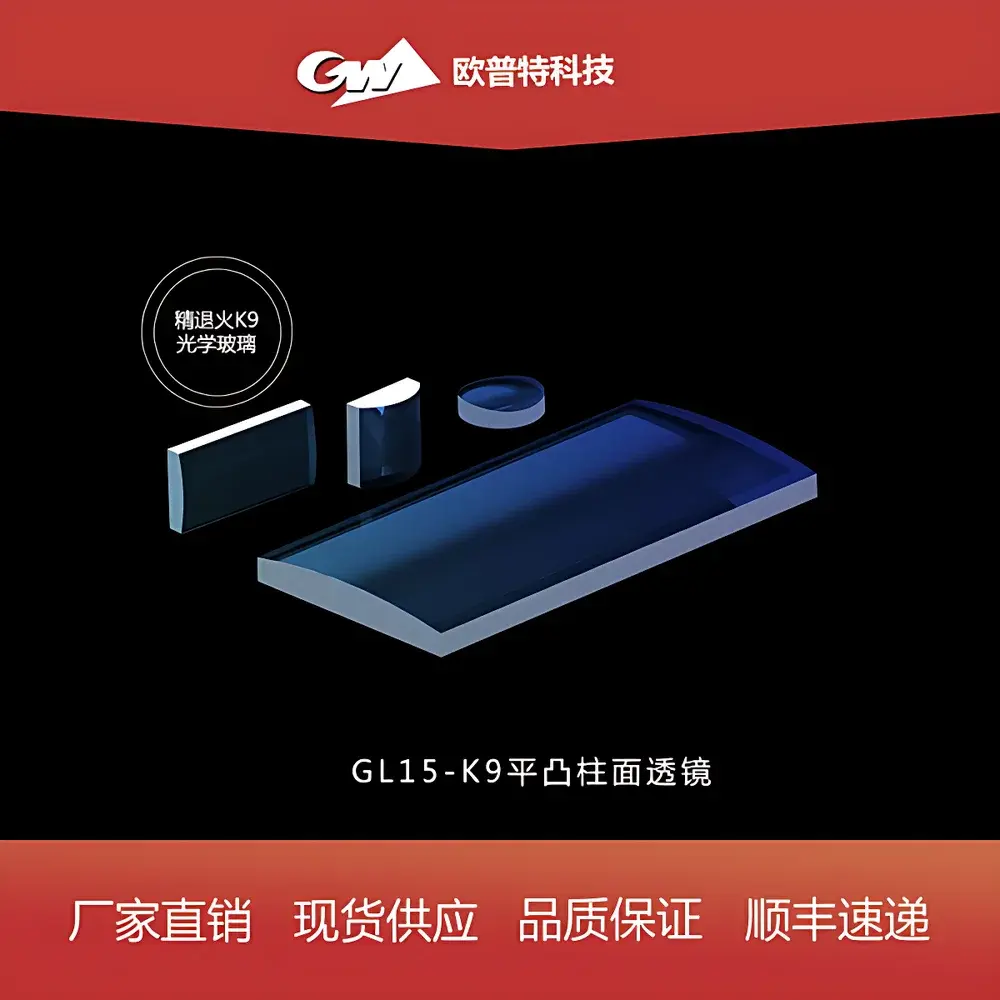
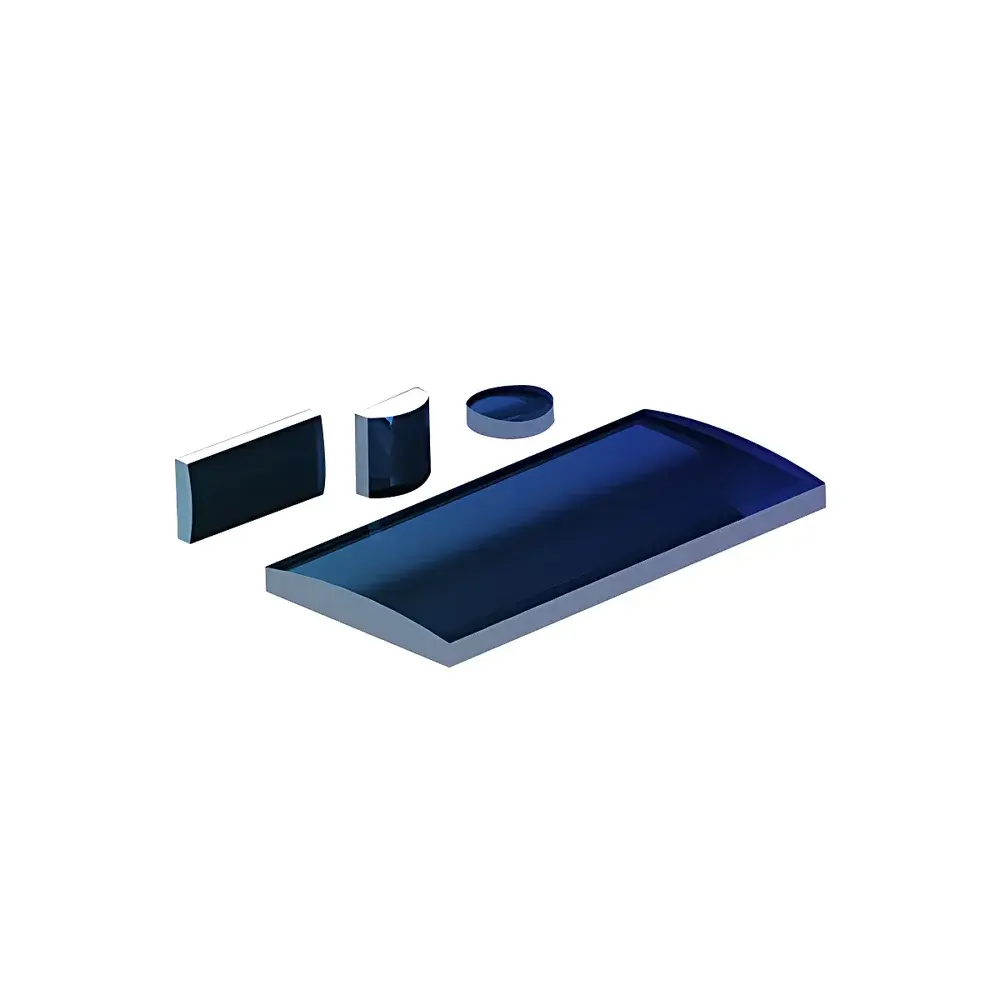
GL15-VIS Plano-Convex Cylindrical Lens with Broadband Anti-Reflection Coating (400–700 nm)
| Origin | Beijing, China |
|---|---|
| Manufacturer Type | Authorized Distributor |
| Regional Origin | Domestic (PRC) |
| Model | GL15-VIS |
| Price Range | USD 0.15 – 75.00 (per piece, volume-dependent) |
| Component Category | Optical Element |
| Dimensions | 5×5 mm to 60×30 mm (rectangular aperture), EFL: 4.0–20.0 mm |
| Coating | Broadband AR @ 400–700 nm (R < 0.5% avg per surface) |
| Material | Optical-grade BK7 glass |
| Surface Quality | 40–20 scratch-dig |
| Clear Aperture | ≥90% of nominal dimension |
Overview
The GL15-VIS Plano-Convex Cylindrical Lens is a precision optical component engineered for beam shaping, line generation, anamorphic correction, and laser line focusing in visible-spectrum applications. Unlike spherical lenses, cylindrical lenses possess curvature along only one axis—enabling asymmetric focusing to transform circular input beams into focused lines or to correct astigmatism in imaging systems. This series utilizes high-homogeneity BK7 substrate with λ/4 transmitted wavefront error and tight surface quality control (40–20 scratch-dig), ensuring minimal wavefront distortion and scatter. Each lens features a broadband anti-reflection coating optimized for the 400–700 nm spectral range—achieving average reflectance below 0.5% per surface across the entire visible band—thereby maximizing throughput in multi-wavelength setups such as white-light interferometry, RGB laser combiners, and fluorescence excitation paths.
Key Features
- Rectangular aperture options from 5.0 × 5.0 mm to 60.0 × 30.0 mm, supporting integration into compact optomechanical assemblies and custom illumination modules
- Focal lengths ranging from 4.0 mm to 20.0 mm, enabling high numerical aperture line focusing for micro-machining alignment, structured light projection, and optical trapping configurations
- Precision-ground cylindrical surface with radius tolerance ±0.5% and center thickness tolerance ±0.05 mm, ensuring repeatable optical alignment in OEM instrumentation
- Broadband AR coating deposited via ion-assisted e-beam evaporation—fully compliant with MIL-C-48497A durability standards (adhesion, humidity, abrasion)
- Back focal length (BFL) and effective focal length (EFL) values provided per configuration for accurate paraxial ray tracing in Zemax/OpticStudio models
- Traceable metrology documentation available upon request—including interferometric wavefront maps and spectral reflectance curves (200–1100 nm)
Sample Compatibility & Compliance
The GL15-VIS lens series is compatible with standard kinematic mounts (e.g., Thorlabs LM1, Newport ULM series) and OEM lens holders featuring rectangular clamping interfaces. All substrates meet RoHS Directive 2011/65/EU and REACH SVHC compliance requirements. The AR coating process adheres to ISO 9211-3:2021 (Optics and photonics — Optical coatings — Environmental durability testing). While not certified to ISO 10110-7 for surface form, each batch undergoes 100% visual inspection under 50× magnification and quantitative reflectance verification at 450 nm, 550 nm, and 650 nm using a calibrated UV-VIS spectrophotometer (PerkinElmer Lambda 950). No outgassing data is provided; however, BK7 exhibits negligible volatile loss under standard laboratory conditions (23 °C, 45% RH).
Software & Data Management
No embedded firmware or driver software is associated with this passive optical component. However, comprehensive optical design support is provided: Zemax Binary (.ZBF) and CODE V ASCII (.ASC) lens files are available for all standard configurations upon quotation request. Spectral performance datasets (reflectance vs. wavelength, incidence angle 0° and 10°) are delivered in CSV format compliant with ASTM E275-22 (Standard Practice for Describing and Measuring Performance of UV–VIS–NIR Spectrophotometers). Traceability records—including lot-specific coating deposition logs and interferometric test reports—are archived for 10 years and accessible under NDA for regulated environments (e.g., medical device manufacturing per ISO 13485).
Applications
- Laser line generation in machine vision systems (e.g., triangulation-based 3D profiling, weld seam tracking)
- Anamorphic beam expansion in ultrafast Ti:sapphire oscillator cavities
- Uniform line illumination for fluorescence microscopy widefield excitation (488 nm / 561 nm dual-line systems)
- Collimation correction in fiber-coupled LED sources used in spectrophotometric cuvette readers
- Custom Shack–Hartmann sensor arrays requiring matched cylindrical focal planes
- Educational optics labs demonstrating cylindrical aberration, astigmatic focus, and Gaussian beam transformation
FAQ
Is the AR coating suitable for high-power CW lasers?
Yes—when operated below 500 W/cm² (measured at 532 nm, 10 mm beam diameter, TEM₀₀), provided proper heat sinking is implemented. Damage threshold validation data is available upon request.
Can custom focal lengths or dimensions be manufactured?
Yes—custom geometries (including non-standard aspect ratios and EFLs between 3.0–50.0 mm) are supported under minimum order quantities of 50 pcs. Lead time: 6–8 weeks.
Do you provide mounting hardware or lens cells?
Standard SM1-threaded cylindrical lens mounts (e.g., Thorlabs LMR1) are compatible; dedicated rectangular lens cells are available as optional accessories (part numbers GL-MNT-5×5, GL-MNT-8×4).
Is there polarization-dependent performance?
No significant polarization dependence is observed within ±5° field angle; retardation introduced by the coating stack is < λ/100 across 400–700 nm.
What is the maximum operating temperature?
Continuous operation up to +70 °C is permissible; thermal lensing effects remain below 0.05 waves PV over the full aperture at steady state.




