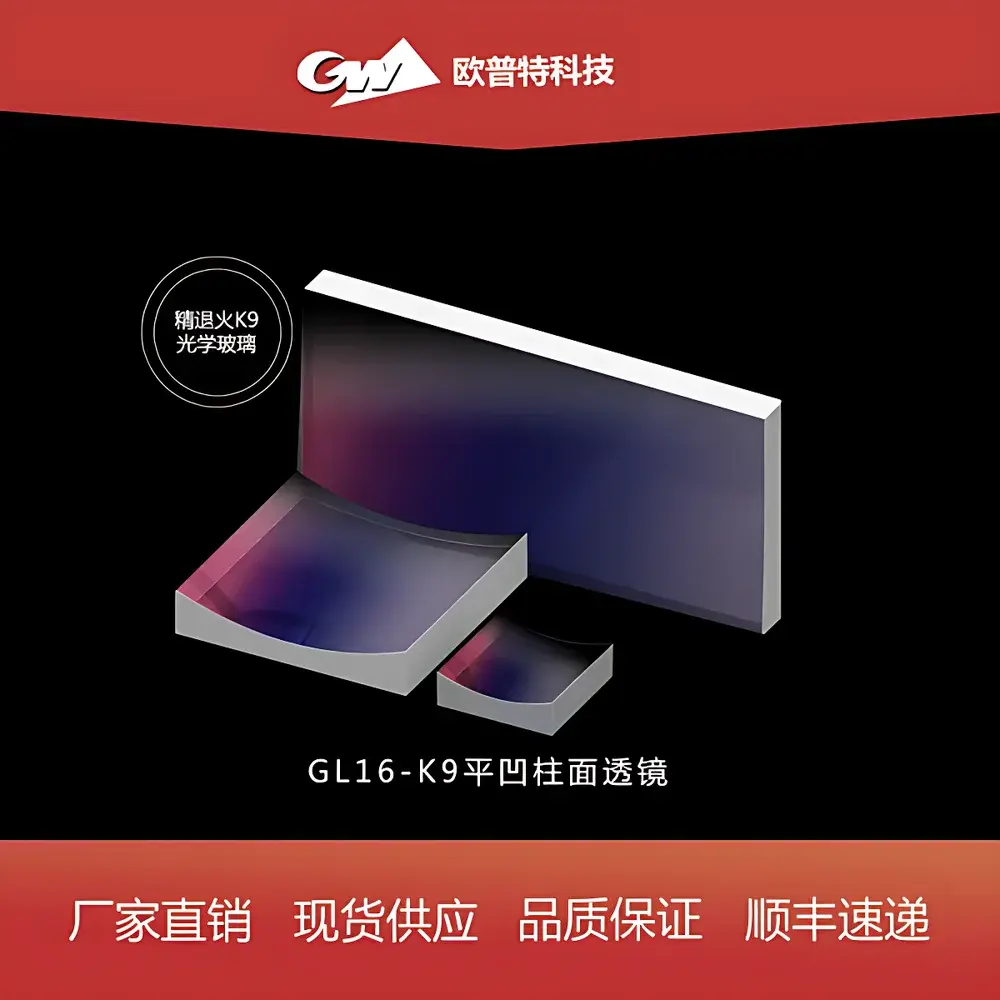
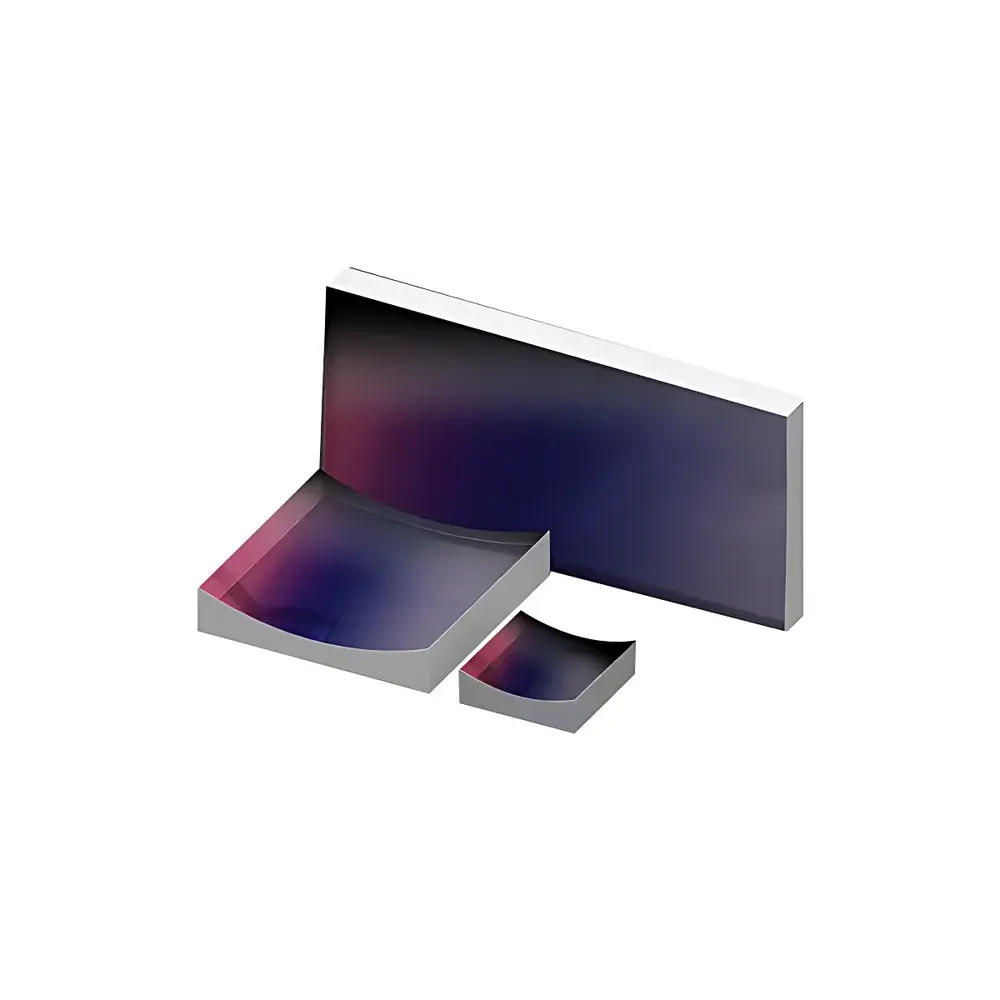
GL16-K9 Plano-Concave Cylindrical Lens with Broadband Anti-Reflection Coating for Short-Wave Near-Infrared (SWIR)
| Origin | Beijing, China |
|---|---|
| Manufacturer Type | Authorized Distributor |
| Regional Origin | Domestic (PRC) |
| Model | GL16-SWIR |
| Unit Price Range | USD 0.15 – 75.00 |
| Component Category | Optical Element |
Overview
The GL16-K9 Plano-Concave Cylindrical Lens is a precision optical component engineered for beam shaping, line generation, and astigmatic correction in short-wave near-infrared (SWIR) spectral applications ranging from 900 nm to 1700 nm. Fabricated from high-homogeneity K9 borosilicate crown glass (Schott BK7 equivalent), this lens features a plano-concave cylindrical geometry—flat on one surface and concave along a single axis—enabling focused line formation or cylindrical wavefront divergence control. Its broadband anti-reflection (BBAR) coating is specifically optimized for minimal reflectance (<0.5% average per surface) across the SWIR band, ensuring maximal transmission efficiency and reduced ghosting in multi-element optical systems. Unlike spherical lenses, cylindrical optics introduce intentional asymmetry in focal power, making them indispensable in laser line projection, optical scanning, spectroscopic slit illumination, and anamorphic beam expansion setups.
Key Features
- Precision-ground and polished K9 optical glass substrate with λ/4 surface flatness and <10-arcsec wedge tolerance
- Broadband anti-reflection coating deposited via ion-assisted e-beam evaporation, validated per ISO 9211-3 for durability (Class 2 per MIL-C-48497A)
- Controlled cylindrical curvature radii (e.g., −250 mm, −300 mm, −500 mm, −1000 mm) with tight radius tolerance of ±0.2%
- Standard clear apertures up to 40.0 × 20.0 mm; center thickness options from 1.5 mm to 3.0 mm; edge thickness ≥0.8 mm
- Surface quality rated at 40–20 scratch-dig per MIL-PRF-13830B; surface irregularity ≤λ/8 at 633 nm
- Available in multiple configurations including VIS-optimized variants (GL16-xxx-VIS) for dual-band compatibility (400–700 nm + 900–1700 nm)
Sample Compatibility & Compliance
These lenses are compatible with standard optomechanical mounts (e.g., SM1-threaded lens tubes, kinematic mirror mounts with adjustable tilt) and integrate seamlessly into OEM SWIR imaging modules, free-space fiber coupling assemblies, and laboratory-grade Fourier-transform spectrometers. All GL16-SWIR series lenses comply with RoHS 2015/863/EU and REACH SVHC regulations. Coating adhesion meets ISO 21254-1 pulsed laser damage threshold requirements (≥5 J/cm² at 1064 nm, 10 ns pulse). While not certified to ISO 10110 drawing standards by default, custom certification documentation—including interferometric test reports and spectral transmittance curves—is available upon request for GxP-aligned integration (e.g., FDA 21 CFR Part 11–compliant validation packages).
Software & Data Management
No embedded firmware or proprietary software is associated with this passive optical component. However, full technical specifications—including measured transmittance spectra (350–2000 nm), Zemax-compatible .ZBF and CODE V .DAT files, mechanical drawings (STEP/IGES), and coating performance datasets—are provided digitally upon order confirmation. These assets support optical design validation in industry-standard simulation platforms (Zemax OpticStudio, Synopsys Code V, FRED, LightTools) and facilitate traceable configuration management within PLM systems such as Siemens Teamcenter or PTC Windchill.
Applications
- SWIR laser line generation for structured light 3D metrology and machine vision inspection
- Anamorphic beam expansion in ultrafast Ti:sapphire and Yb-fiber amplifier systems
- Slit illumination in compact NIR spectrophotometers and process analytical technology (PAT) sensors
- Astigmatism compensation in quantum cascade laser (QCL) collimation assemblies
- Optical coherence tomography (OCT) reference arm beam conditioning
- Thermal imaging calibration sources requiring uniform line emission profiles
FAQ
What is the damage threshold of the SWIR BBAR coating?
The coating exhibits a laser-induced damage threshold (LIDT) of ≥5 J/cm² at 1064 nm (10 ns, 20 Hz, Ø0.37 mm), verified per ISO 21254-2. For CW operation at 1550 nm, the maximum power density is 1 MW/cm² (unfocused, continuous exposure).
Can I request custom focal lengths or non-standard dimensions?
Yes. Custom cylindrical radii (±0.1% tolerance), rectangular or elliptical clear apertures, and hybrid coatings (e.g., SWIR + MWIR dual-band AR) are available under NRE-supported engineering services.
Is environmental stability data available (e.g., humidity, temperature cycling)?
Accelerated aging tests per ISO 9211-4 confirm coating integrity after 500 hr at 85°C/85% RH and 100 thermal cycles from −40°C to +85°C. Full test reports accompany qualifying orders.
Do you provide mounting solutions or kinematic adapters?
Standard SM1-threaded lens cells and adjustable cylindrical lens holders (e.g., Thorlabs LCP1/M-compatible) are recommended and supported with mechanical interface drawings.
Are these lenses suitable for vacuum or UHV environments?
K9 glass and oxide-based BBAR coatings are low-outgassing (water vapor rate <1×10⁻⁹ Torr·L/s·cm² per ASTM E595); UHV-compatible versions with additional cleaning and bake-out verification are available on request.