
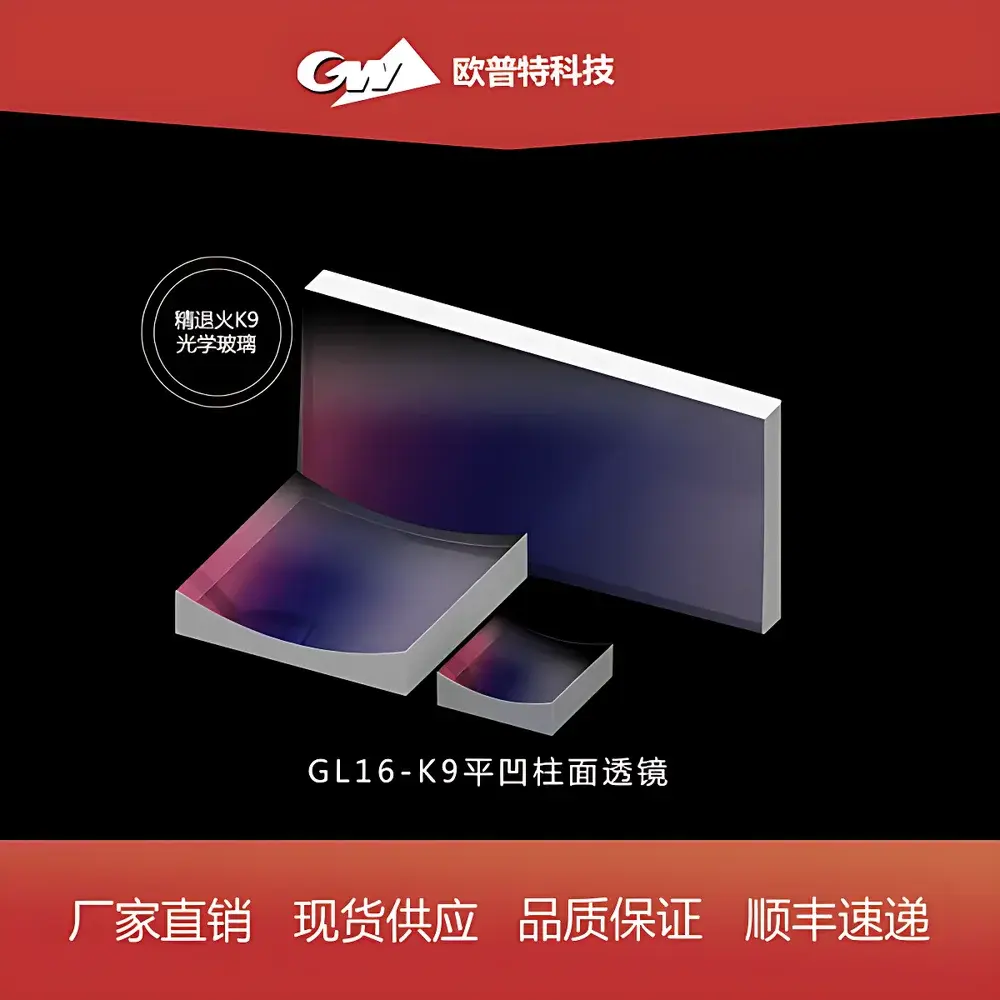
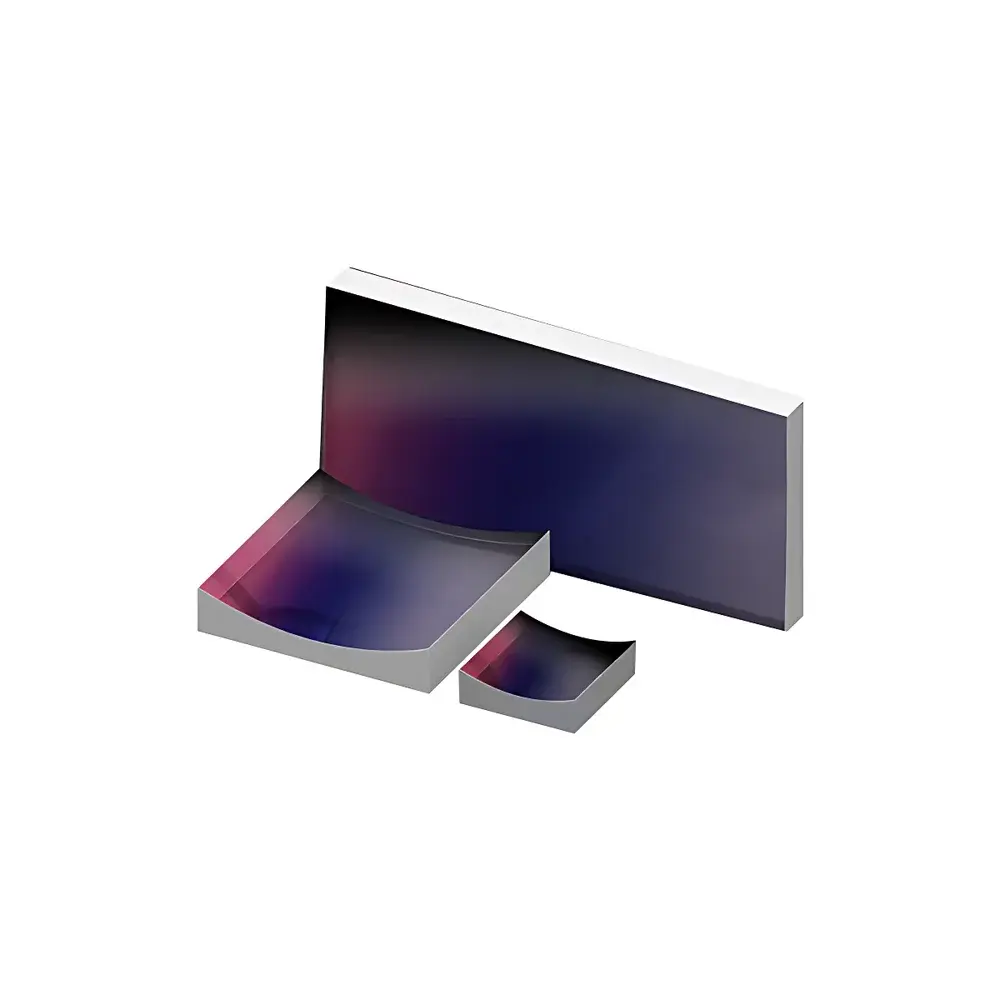
GL16-K9 Plano-Concave Cylindrical Lens with Broadband NIR Anti-Reflection Coating
| Origin | Beijing |
|---|---|
| Manufacturer Type | Distributor |
| Regional Origin | Domestic (China) |
| Model | GL16-NIR |
| Price Range | USD 0.15–75.00 |
| Component Category | Optical Element |
Overview
The GL16-K9 Plano-Concave Cylindrical Lens is a precision optical component engineered for beam shaping, line generation, and astigmatic correction in near-infrared (NIR) laser systems and imaging applications. Fabricated from high-homogeneity K9 borosilicate crown glass (Schott BK7 equivalent), this lens features a plano surface on one side and a concave cylindrical surface on the other, enabling focused light distribution along a single axis while preserving collimation in the orthogonal direction. The broadband anti-reflection (AR) coating is specifically optimized for the 700–1100 nm spectral range, achieving average reflectance <0.5% across the NIR band—critical for minimizing ghost reflections, power loss, and thermal loading in high-flux diode laser, fiber-coupled, and free-space optical setups. Its design adheres to ISO 10110-1 surface quality standards and is compatible with standard optomechanical mounts (e.g., SM1-threaded lens tubes, kinematic lens holders).
Key Features
- Optical substrate: High-purity K9 glass (refractive index nd = 1.5163 @ 587.6 nm; Abbe number νd = 64.2)
- Cylindrical geometry: Plano-concave configuration with precise radius of curvature tolerance ±0.2% and surface irregularity λ/4 @ 633 nm
- Broadband NIR AR coating: Ravg 5 J/cm² @ 1064 nm, 10 ns pulse)
- Dimensional consistency: Tight mechanical tolerances—diameter/thickness ±0.05 mm, center thickness uniformity ±0.02 mm
- Edge treatment: Fine ground and chamfered edges (0.2–0.3 mm × 45°) to prevent chipping and facilitate safe handling
- Traceable metrology: Each batch accompanied by interferometric surface map and spectral reflectance report
Sample Compatibility & Compliance
The GL16-NIR series supports integration into Class 1 and Class 4 laser safety architectures per IEC 60825-1:2014. All lenses are cleaned and inspected under ISO 14644-1 Class 5 cleanroom conditions prior to packaging. The K9 substrate complies with MIL-O-13830A scratch-dig specifications (20–10), and the AR coating meets ISO 9211-3 for durability (tape adhesion test per ASTM D3359, abrasion resistance per ISO 9211-4). No hazardous substances are used in coating deposition—fully RoHS 2011/65/EU and REACH SVHC-compliant. Documentation includes material certificates of conformance (CoC) and coating spectral data files in CSV and SDF format.
Software & Data Management
Spectral performance data (reflectance, transmittance, phase delay) are provided in standardized formats compatible with Zemax OpticStudio (.ZRD), CODE V (.DAT), and Python-based optical modeling libraries (e.g., PyOptica, scikit-rf). Optional calibration reports include MTF measurements at 850 nm and 1064 nm using a calibrated interferometer (Wyko NT1100 or Zygo Verifire). For traceability in regulated environments (e.g., medical laser OEMs), optional 21 CFR Part 11–compliant digital audit trails are available upon request—covering coating run logs, environmental chamber records (temperature/humidity during deposition), and post-coating inspection timestamps.
Applications
- NIR laser line generators for structured light 3D scanning (e.g., time-of-flight sensors, LiDAR receivers)
- Astigmatism compensation in fiber collimator assemblies (FC/PC, FC/APC interfaces)
- Beam expansion and anamorphic correction in ultrafast amplifier chains (Ti:sapphire, Yb:fiber)
- Thermal imaging optics requiring minimal wavefront distortion in SWIR/NIR bands
- Custom optical benches for spectroscopic alignment, including FTIR source conditioning and detector array illumination
- Research-grade setups in quantum optics labs where polarization preservation and low birefringence (<5 nm/cm) are essential
FAQ
Is the NIR coating suitable for pulsed lasers operating at 1064 nm with 10 ps pulse width?
Yes—the coating is qualified for nanosecond-to-picosecond regimes; LIDT testing confirms stability up to 2 GW/cm² peak intensity at 1064 nm.
Can I request custom focal lengths outside the listed catalog options?
Yes—custom radii, dimensions, and coating bands (e.g., extended NIR: 900–1700 nm) are available under NRE-supported engineering support.
Do you provide mounting solutions or kinematic adapters for these cylindrical lenses?
Standard SM1-threaded lens cells and adjustable cylindrical lens mounts (with tip/tilt fine adjustment) are offered as accessory SKUs.
What is the typical lead time for bulk orders (>50 pcs) with full metrology documentation?
Standard lead time is 12–15 working days after order confirmation and drawing approval; expedited service (7 days) is available with priority scheduling.
Are coating performance data traceable to NIST-traceable spectrophotometers?
Yes—all spectral measurements are performed on PerkinElmer Lambda 1050+ UV/VIS/NIR systems calibrated annually against NIST SRM 2036 and 2065 standards.




