
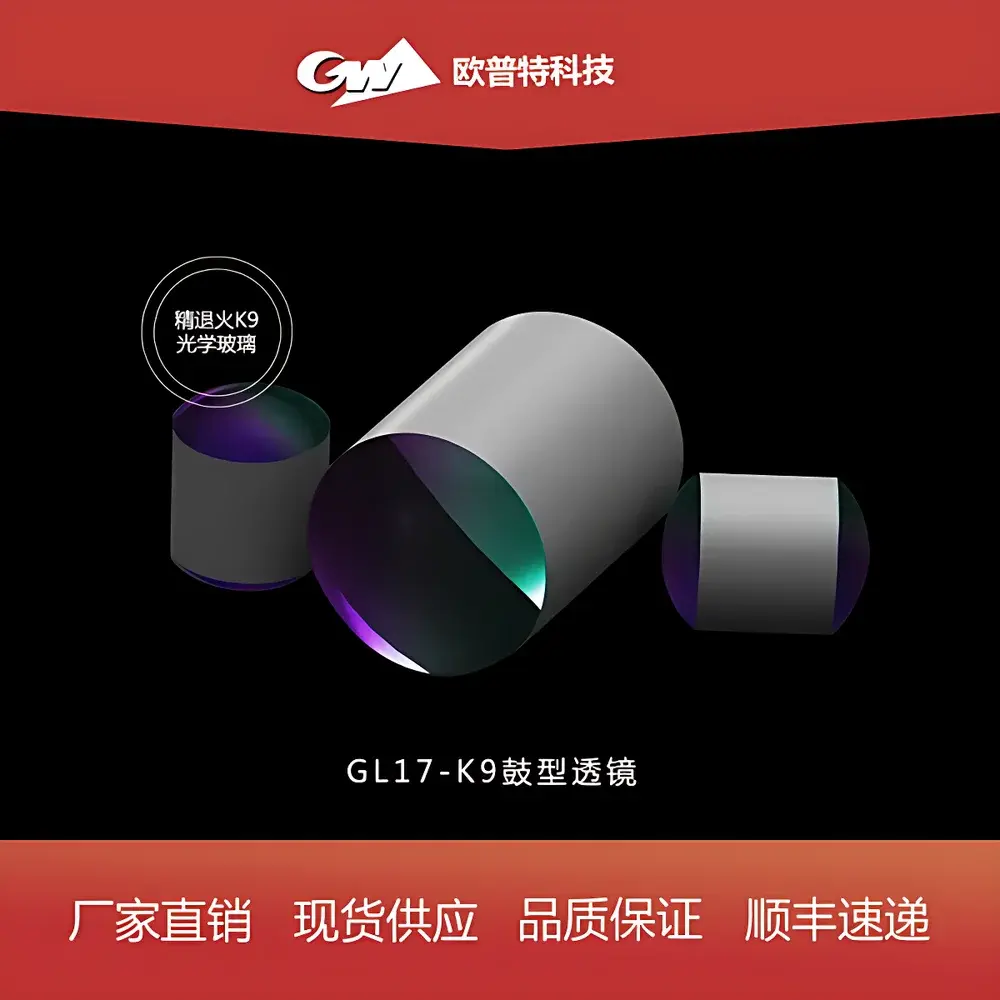
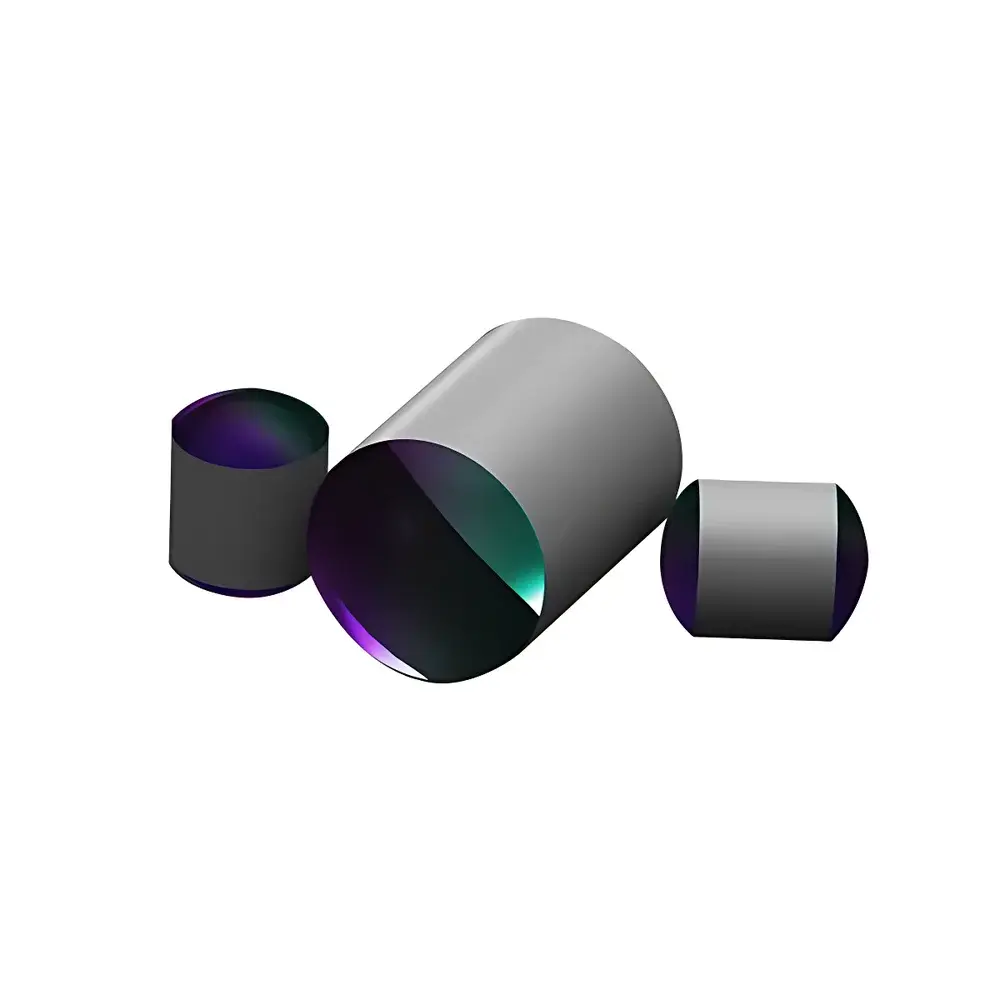
GL17-K9 Drum Lens (Uncoated / VIS / NIR / SWIR Broadband AR Coated)
| Origin | Beijing, China |
|---|---|
| Manufacturer Type | Distributor |
| Origin Category | Domestic |
| Model | GL17 |
| Price Range | USD 0.15–75.00 (per piece) |
| Component Category | Optical Element |
| Material | Precision-Annealed K9 Optical Glass |
| Design Wavelength | 587.6 nm |
| Diameter Tolerance | +0.0 / −0.05 mm |
| Center Thickness Tolerance | ±0.005 mm |
| Surface Irregularity | λ/4 @ 632.8 nm |
| Surface Quality | 2–3 Scratch-Dig |
| Coating Options | Uncoated, VIS (400–700 nm), NIR (650–1050 nm), SWIR (1000–1650 nm) Broadband Anti-Reflection |
Overview
The GL17-K9 Drum Lens is a precision-engineered cylindrical optical component fabricated from high-homogeneity, precision-annealed K9 borosilicate crown glass. Unlike conventional spherical lenses, the drum lens features two spherical surfaces along the optical axis and a precisely ground cylindrical outer surface—providing mechanical self-alignment and stable mounting in compact optomechanical assemblies. Its geometry enables axial positioning without additional alignment fixtures, making it especially suitable for space-constrained applications such as fiber-coupled photonic modules, free-space beam shaping in telecom transceivers, and miniature collimation systems. The lens operates across three defined spectral bands—visible (VIS: 400–700 nm), near-infrared (NIR: 650–1050 nm), and short-wave infrared (SWIR: 1000–1650 nm)—with optical performance characterized at the helium d-line (587.6 nm). Surface figure accuracy is maintained at λ/4 @ 632.8 nm (HeNe wavelength), ensuring minimal wavefront distortion in low-aberration imaging and coupling tasks.
Key Features
- Precision-annealed K9 optical glass substrate with certified homogeneity and low bubble/inclusion content per ISO 10110-2
- Cylindrical outer geometry enabling passive alignment and direct press-fit mounting in standard lens holders or fiber ferrules
- Tight dimensional tolerances: diameter tolerance +0.0 / −0.05 mm; center thickness tolerance ±0.005 mm
- Surface quality rated 2–3 scratch-dig per MIL-PRF-13830B, verified via interferometric inspection
- Three standardized coating options: uncoated (for UV-VIS-NIR broadband compatibility with external AR stack integration), VIS broadband AR (R<0.5% avg. 400–700 nm), NIR broadband AR (R<0.5% avg. 650–1050 nm), and SWIR broadband AR (R<0.5% avg. 1000–1650 nm)
- Designed for use with standard 3 mm diameter variants (e.g., GL17-003-003: Ø3 mm × f = 3 mm) and scalable to other focal lengths per OEM request
Sample Compatibility & Compliance
The GL17-K9 Drum Lens is compatible with standard optomechanical interfaces including SM1 (1.035″-40) lens tubes, FC/PC and SC fiber adapters, and custom PCB-mounted lens carriers. It complies with ISO 10110 optical drawing standards for surface form, finish, and labeling. All coated versions meet ISO 9211-3 specifications for adhesion, environmental durability (humidity, abrasion, thermal cycling), and spectral performance verification. Uncoated variants support in-house thin-film deposition under Class 100 cleanroom conditions. The lens is not intended for high-power laser applications (>500 mW CW at 1064 nm) without prior damage threshold validation.
Software & Data Management
While the GL17-K9 Drum Lens is a passive optical element, its metrological data—including interferometric surface maps, spectral reflectance curves (measured on PerkinElmer Lambda 950 or equivalent), and dimensional CMM reports—are archived in accordance with ISO/IEC 17025 traceability requirements. Coating batch records include deposition parameters (rate, pressure, temperature), quartz crystal monitor logs, and post-coating spectral verification. All documentation supports GLP-compliant optical subsystem qualification and FDA 21 CFR Part 11–aligned electronic record retention when integrated into regulated photonic instrumentation.
Applications
- Fiber-to-fiber and fiber-to-detector coupling in 1310/1550 nm telecom modules
- Collimation of VCSEL and edge-emitting laser diodes in LiDAR transmitter optics
- Miniature beam expanders in portable spectroscopic sensors operating across VIS–SWIR
- Alignment reference elements in multi-channel optical interconnects
- Custom hybrid lens arrays for computational imaging systems requiring mechanical registration stability
- Calibration standards for optical test benches evaluating axial focus shift vs. wavelength (chromatic focal shift)
FAQ
What is the typical surface figure specification for the GL17-K9 Drum Lens?
Surface irregularity is specified as λ/4 peak-to-valley @ 632.8 nm, measured using phase-shifting interferometry with a Zygo Verifire or equivalent system.
Can this lens be used in vacuum environments?
Yes—uncoated and VIS/NIR/SWIR AR-coated variants are compatible with UHV conditions (<10⁻⁶ Torr) provided outgassing tests confirm compliance with ECSS-Q-ST-70-02C.
Is there a tolerance specification for focal length?
Focal length tolerance is ±2% for standard catalog items, derived from radius-of-curvature control and index homogeneity (n = 1.5163 ±0.0002 at 587.6 nm).
Do you provide Zemax or CODE V optical design files?
Yes—non-proprietary sequential ray-trace files (.zmx and .cvd) are available upon NDA execution for qualified engineering partners.
Are custom diameters or focal lengths available?
Yes—custom geometries (Ø1–12 mm, f = 1–25 mm) are supported under ISO 9001 production protocols with full metrology reporting. Lead time: 4–6 weeks.




