
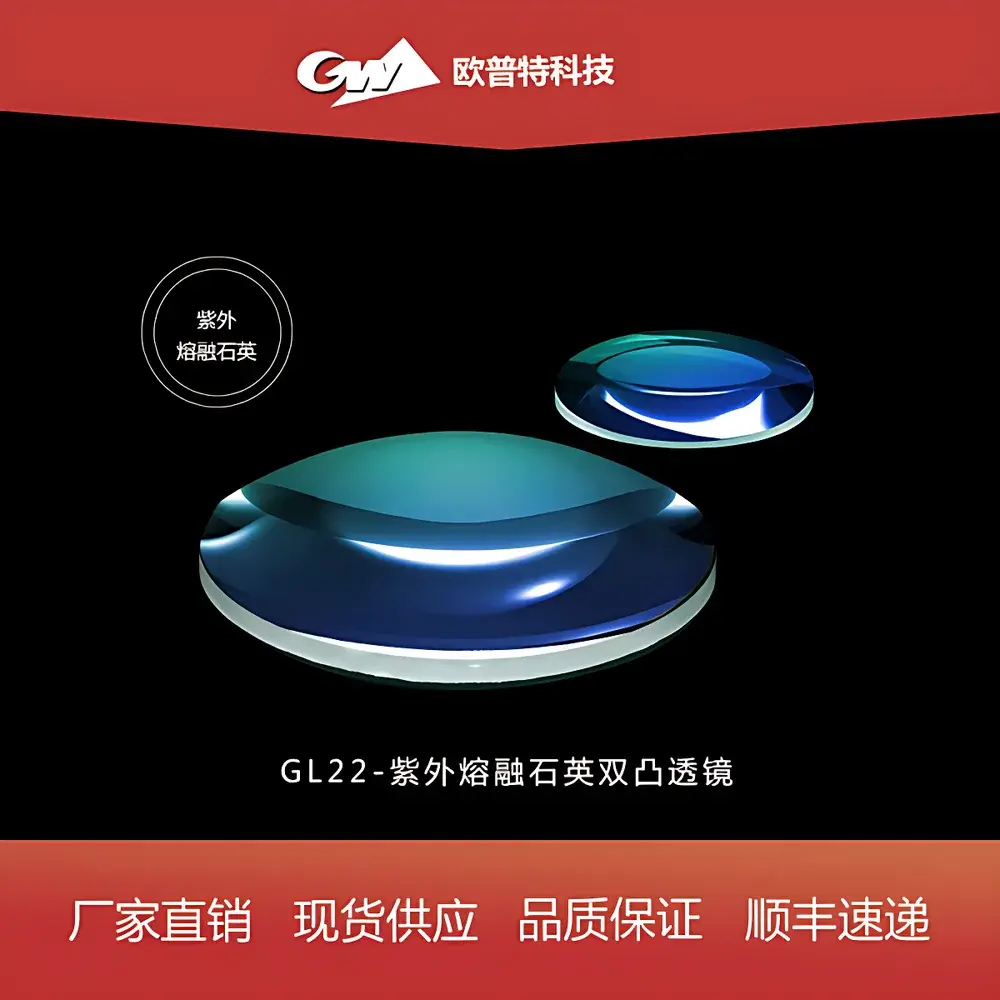
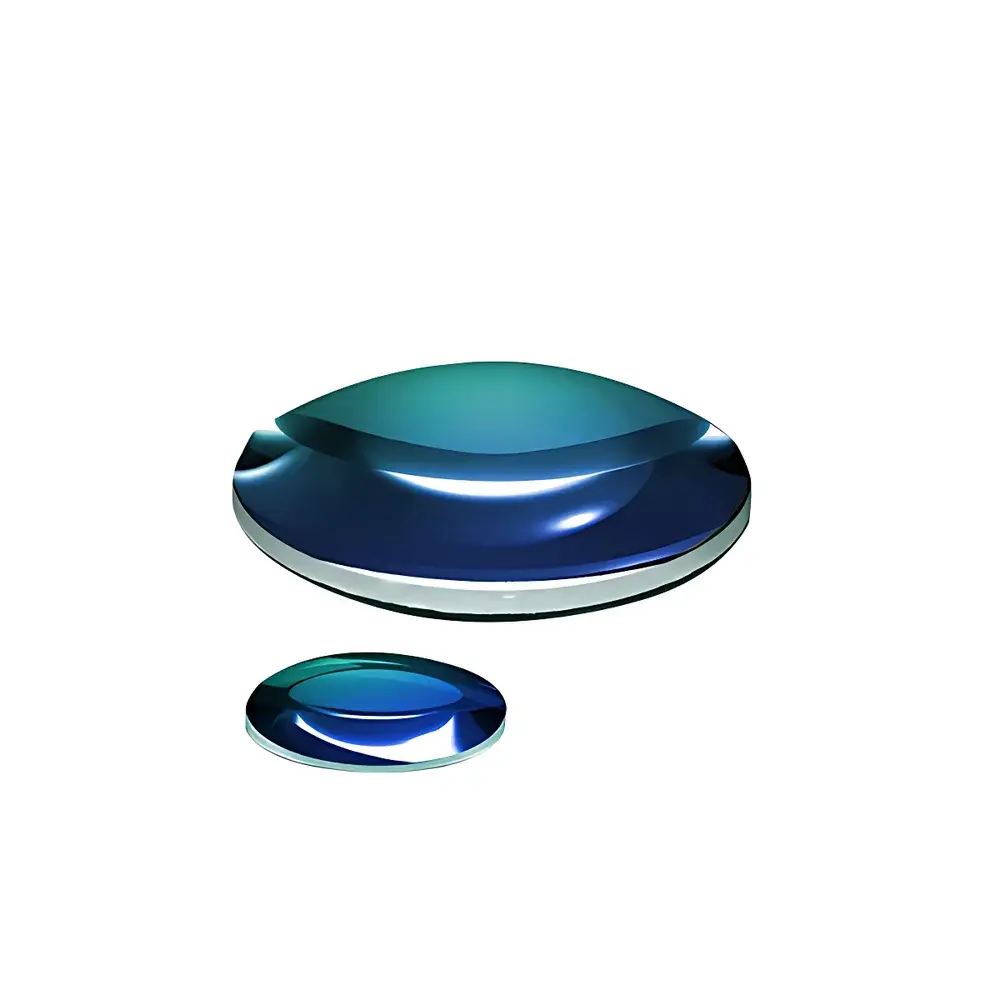
GL22 UV-Fused Silica Bi-Convex Lens (Uncoated & UV-AR Coated)
| Origin | Beijing, China |
|---|---|
| Manufacturer Type | Authorized Distributor |
| Origin Category | Domestic |
| Model | GL22 |
| Price Range | USD 0.15–75.00 (per piece) |
| Component Category | Optical Element |
| UV AR Coating | Ravg < 0.5% @ 250–400 nm |
| Substrate Material | UV-grade Fused Silica (SiO₂) |
| Surface Quality | 40–20 scratch-dig |
| Surface Flatness | λ/4 @ 633 nm |
| Clear Aperture | ≥90% of diameter |
| Centration | ≤3 arcmin |
| Focal Length Tolerance | ±1% |
| Diameter Tolerance | ±0.1 mm |
| Thickness Tolerance | ±0.2 mm |
Overview
The GL22 series comprises precision-engineered bi-convex lenses fabricated from high-purity UV-grade fused silica (SiO₂), optimized for demanding ultraviolet optical applications spanning 250–400 nm. Unlike standard optical glass, UV fused silica exhibits exceptional transmission below 250 nm, negligible fluorescence under UV excitation, and superior thermal stability (CTE ≈ 0.55 × 10⁻⁶ /°C), making it indispensable in spectroscopic instrumentation, excimer laser beam shaping, UV lithography alignment systems, and space-qualified optical assemblies. Each GL22 lens is manufactured using deterministic polishing and metrology-controlled centering to ensure wavefront fidelity and minimal spherical aberration. The bi-convex geometry provides positive focal power with balanced surface curvatures—reducing off-axis aberrations compared to plano-convex alternatives—while maintaining compatibility with standard kinematic lens mounts and collimation housings.
Key Features
- UV-grade fused silica substrate with certified transmission >85% at 254 nm and >90% at 365 nm (per ASTM E1331)
- Optional broadband UV anti-reflection coating: average reflectance Ravg < 0.5% across 250–400 nm, deposited via ion-assisted e-beam evaporation per MIL-C-48497A
- Consistent surface quality: 40–20 scratch-dig per ISO 10110-7, verified by automated dark-field inspection
- Tight dimensional tolerances: ±0.1 mm on diameter, ±0.2 mm on center thickness, enabling drop-in replacement in OEM optical trains
- Wavefront error ≤λ/4 @ 633 nm (peak-to-valley), validated via interferometric testing per ISO 10110-5
- Centration error ≤3 arcminutes—critical for multi-element UV imaging systems requiring alignment stability under thermal cycling
Sample Compatibility & Compliance
The GL22 lens family supports rigorous environmental and regulatory requirements common in analytical and industrial UV optics. All substrates comply with SEMI F72 specifications for particle-free surface cleanliness post-cleaning. UV-AR coated variants meet ISO 9211-3 for coating adhesion (tape test per ASTM D3359) and humidity resistance (95% RH, 40°C, 240 h). For life science instrumentation, the material passes USP bacterial endotoxin testing (<0.25 EU/mL) when processed under cleanroom Class 100 conditions. No RoHS-restricted substances are used in substrate synthesis or coating deposition; full material declarations (IMDS/SDS) are available upon request. Lenses are packaged in nitrogen-purged, static-dissipative containers compliant with IEC 61340-5-1.
Software & Data Management
While the GL22 is a passive optical component, its performance integration is fully supported within industry-standard optical design and verification workflows. Zemax OpticStudio and CODE V prescription files—including exact surface sagitta, refractive index dispersion (Schott N-SF6 equivalent for UV-SiO₂), and coating spectral reflectance curves—are provided in native format for each SKU. Traceable metrology reports (including interferograms, MTF measurements, and spectral transmittance scans from 190–2500 nm) are archived digitally with unique lot-level identifiers. Calibration certificates conform to ISO/IEC 17025:2017 and include uncertainty budgets traceable to NIST SRM 1921b (fused silica reference).
Applications
- Excimer laser (193 nm ArF, 248 nm KrF) beam expanders and focusing objectives
- UV-Vis spectrophotometer collimators and detector relay optics
- Fluorescence microscopy filter cube assemblies requiring high UV throughput
- UV curing system condenser optics operating under high-intensity broadband irradiation
- Spaceborne Earth observation sensors (e.g., ozone monitoring at 255 nm) requiring radiation-hardened optics
- Photolithography stepper alignment subassemblies where thermal drift must remain <50 nm over ±10°C
FAQ
What is the damage threshold for GL22 lenses under pulsed UV laser exposure?
For 20 ns pulses at 248 nm, the typical LIDT is ≥5 J/cm² (tested per ISO 21254-2); continuous-wave thresholds exceed 10 kW/cm² at 355 nm with active cooling.
Can GL22 lenses be customized with non-standard focal lengths or mounting threads?
Yes—custom radii, central thicknesses, and SM-threaded mounts (e.g., SM1, SM2) are available under NRE-supported engineering agreements.
Is the UV-AR coating durable enough for repeated cleaning with IPA and lint-free wipes?
Yes—the coating withstands >100 standardized wipe cycles per ISO 9211-4 without measurable reflectance shift or delamination.
Do you provide mounting adapters or kinematic cells compatible with GL22 diameters?
Standard Thorlabs-compatible lens tubes (SM05, SM1, SM2) and Kinetic Systems kinematic mounts are stocked and cross-referenced in the accessory catalog.
Are measurement reports available for individual lens lots prior to shipment?
Yes—full interferometric and spectral data are delivered electronically with each order; physical hard copies available upon request.





