
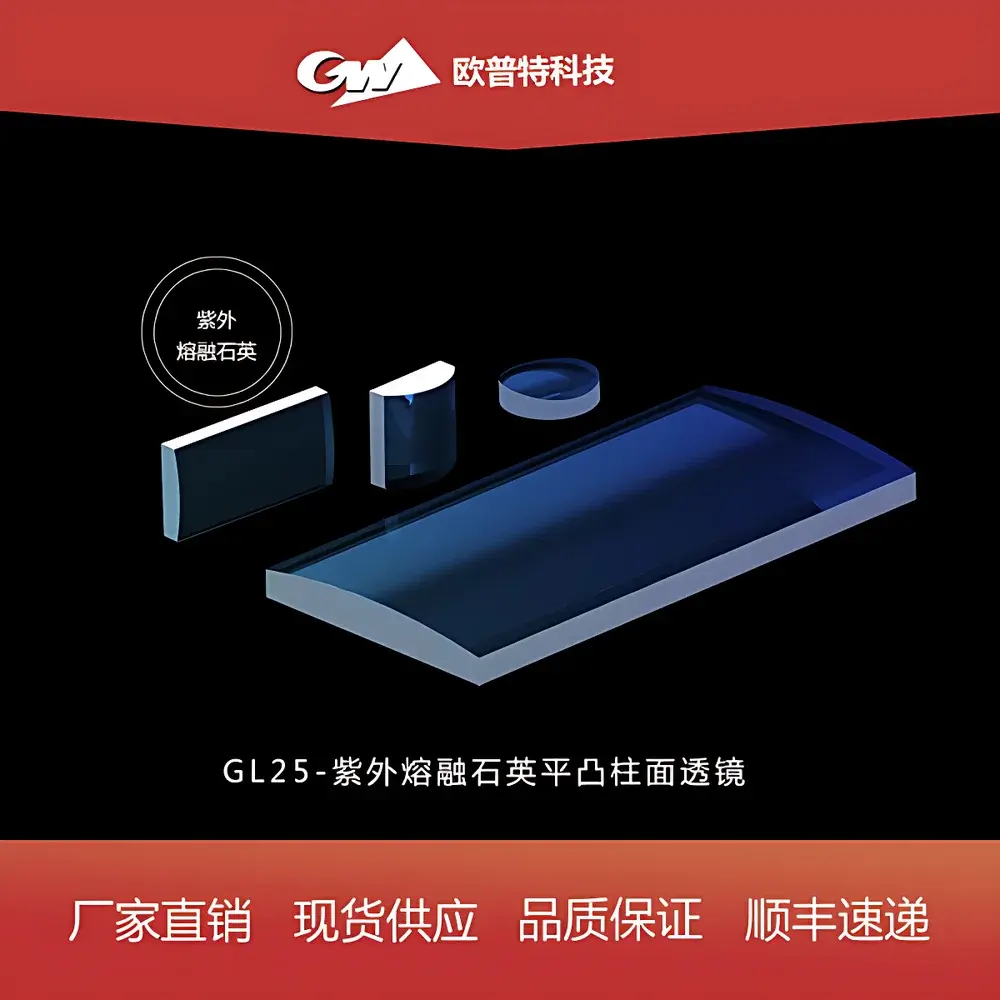
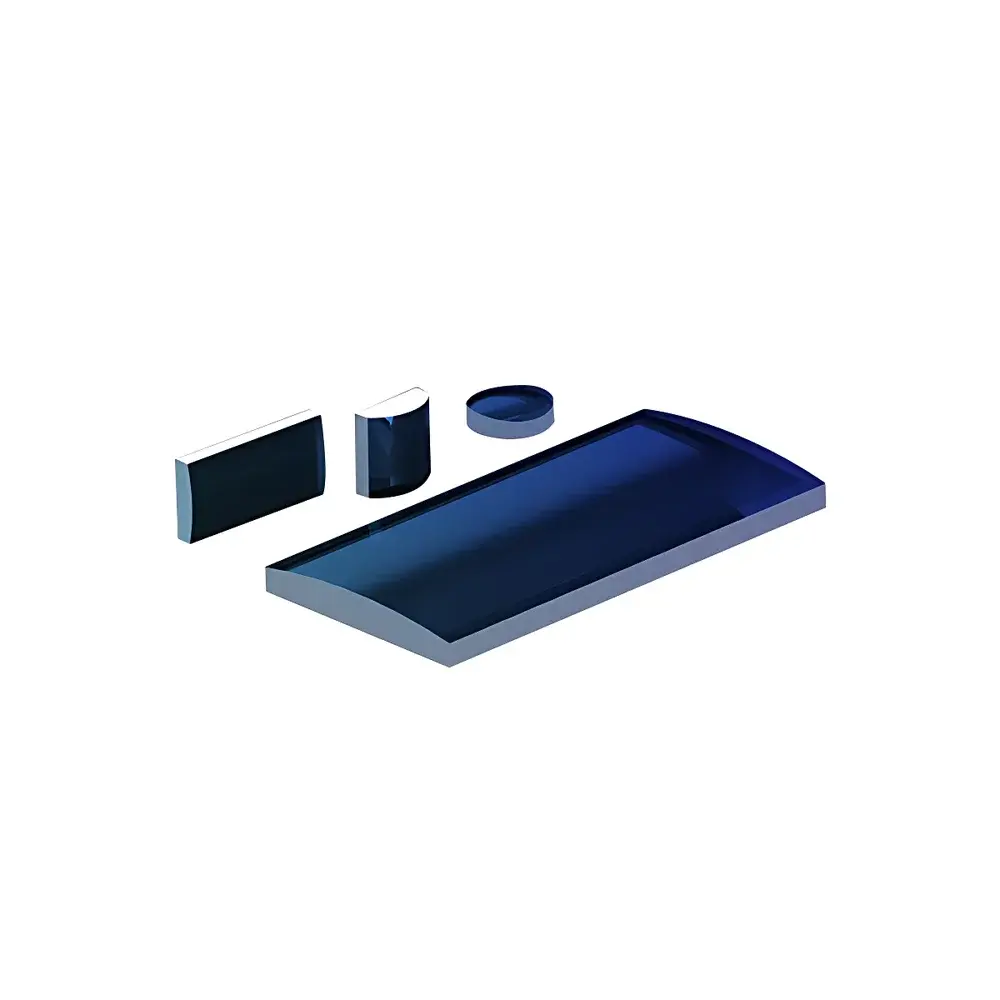
GL25 UV Fused Silica Plano-Convex Cylindrical Lens (Uncoated)
| Origin | Beijing |
|---|---|
| Manufacturer Type | Distributor |
| Regional Origin | Domestic (China) |
| Model | GL25 |
| Price Range | USD 0.15–75.00 |
| Component Category | Optical Element |
Overview
The GL25 UV Fused Silica Plano-Convex Cylindrical Lens is a precision optical component engineered for controlled one-dimensional focusing and beam shaping in ultraviolet (UV) and visible spectral regions. Constructed from high-purity synthetic fused silica (SiO₂), this lens exhibits exceptional transmission (>85% at 193 nm, >90% at 248 nm) and low thermal expansion (α ≈ 0.55 × 10⁻⁶ /°C), making it suitable for demanding applications including excimer laser systems, UV spectroscopy, photolithography alignment optics, and fluorescence microscopy illumination paths. Its plano-convex cylindrical geometry introduces optical power along a single meridional plane while maintaining collimation in the orthogonal direction—enabling line generation from collimated input or anamorphic magnification of asymmetric beams. The uncoated surface finish ensures minimal phase distortion and avoids residual stress-induced birefringence associated with thin-film coatings, preserving wavefront fidelity critical for interferometric and coherent applications.
Key Features
- Substrate material: High-hydroxyl (OH⁻) fused silica compliant with ASTM F796 and MIL-O-13830A surface quality standards
- Optical geometry: Plano-convex cylindrical profile with precise radius-of-curvature tolerance ±0.5% and surface irregularity λ/4 @ 633 nm (verified via interferometry)
- Dimensional specifications: Clear aperture ≥ 90% of nominal diameter; center thickness tolerance ±0.1 mm; edge thickness consistent with standard mounting requirements
- Surface quality: 20–10 scratch-dig per MIL-PRF-13830B; polished to RMS surface roughness < 5 Å
- Environmental stability: Resistant to solarization under prolonged UV exposure; certified for operation from –60°C to +350°C continuous duty
- Mounting compatibility: Designed for integration into standard SM1 (1.035″-40) lens tubes or kinematic mounts without custom adapters
Sample Compatibility & Compliance
This lens is compatible with standard optical breadboards, cage systems (e.g., Thorlabs 30 mm and 60 mm), and OEM laser subassemblies requiring UV-grade beam conditioning. It meets ISO 10110-7 surface form tolerances for cylindrical elements and conforms to RoHS 2015/863/EU directive for hazardous substances. While not individually certified for FDA 21 CFR Part 11 compliance (as a passive optical component), its material traceability—batch-specific certificate of conformance (CoC) including refractive index (n = 1.560 @ 257 nm), Abbe number (νd ≈ 67.8), and UV transmission data—is provided with each shipment to support GLP/GMP documentation workflows in regulated R&D environments.
Software & Data Management
As a passive optical element, the GL25 lens requires no embedded firmware or driver software. However, its performance parameters are fully integrated into industry-standard optical design platforms including Zemax OpticStudio (v23+), CODE V (v12.5+), and FRED (v17.0+). A complete Zemax-compatible .ZAR file—including measured surface sag tables, bulk absorption coefficients across 185–2100 nm, and thermal lensing coefficients—is available upon request for rigorous system-level modeling. All dimensional and metrology data adhere to ASME Y14.5 geometric dimensioning and tolerancing (GD&T) conventions, facilitating seamless import into mechanical CAD environments (SolidWorks, Creo Parametric).
Applications
- Line-generation optics in UV laser marking and micromachining systems (e.g., KrF 248 nm, ArF 193 nm sources)
- Anamorphic beam correction for diode laser arrays prior to fiber coupling or nonlinear frequency conversion
- Entrance slit conditioning in monochromators and imaging spectrometers operating below 250 nm
- Collimated light sheet formation in selective plane illumination microscopy (SPIM) and light-sheet fluorescence microscopy (LSFM)
- Reference optics in UV-based ellipsometers and reflectometers requiring polarization-maintaining beam geometry
- Alignment fiducials in vacuum-compatible EUV lithography test benches where outgassing must remain <1×10⁻⁹ Torr·L/s per cm²
FAQ
What is the damage threshold for this lens at 193 nm?
Typical LIDT (laser-induced damage threshold) for uncoated fused silica at 193 nm, 20 ns pulse width, 20 Hz repetition rate is 5–8 J/cm²; exact value depends on beam homogeneity and spot size—consult application-specific testing reports.
Can this lens be used in vacuum environments?
Yes. Fused silica exhibits negligible outgassing and maintains structural integrity under high vacuum (≤10⁻⁷ Torr); optional vacuum-bake certification available upon request.
Is there a coated version available?
Standard AR coatings for 193 nm (MgF₂-based) or broadband UV-VIS (185–700 nm) can be applied; lead time increases by 10–14 business days and requires minimum order quantity.
How is centering error specified for cylindrical lenses?
Centering tolerance is defined as wedge angle ≤ 3 arcminutes per DIN ISO 10110-7; verified using autocollimation and prism deviation measurement.
Do you provide metrology reports for individual units?
Yes—certified interferometric surface map, spectral transmission curve, and dimensional inspection report are included with every shipped unit.




