
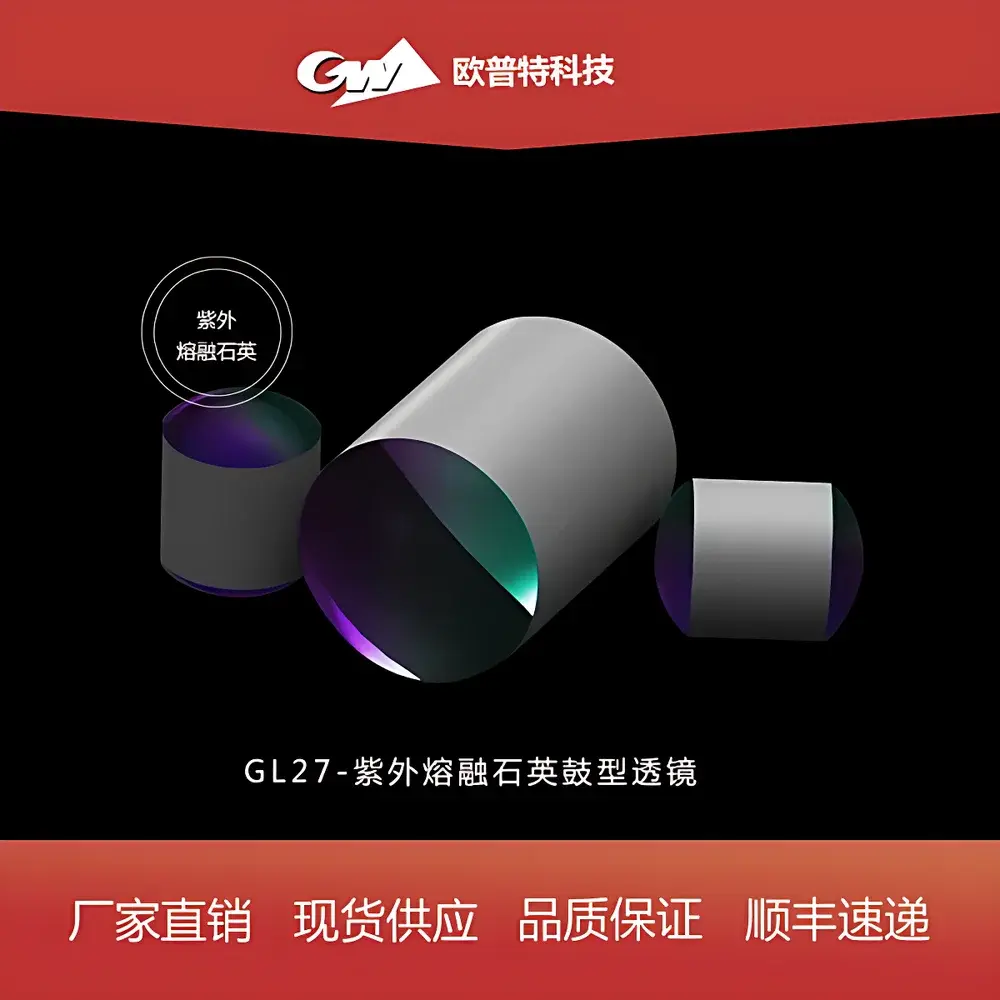
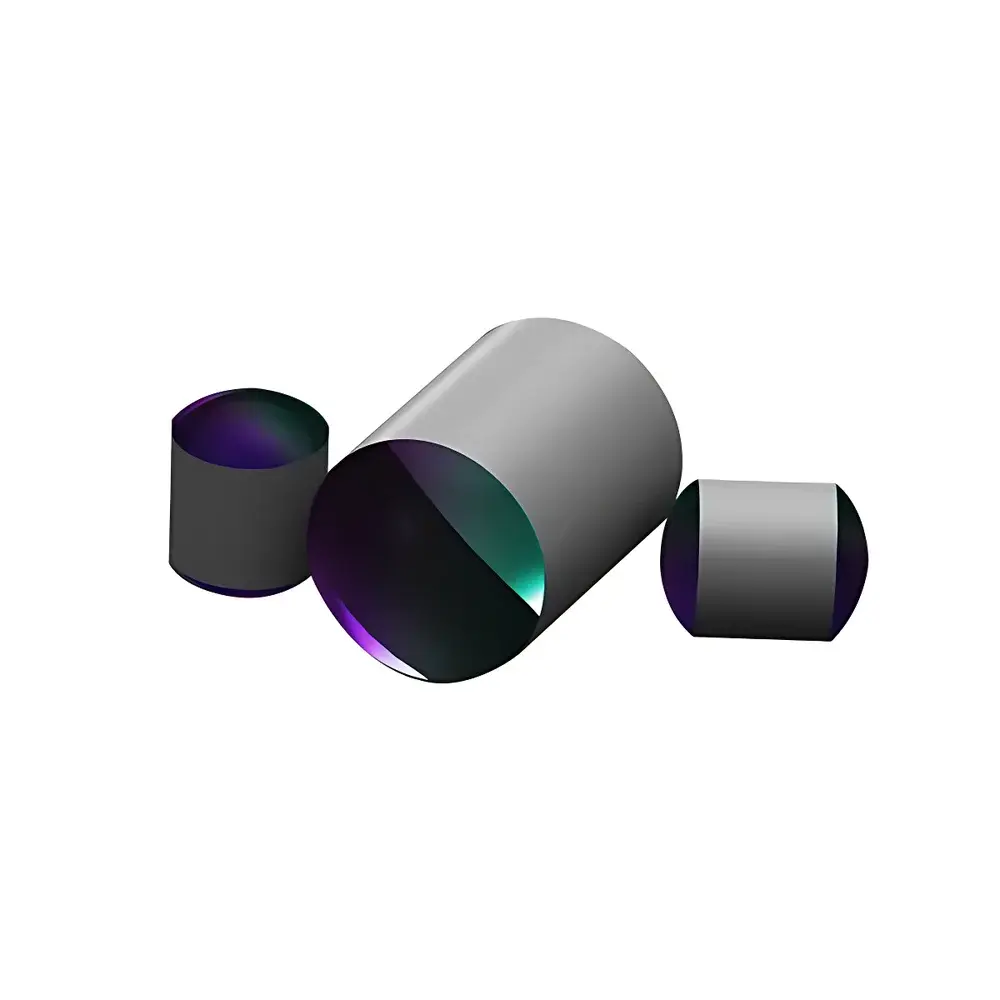
GL27 UV Fused Silica Drum Lens (Uncoated, UV-Grade)
| Origin | Beijing |
|---|---|
| Manufacturer Type | Distributor |
| Origin Category | Domestic |
| Model | GL27 |
| Price Range | USD 0.15–75.00 |
| Component Category | Optical Element |
| Material | UV-grade Fused Silica |
| Design Wavelength | 587.6 nm (n = 1.45848) |
| Diameter Tolerance | +0.0 / −0.05 mm |
| Center Thickness Tolerance | ±0.005 mm |
| Surface Irregularity | λ/4 @ 632.8 nm |
| Surface Quality | 2–3 Scratch-Dig |
| Lens Type | Drum (Cylindrical Barrel with Spherical Ends) |
| Diameter | 3 mm |
| Focal Length | 3 mm |
Overview
The GL27 UV Fused Silica Drum Lens is a precision optical component engineered for stable beam positioning and compact collimation in ultraviolet-sensitive photonic systems. Fabricated from high-purity synthetic fused silica (SiO₂), this drum lens exhibits exceptional transmission down to 185 nm, low thermal expansion (α ≈ 0.55 × 10⁻⁶ /°C), and minimal birefringence—critical attributes for UV lithography alignment, fiber-coupled spectroscopy, and miniature laser diode modules. Its drum geometry—comprising two spherical end surfaces joined by a precisely ground cylindrical barrel—enables passive mechanical alignment along the optical axis without requiring adhesive bonding or complex kinematic mounts. The lens operates on the principle of spherical refraction at both ends, with effective focal length (EFL) determined by the curvature radius, material refractive index (n = 1.45848 at 587.6 nm), and center thickness. Unlike plano-convex or ball lenses, the drum configuration provides inherent axial registration, reducing assembly tolerances in space-constrained optomechanical assemblies.
Key Features
- UV-grade fused silica substrate with <99.999% purity, certified hydroxyl content <1 ppm for minimal absorption below 220 nm
- Drum geometry: 3 mm outer diameter cylindrical barrel with spherically polished ends; enables direct press-fit into Ø3.0 mm kinematic bores or SM1-threaded lens cells
- Tight dimensional control: diameter tolerance +0.0 / −0.05 mm ensures repeatable seating force; center thickness tolerance ±0.005 mm supports consistent EFL reproducibility across batches
- Surface quality rated 2–3 scratch-dig per MIL-PRF-13830B, verified via automated dark-field inspection
- Surface irregularity ≤ λ/4 PV @ 632.8 nm (HeNe wavelength), measured interferometrically using a Zygo Verifire™ system with Zernike polynomial fitting
- No anti-reflection coating applied—intentionally supplied uncoated to permit custom thin-film deposition (e.g., MgF₂ single-layer for 193 nm excimer lasers or multilayer V-coats for broadband UV-VIS)
Sample Compatibility & Compliance
The GL27 lens is compatible with standard optomechanical interfaces including Thorlabs SM1 (1.035″-40) lens tubes, Newport 60-series cage systems, and custom-machined aluminum or stainless-steel housings. It meets ISO 10110-7:2019 requirements for surface form error reporting and conforms to RoHS Directive 2011/65/EU for hazardous substance restrictions. While not individually certified to ISO 9001, the manufacturing partner maintains full traceability per ISO 17025-accredited calibration records for all metrology equipment used in final inspection—including Mitutoyo roundness testers, Zygo interferometers, and Veeco Wyko NT1100 profilometers. No FDA, CE, or UL certification applies, as this is a component-level optical element—not an end-use device.
Software & Data Management
No embedded firmware or proprietary software is associated with the GL27 drum lens, as it is a passive optical component. However, its geometric and material specifications are fully compatible with industry-standard optical design platforms: Zemax OpticStudio (file format .ZAR), CODE V (importable as .LEN), and FRED (via ASCII lens data import). All published parameters—including refractive index dispersion (Sellmeier coefficients for UV fused silica), thermal expansion coefficient, and UV transmission curves—are traceable to NIST SRM 739 reference data and Schott Technical Glass Catalog values. For GMP-regulated environments, batch-specific certificates of conformance (CoC) and raw material mill test reports (MTRs) are available upon request and include full metrology audit trails.
Applications
- Fiber-to-chip coupling in silicon photonics test benches, where axial stability minimizes mode mismatch loss during thermal cycling
- Miniaturized UV fluorescence excitation optics in portable biosensors, leveraging deep-UV transmission for tryptophan/tyrosine detection
- Beam shaping elements in ultrafast Ti:sapphire oscillator cavities, where low nonlinearity and high laser-induced damage threshold (>10 J/cm² @ 355 nm, 10 ns) prevent pulse distortion
- Alignment fiducials in EUV mask inspection tools, where dimensional stability under vacuum and synchrotron radiation exposure is essential
- Collimating optics for micro-LED arrays in AR/VR near-eye displays, where the drum profile simplifies automated pick-and-place placement accuracy
FAQ
Is this lens suitable for 193 nm ArF excimer laser applications?
Yes—UV-grade fused silica with low OH content and λ/4 surface figure supports high-energy pulsed operation at 193 nm when used within fluence limits and with appropriate thermal management.
Can I specify custom diameters or focal lengths?
Standard GL27 variants are limited to 3 mm diameter and 3 mm EFL; custom geometries require minimum order quantities of 50 pcs and extended lead times of 10–12 weeks.
Do you provide coated versions?
No—GL27 is shipped uncoated by default; however, we supply technical drawings and surface preparation protocols compatible with third-party coating vendors specializing in UV dielectric stacks.
What is the maximum operating temperature?
Continuous use up to 800 °C is permissible in inert atmospheres; for vacuum applications above 300 °C, outgassing rates comply with ASTM E595-22 criteria (TML <1.0%, CVCM <0.1%).
How is center thickness verified during production?
Using dual-probe capacitance gauges calibrated against NIST-traceable gauge blocks, with real-time SPC charting per ASME B89.1.10M-2020.



