
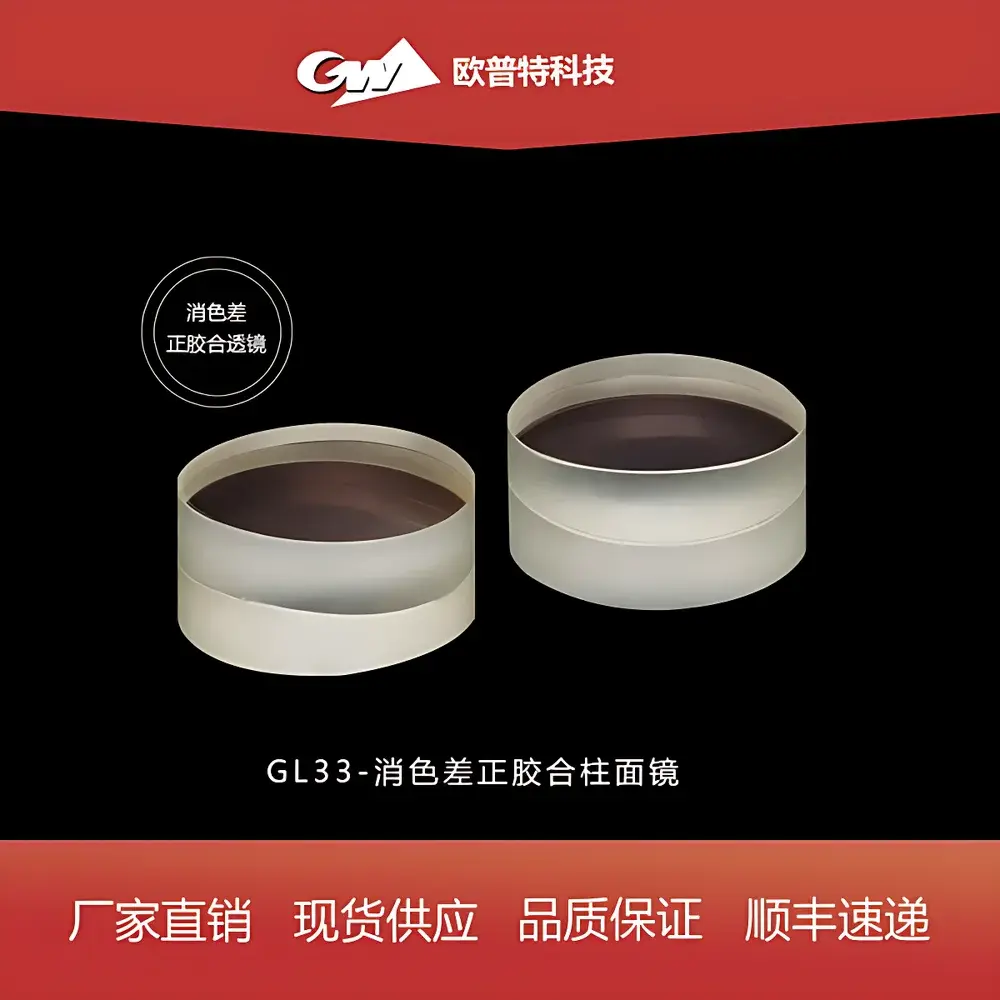
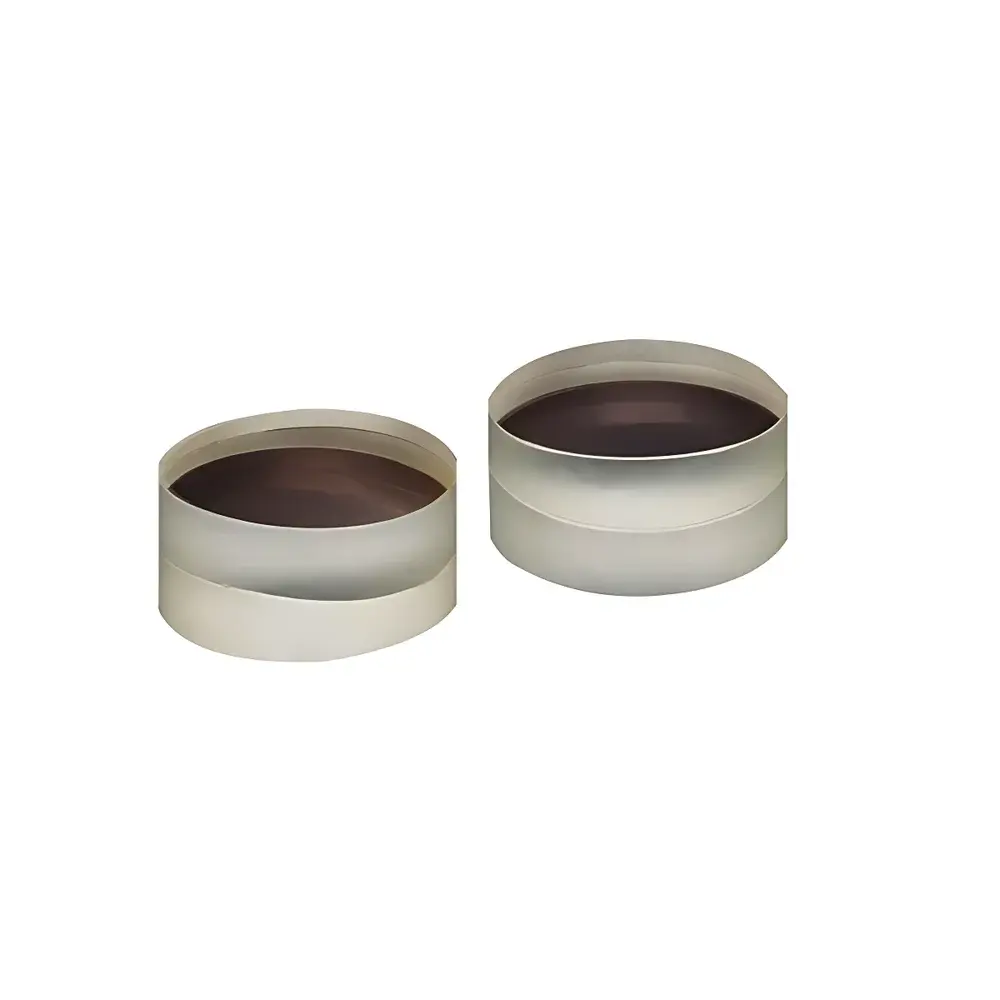
GL33 Achromatic Positive Cemented Cylindrical Lens (VIS & NIR AR-Coated)
| Origin | Beijing |
|---|---|
| Manufacturer Type | Distributor |
| Origin Category | Domestic |
| Model | GL33 |
| Price Range | USD 1–499 |
| Component Category | Optical Element |
Overview
The GL33 series comprises precision-engineered achromatic positive cemented cylindrical lenses designed for high-fidelity beam shaping and line generation in visible (VIS) and near-infrared (NIR) optical systems. Unlike singlet cylindrical lenses, the GL33 utilizes a two-element cemented design—typically combining H-K9L crown and H-ZF2 or H-ZF1/H-ZF13 flint glasses—to correct both longitudinal chromatic aberration and spherical aberration across broad spectral bands. This dual-wavelength optimization enables consistent focal line position and minimal astigmatism shift when used with broadband sources such as white-light LEDs, supercontinuum lasers, or multi-line diode arrays. The lens geometry preserves cylindrical symmetry while delivering uniform line focus profiles essential for applications including laser scanning, optical trapping alignment, spectroscopic slit illumination, and structured light projection.
Key Features
- Achromatic correction over two spectral ranges: VIS (400–700 nm) and NIR (650–1050 nm), with RMS wavefront error < λ/4 at design wavelength
- Double-sided anti-reflection coating: VIS version features Ravg < 0.5% across 400–700 nm; NIR version achieves Ravg < 0.5% across 650–1050 nm
- Standard diameters of 12.5 mm and 25.4 mm, with EFL options from 25 mm to 250 mm—each calibrated to ISO 10110-3 tolerances for focal length (±1%) and center thickness (±0.05 mm)
- Cemented interface optimized for thermal stability: coefficient of thermal expansion (CTE) mismatch < 1.5 × 10⁻⁶/°C between elements ensures minimal decentering under ambient temperature cycling (15–30 °C)
- Surface quality rated at 40-20 scratch-dig per MIL-PRF-13830B; surface flatness λ/4 per interferometric verification
- Pre-mounted variants (marked with asterisk *) include kinematic mounting in black-anodized aluminum housings compatible with standard SM1 (1.035″-40) threading
Sample Compatibility & Compliance
The GL33 series is engineered for integration into ISO/IEC 17025-accredited optical test benches and conforms to dimensional and material specifications outlined in ISO 10110-1 (optical drawing standards) and ISO 9001:2015 manufacturing controls. All H-K9L and H-ZF-series glass substrates are certified to Schott or CDGM material datasheets, with refractive index homogeneity Δn ≤ 5 × 10⁻⁶ and bubble/inclusion grade ≤ A2 per ISO 10110-7. The AR coatings meet MIL-C-48497A durability requirements—including tape adhesion (ASTM D3359), abrasion resistance (ISO 9211-4), and humidity exposure (IEC 60068-2-30). For regulated environments, lens traceability includes batch-specific interferometric certification reports and RoHS-compliant material declarations.
Software & Data Management
While the GL33 is a passive optical component, its performance integration is supported via Zemax OpticStudio™ and Code V® lens design libraries. Each product variant is supplied with a standardized .ZMX file containing exact surface prescriptions, glass dispersion models (Sellmeier coefficients), and coating stack definitions. Users may import these files directly into sequential or non-sequential mode for stray-light analysis, tolerance sensitivity studies, or system-level MTF prediction. Manufacturing data—including measured focal length deviation, transmitted wavefront error (TWE), and spectral reflectance curves—is archived in secure cloud storage accessible via unique serial-number-based portal login. Audit logs comply with FDA 21 CFR Part 11 requirements for electronic records retention where applicable.
Applications
- Laser line generation for machine vision inspection systems operating at 532 nm, 635 nm, or 785 nm wavelengths
- Collimation and focusing of fiber-coupled broadband sources in OCT (optical coherence tomography) sample arms
- Beam homogenization in UV-VIS-NIR spectrophotometer slit illuminators
- Alignment reference optics in multi-axis interferometric metrology platforms
- Custom cylindrical relay systems for anamorphic imaging in hyperspectral push-broom sensors
- Optical pumping setups requiring chromatically stable line foci across Ti:sapphire and OPO tuning ranges
FAQ
What is the difference between the VIS and NIR versions of the GL33 lens?
The VIS version uses H-K9L/H-ZF2 glass pairs and AR coating optimized for 400–700 nm; the NIR version employs H-K9L/H-ZF13 with coating tuned for 650–1050 nm—resulting in lower residual reflectance and improved transmission in their respective bands.
Are custom focal lengths or diameters available?
Yes—custom configurations (including EFLs outside standard offerings, non-standard diameters up to 50.8 mm, or alternate coating bands such as 350–450 nm UV-AR) can be quoted upon submission of optical design requirements and minimum order quantity.
Do pre-mounted GL33 lenses include alignment adjustability?
Pre-mounted units feature fixed kinematic alignment but can be integrated into translation stages (e.g., Thorlabs KM100 or Newport UVP series) using standard SM1-threaded adapters; optional tip/tilt mounts are available for fine angular registration.
How is thermal drift managed in cemented cylindrical designs?
Thermal compensation is achieved through matched CTE selection and finite-element validated cement layer thickness—validated by thermal vacuum cycling from −10 °C to +50 °C with focal shift < ±0.15% of EFL.
Can GL33 lenses be cleaned using standard optical protocols?
Yes—lenses are compatible with methanol/isopropanol solvent cleaning, lint-free polyester wipes (e.g., Texwipe TX609), and nitrogen purging; avoid ultrasonic baths due to cement interface integrity constraints.






