
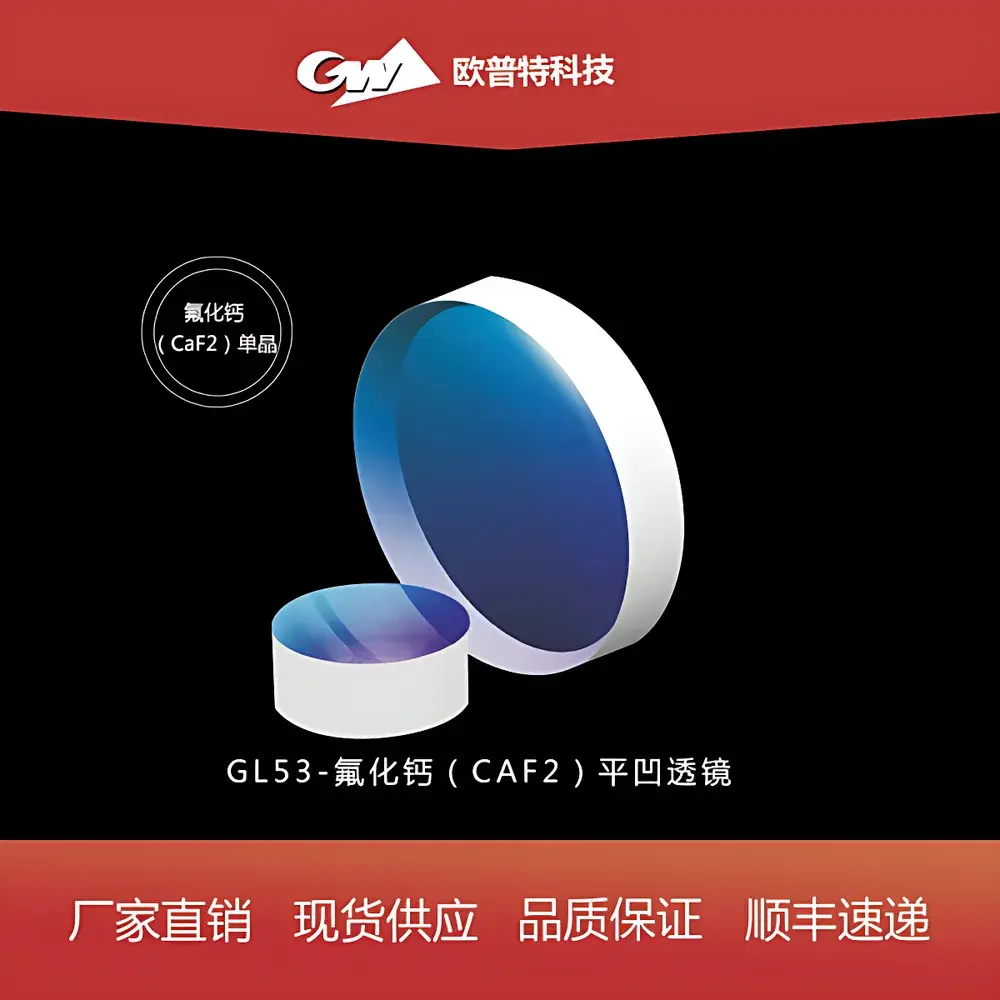
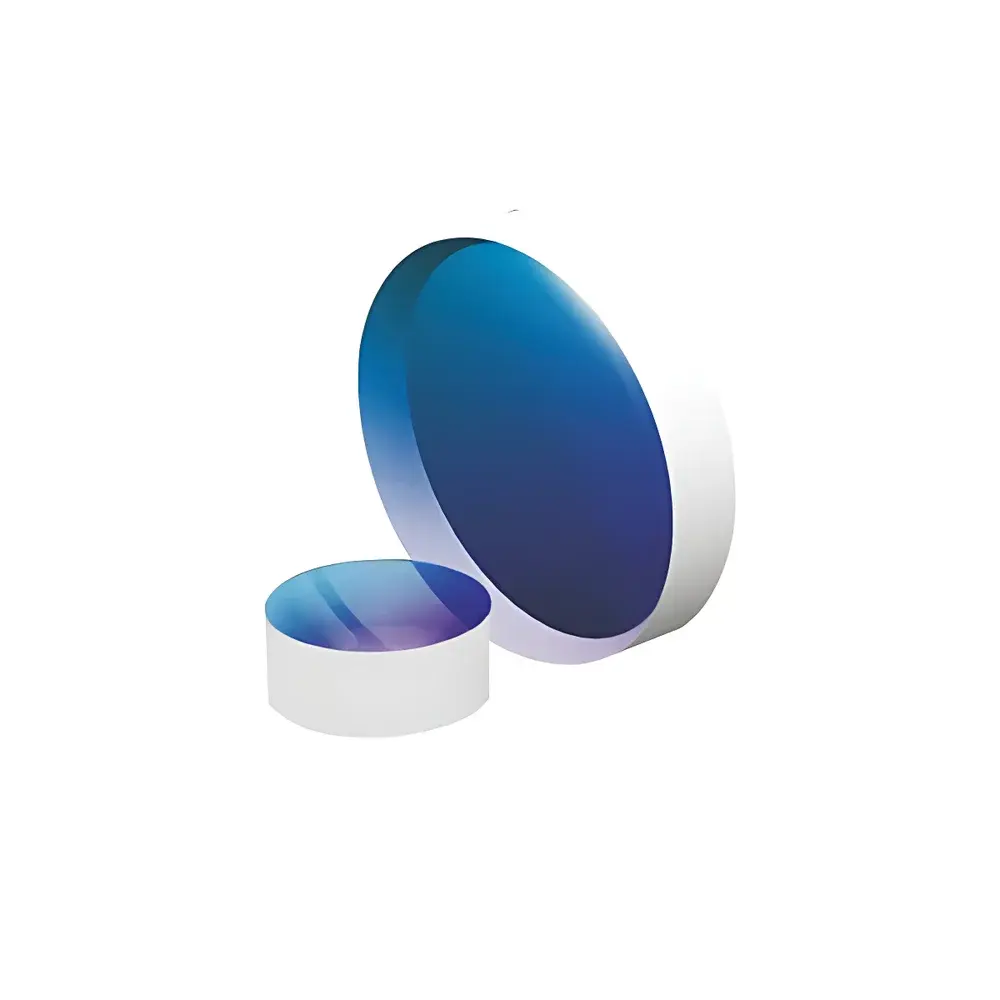
GL53 Calcium Fluoride (CaF₂) Plano-Concave Lens, Uncoated or IR Broadband Anti-Reflective Coated (3–5 µm)
| Diameter Tolerance | +0.0 / −0.1 mm |
|---|---|
| Center Thickness Tolerance | ±0.1 mm |
| EFL Tolerance | ±1% |
| Surface Quality | < 3/2 (per MIL-PRF-13830B) |
| Edge Chamfer | 0.2 mm × 45° |
| Material | Single-Crystal CaF₂ |
| Design Wavelength | 587.6 nm |
| Coating Options | Uncoated or Broadband AR (Rₐᵥg < 1.5% @ 3–5 µm) |
Overview
The GL53 Calcium Fluoride (CaF₂) Plano-Concave Lens is a precision optical component engineered for demanding infrared (IR) applications in spectroscopy, thermal imaging, laser beam manipulation, and quantum optics systems. Fabricated from high-purity, single-crystal calcium fluoride, this lens exhibits exceptional transmission across the ultraviolet (UV) to mid-infrared spectrum — particularly optimized for the 3–5 µm atmospheric window. Its plano-concave geometry introduces negative focal power, enabling controlled beam divergence, collimation correction, and expansion of optical path lengths in multi-element systems. Unlike fused silica or BK7 lenses, CaF₂ offers low refractive index dispersion, minimal thermal lensing, and negligible fluorescence under UV excitation — critical attributes for high-energy pulsed laser systems and low-background IR detection setups. The lens is manufactured to ISO 10110–1 surface form tolerances and conforms to MIL-PRF-13830B standards for surface quality and defect classification.
Key Features
- Single-crystal CaF₂ substrate with >99.9% purity, verified by X-ray diffraction and absorption spectroscopy
- Plano-concave configuration with precisely defined radius of curvature (R₁) and mechanical centering within ±5 arcsec
- Tight dimensional tolerances: diameter ±0.1 mm (unilateral), center thickness ±0.1 mm, EFL ±1% (measured at 587.6 nm)
- Surface quality rated < 3/2 scratch-dig per MIL-PRF-13830B; polished using magnetorheological finishing (MRF) for sub-nanometer RMS roughness
- Standard edge treatment: 0.2 mm × 45° chamfer to prevent chipping and support mechanical mounting integrity
- Two coating variants available: uncoated (for UV-critical or vacuum-UV applications) and broadband anti-reflective coating (Rₐᵥg < 1.5% over 3–5 µm), deposited via ion-assisted e-beam evaporation
Sample Compatibility & Compliance
The GL53 lens is compatible with standard kinematic and threaded lens mounts (e.g., SM1, RMS, or custom flange interfaces) and integrates seamlessly into OEM optical benches, FTIR spectrometers, CO₂ laser delivery systems, and MWIR camera objectives. It meets material traceability requirements per ISO 9001 and complies with RoHS Directive 2011/65/EU. All CaF₂ wafers originate from certified crystal growers with full lot documentation, including spectral transmittance curves (200 nm – 8 µm), birefringence maps (< 5 nm/cm), and thermal expansion coefficient verification (18.9 × 10⁻⁶ /K). No outgassing or hydrocarbon contamination is introduced during polishing or cleaning — validated per ASTM E595 for space-qualified optical components.
Software & Data Management
While the GL53 is a passive optical element, its metrological specifications are fully integrated into common optical design platforms including Zemax OpticStudio (v23+), CODE V, and FRED. Manufacturer-provided ZMX files include measured surface irregularity (PV < λ/8 @ 632.8 nm), coating dispersion models, and thermal optical constants (dn/dT = −8.9 × 10⁻⁶ /K). Spectral performance data (transmission, reflectance, group delay dispersion) is delivered in CSV and SDF format upon request. For regulated environments, calibration certificates (ISO/IEC 17025 accredited) and material compliance dossiers (including REACH SVHC screening) are available under NDA.
Applications
- Beam expansion and collimation in Q-switched Nd:YAG and Er:YAG laser systems operating at 2.94 µm
- Field-widening elements in uncooled microbolometer-based thermal imagers (3–5 µm band)
- Negative power correction lenses in multi-lens IR objective assemblies for hyperspectral remote sensing
- Reference optics in cryogenic Fourier-transform spectrometers (FTS) requiring low-thermal-drift substrates
- UV-VIS-IR broadband alignment tools where chromatic aberration must be minimized across wide spectral ranges
FAQ
Is this lens suitable for high-power CO₂ laser applications (10.6 µm)?
No — CaF₂ exhibits strong phonon absorption beyond 5.5 µm; for 10.6 µm operation, ZnSe or Ge plano-concave lenses are recommended.
Can the uncoated version be retrofitted with custom coatings post-purchase?
Yes, provided the lens has not been exposed to humid or contaminated environments; contact technical support for recoating feasibility assessment and cleanroom handling protocols.
What is the damage threshold for the IR-coated variant under pulsed 3.8 µm OPO irradiation?
Measured LIDT is 0.8 J/cm² at 10 ns, 10 Hz (3.8 µm); full test report available upon request with pulse duration and spot size parameters.
Does the ±1% EFL tolerance apply at all wavelengths between 3–5 µm?
No — EFL variation follows the CaF₂ Sellmeier equation; nominal tolerance is specified at 587.6 nm; chromatic focal shift is ±0.3% over 3–5 µm.
Are mounting fixtures included with the lens?
Mounting hardware is sold separately; compatible SM1-threaded lens cells and kinematic mounts are listed in the Accessories Catalog (Ref. PN35030-LM127-S).






