
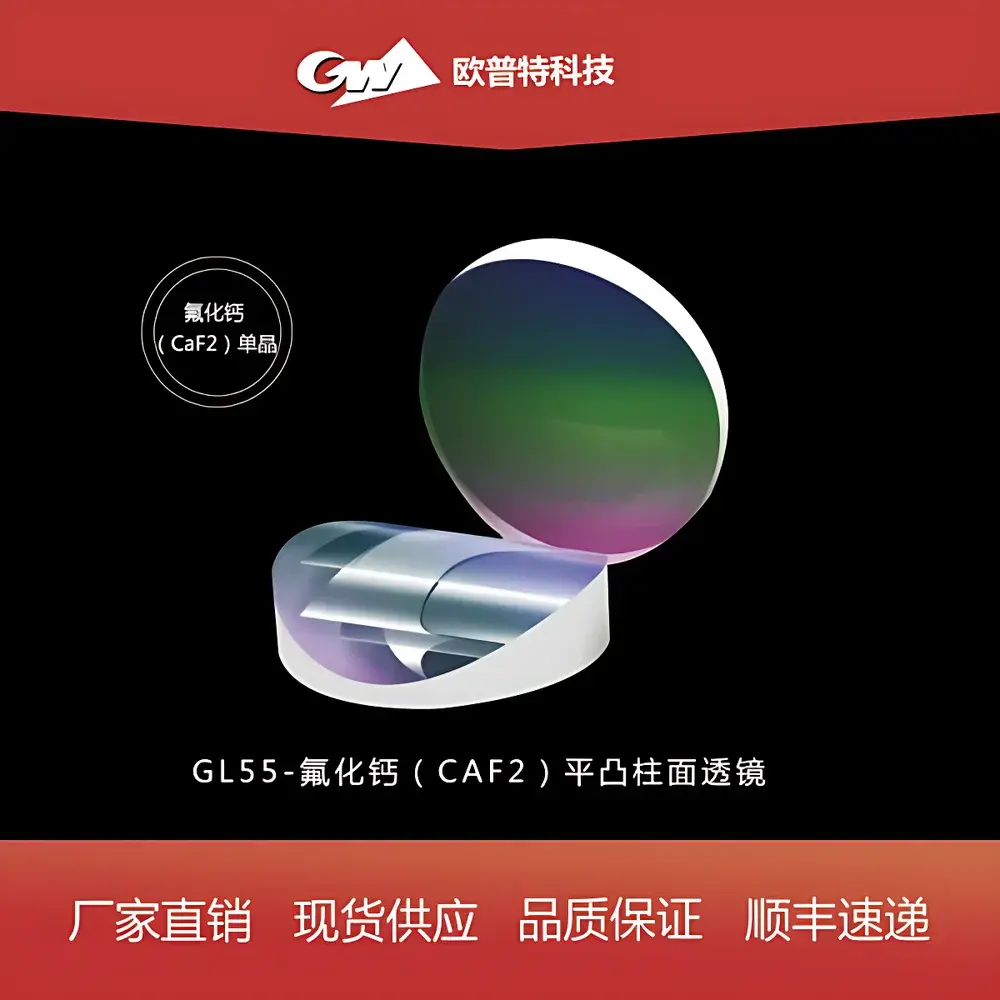
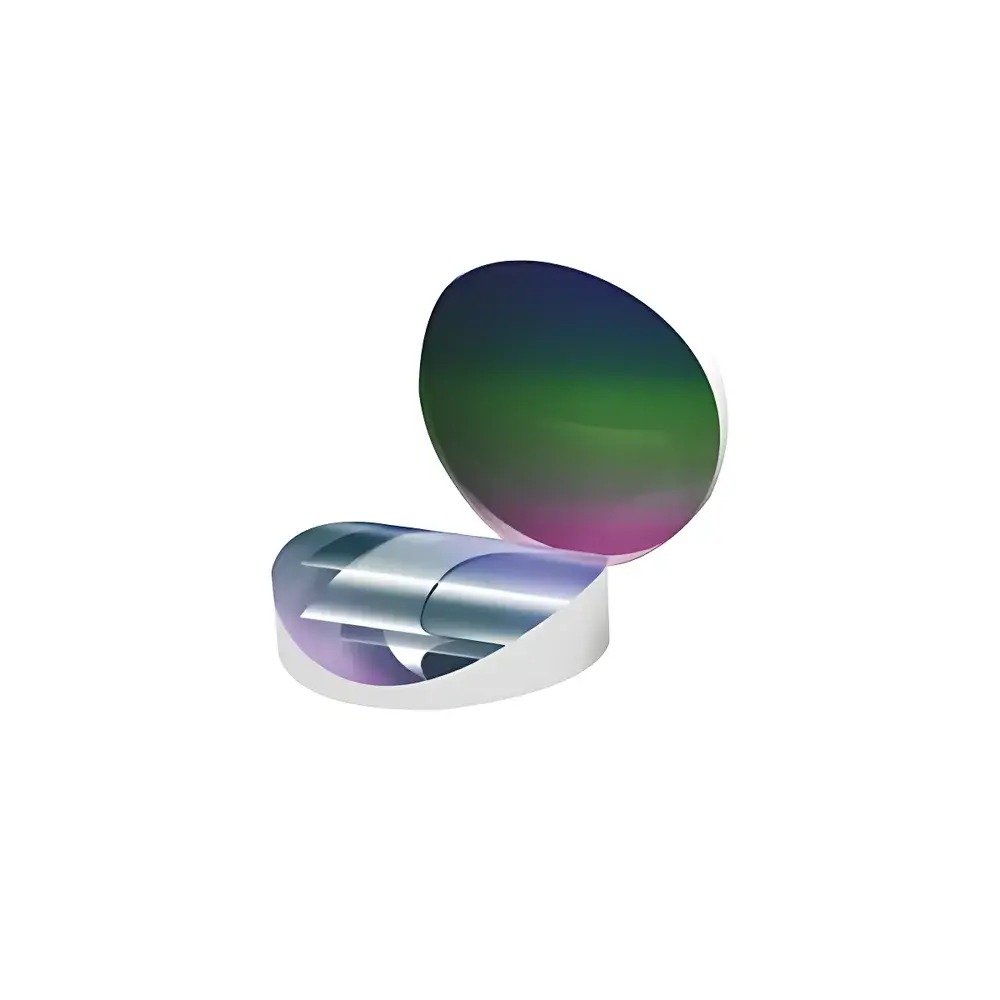
GL55 CaF₂ Plano-Convex Cylindrical Lens (Uncoated & IR Broadband AR-Coated)
| Origin | Beijing |
|---|---|
| Manufacturer Type | Distributor |
| Origin Category | Domestic |
| Model | GL55 |
| Price Range | USD 72–143 |
| Component Category | Optical Element |
| Material | Single-Crystal Calcium Fluoride (CaF₂) |
| Design Wavelength | 4 μm |
| Diameter Tolerance | +0.0 / −0.1 mm |
| Center Thickness Tolerance | ±0.1 mm |
| EFL Tolerance | ±1% |
| Surface Quality | < 3 Scratch-Dig |
| Edge Bevel | 0.2 mm × 45° |
| Coating Options | Uncoated or Broadband AR (Rₐᵥg < 1.5% @ 3–5 μm) |
Overview
The GL55 CaF₂ Plano-Convex Cylindrical Lens is a precision optical component engineered for demanding infrared (IR) applications in spectroscopy, thermal imaging, laser beam shaping, and quantum cascade laser (QCL) systems. Fabricated from high-purity single-crystal calcium fluoride (CaF₂), this lens exhibits exceptional transmission across the mid-wave infrared (MWIR) spectrum—specifically optimized for operation between 3 µm and 5 µm, with a design wavelength of 4 µm. Unlike fused silica or BK7 lenses, CaF₂ offers low absorption, minimal thermal lensing, and negligible birefringence in the IR region, making it indispensable for high-flux IR beam conditioning where thermal stability and spectral fidelity are critical. Its plano-convex cylindrical geometry introduces focusing power along a single axis only, enabling line-focused irradiance distribution—ideal for anamorphic beam correction, slit illumination in FTIR spectrometers, or asymmetric collimation of quantum cascade laser outputs.
Key Features
- Single-crystal CaF₂ substrate with verified homogeneity and low intrinsic scattering—certified per MIL-O-13830A surface quality standards (≤3 scratch-dig)
- Precision diamond-turned cylindrical surface with radius tolerance controlled to ±0.3% of nominal R₁ value
- Diameter tolerance held to +0.0 / −0.1 mm; center thickness tolerance maintained at ±0.1 mm for consistent mechanical integration
- Effective focal length (EFL) accuracy of ±1%, validated via interferometric focal plane mapping using HeNe reference beams and calibrated CCD-based position sensors
- Standard edge preparation: 0.2 mm × 45° protective bevel applied to both edges to mitigate chipping during mounting and handling
- Two coating configurations available: uncoated for maximum UV–NIR versatility or broadband anti-reflection (BBAR) coating optimized for 3–5 µm (Rₐᵥg < 1.5%), deposited via ion-assisted e-beam evaporation with in-situ monitoring
Sample Compatibility & Compliance
This lens is compatible with standard kinematic mounts (e.g., Thorlabs KCB1, Newport UMB1), lens tubes (SM1-threaded), and custom IR-compatible lens holders fabricated from Invar or low-CTE aluminum alloys. It complies with ISO 10110-7:2019 for surface imperfections and ISO 10110-3:2019 for surface form tolerances. For regulated environments—including ISO/IEC 17025-accredited calibration labs and FDA-regulated medical IR imaging platforms—the lens documentation includes full traceability to raw material lot numbers, batch-specific interferometric test reports, and coating spectral reflectance curves measured on PerkinElmer Lambda 950 UV/Vis/NIR spectrophotometers equipped with Pike Technologies Golden Gate ATR accessory for IR validation.
Software & Data Management
While the GL55 lens is a passive optical element, its performance integration is supported through Zemax OpticStudio (version 23+) and CODE V (v12.10+) optical design libraries. Pre-characterized CaF₂ dispersion data (Sellmeier coefficients valid from 0.15 µm to 9.0 µm) and measured coating reflectance datasets (in .dat and .txt formats) are provided upon request for rigorous system-level modeling. All delivery packages include a digital Certificate of Conformance (CoC) with embedded metadata compliant with ASTM E2659-21 for non-destructive test records, supporting audit readiness under GLP and GMP frameworks.
Applications
- MWIR beam expansion and line generation in gas sensing systems utilizing tunable QCLs operating at 4.5 µm
- Anamorphic correction of elliptical output beams from interband cascade lasers (ICLs)
- Slit illumination optics in Fourier-transform infrared (FTIR) spectrometers conforming to ASTM E1421-20
- Focusing elements in industrial thermal imaging systems requiring diffraction-limited line focus at 3.9 µm blackbody wavelengths
- Reference optics in NIST-traceable radiometric calibration setups for IR detector responsivity testing
FAQ
Is the CaF₂ substrate certified for vacuum ultraviolet (VUV) use?
No—this grade of CaF₂ is optimized for MWIR transmission and has not undergone VUV-grade annealing or impurity screening. For VUV applications (< 190 nm), consult our GL88 series.
Can the lens be cleaned with acetone or IPA without damaging the coating?
Yes—both uncoated and BBAR-coated variants tolerate standard optical cleaning protocols using spectroscopic-grade isopropanol and Class 100 cleanroom swabs. Avoid ultrasonic baths unless pre-validated for CaF₂.
What is the maximum permissible power density for continuous-wave (CW) 4.2 µm laser exposure?
At room temperature and with proper heat sinking, the damage threshold is ≥500 W/cm² for CW operation (tested per ISO 21254-1:2011 with 10.6 µm CO₂ reference, extrapolated using CaF₂’s known thermal conductivity and absorption coefficient at 4.2 µm).
Do you provide mounting adapters for SM2-threaded housings?
Yes—custom-machined aluminum retaining rings (SM2-to-SM1) and kinematic flexure mounts are available as optional accessories with lead time of 2 weeks.
Is there batch-to-batch variation in transmission at 4.6 µm?
No—each production lot undergoes spectral transmission verification at 10-nm intervals from 3.0 µm to 5.0 µm using a Bruker VERTEX 80v FTIR with liquid nitrogen–cooled MCT detector. Lot-specific spectra are archived and supplied with shipment.



