
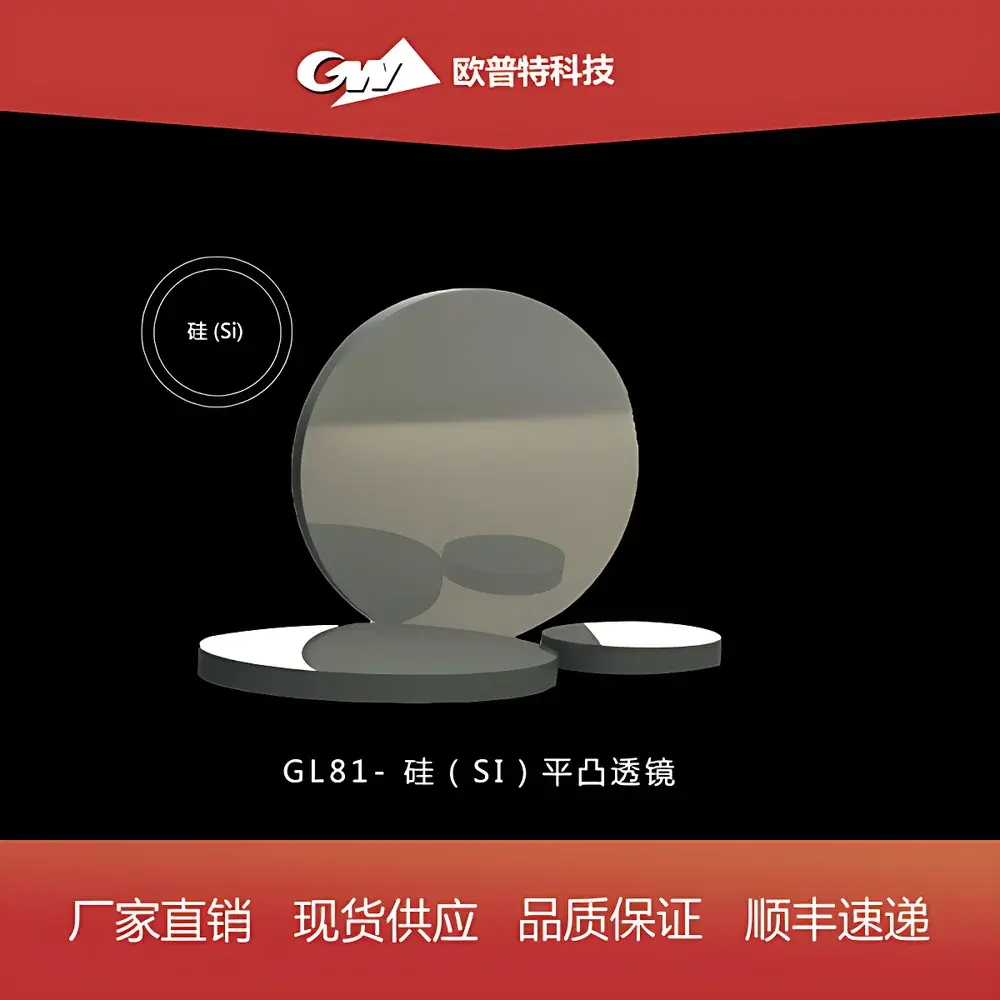
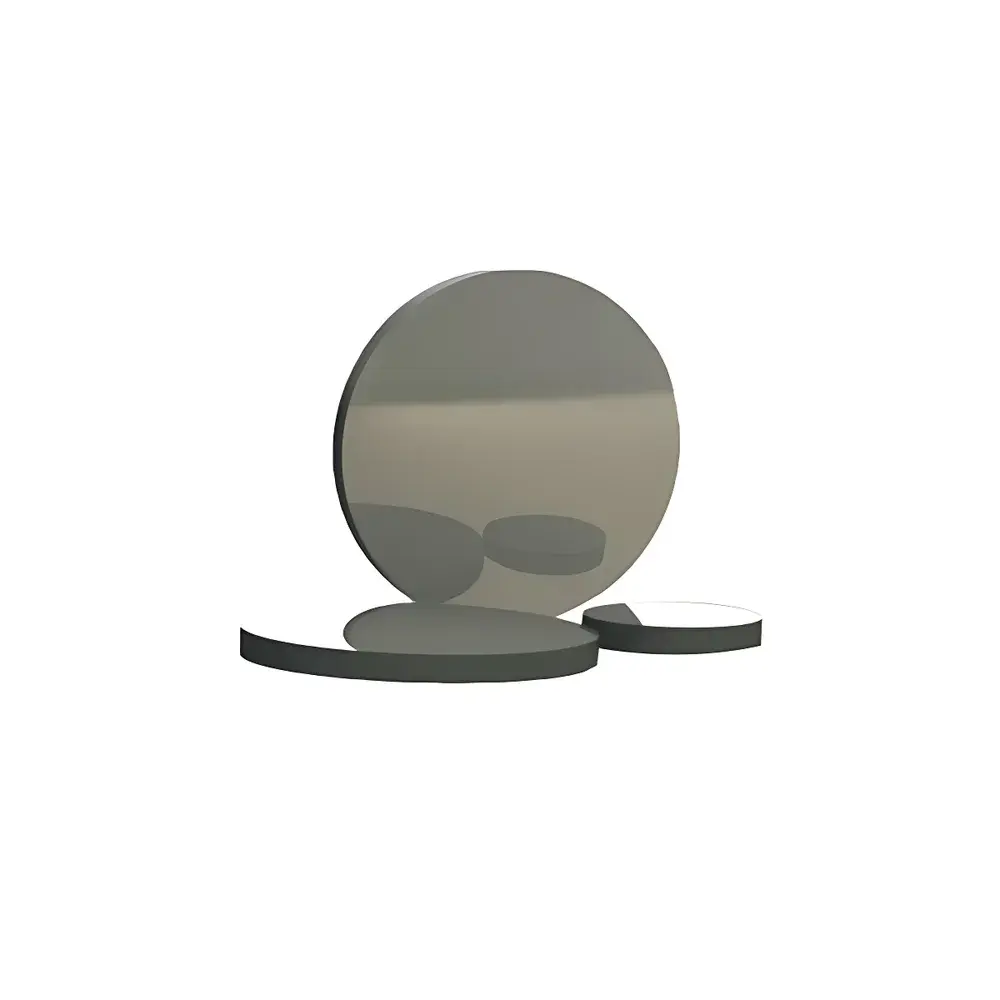
GL81 Silicon Plano-Convex Lens (Uncoated & IR Anti-Reflection Coated for 3–5 µm)
| Origin | Beijing |
|---|---|
| Manufacturer Type | Distributor |
| Regional Origin | Domestic (China) |
| Model | GL81 |
| Price Range | USD 70–140 |
| Component Category | Optical Element |
| Material | Czochralski-Grown Silicon (Si) |
| Coating Option | Broadband AR Coating for 3–5 µm (IR1) |
| Surface Quality | 40–20 Scratch-Dig |
| Surface Flatness (Plano Side) | λ/4 @ 633 nm |
| Center Thickness Tolerance | ±0.1 mm |
| Diameter Tolerance | ±0.1 mm |
| Focal Length Tolerance | ±1% |
| Clear Aperture | ≥90% of Diameter |
Overview
The GL81 series comprises precision-engineered silicon plano-convex lenses designed specifically for mid-wave infrared (MWIR) optical systems operating in the 3–5 µm spectral band. Fabricated from high-purity, single-crystal Czochralski-grown silicon (Si), these lenses leverage silicon’s exceptional transmission (>50% at 3 µm, >70% across 3.5–5 µm), low thermal expansion coefficient (~2.6 × 10⁻⁶ /°C), and high thermal conductivity (~149 W/m·K) — making them ideal for stable, high-flux IR imaging, laser beam shaping, spectroscopic collimation, and thermal sensing applications in demanding industrial and defense environments. Unlike fused silica or BK7 optics, silicon exhibits negligible absorption in the MWIR range but requires anti-reflection (AR) coating to mitigate Fresnel losses — hence the availability of both uncoated variants (for custom coating or vacuum UV compatibility) and factory-applied IR1 broadband AR coating optimized for 3–5 µm.
Key Features
- Material: Optical-grade monocrystalline silicon with resistivity ≥10 Ω·cm, polished to ≤0.5 nm RMS surface roughness on both sides
- Geometry: Plano-convex configuration with convex surface radius calculated per paraxial lensmaker’s equation; plano side flatness maintained at λ/4 @ 633 nm (verified via interferometry)
- Coating Options: Standard uncoated (R ≈ 30% per surface @ 4 µm); optional IR1 single-layer or multilayer AR coating achieving 97% peak transmission
- Mechanical Robustness: Vickers hardness ~1150 HV; suitable for integration into vibration-prone or thermally cycled optical mounts without degradation
- Dimensional Consistency: Tight tolerances maintained across all standard SKUs — diameter ±0.1 mm, center thickness ±0.1 mm, focal length ±1%, edge thickness controlled to ±0.2 mm
- Traceability: Each lens carries a unique serial number etched on the edge; full metrology data (interferometric map, spectral transmittance curve, surface inspection report) available upon request
Sample Compatibility & Compliance
The GL81 lens series is compatible with standard kinematic and flexure-based lens mounts (e.g., Thorlabs SM1-threaded, Newport 1″ cage systems). All substrates comply with ISO 10110-7:2017 for surface imperfections (40–20 scratch-dig) and ISO 10110-3:2017 for surface form error. The IR1 AR coating meets MIL-C-48497A specifications for environmental durability (adhesion, humidity, abrasion) and is qualified per ASTM F1636-21 for optical component coatings in military electro-optical systems. No hazardous substances are used in manufacturing; RoHS 3 (2015/863/EU) and REACH SVHC compliance documentation is provided with bulk orders.
Software & Data Management
While the GL81 is a passive optical component, its performance is fully modelable in industry-standard optical design software including Zemax OpticStudio (v23+), CODE V (v12.1+), and FRED (v18+). Pre-characterized material dispersion data (Sellmeier coefficients for Si from 3–5 µm) and measured coating spectral curves (CSV format) are supplied with every order. For traceability-critical applications (e.g., aerospace QA or FDA-regulated IR instrumentation), digital calibration reports include timestamped interferograms, spectrophotometer scans (PerkinElmer Lambda 950), and operator-signed QA sign-offs — all archived under 21 CFR Part 11-compliant document control protocols.
Applications
- MWIR thermal imaging systems (e.g., cooled InSb or HgCdTe detector front-end optics)
- CO and CO₂ laser beam delivery and focusing (3.8 µm and 4.2–4.4 µm lines)
- Fourier-transform infrared (FTIR) spectrometer collimators and focusing elements
- Gas sensing platforms targeting hydrocarbon absorption bands (e.g., CH₄ at 3.3 µm, CO at 4.6 µm)
- Industrial process monitoring in high-temperature environments (furnace viewport windows, combustion diagnostics)
- Research-grade quantum cascade laser (QCL) optical benches requiring low wavefront distortion
FAQ
Is the IR1 coating durable enough for cleaning with ethanol or acetone?
Yes — the IR1 coating is ion-assisted deposited (IAD) SiO₂/TiO₂ multilayer and withstands standard optical cleaning procedures using lens tissue and spectroscopic-grade solvents. Avoid ultrasonic baths or aggressive abrasives.
Can I specify custom focal lengths outside the standard catalog?
Yes — custom radii and thicknesses can be manufactured under NDA; lead time extends to 6–8 weeks with minimum order quantity of 5 units.
What is the damage threshold for pulsed QCL operation?
For 100 ns pulses at 4.5 µm, the certified LIDT is 0.8 J/cm² (tested per ISO 21254-2:2018); continuous-wave power handling exceeds 5 kW/cm² with active cooling.
Do you provide mounting adapters or kinematic cells for these lenses?
Standard SM1-threaded lens tubes and retaining rings are available separately; custom machined mounts (e.g., aluminum or invar) can be quoted per mechanical drawing.
Is there batch-to-batch consistency in transmission spectra?
Yes — all Si wafers are sourced from the same CZ furnace lot; spectral transmittance variation across batches is limited to ±0.3% RMS in the 3–5 µm band (verified by in-house FTIR).




