
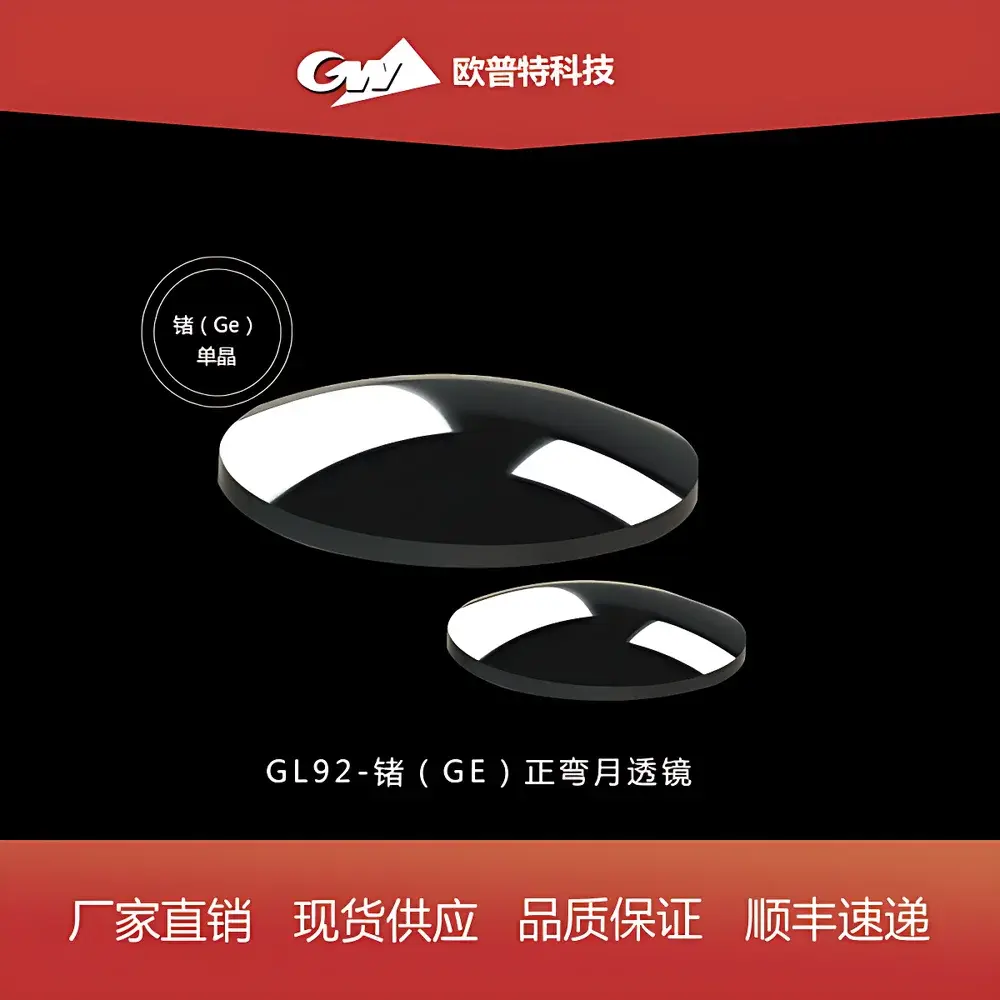
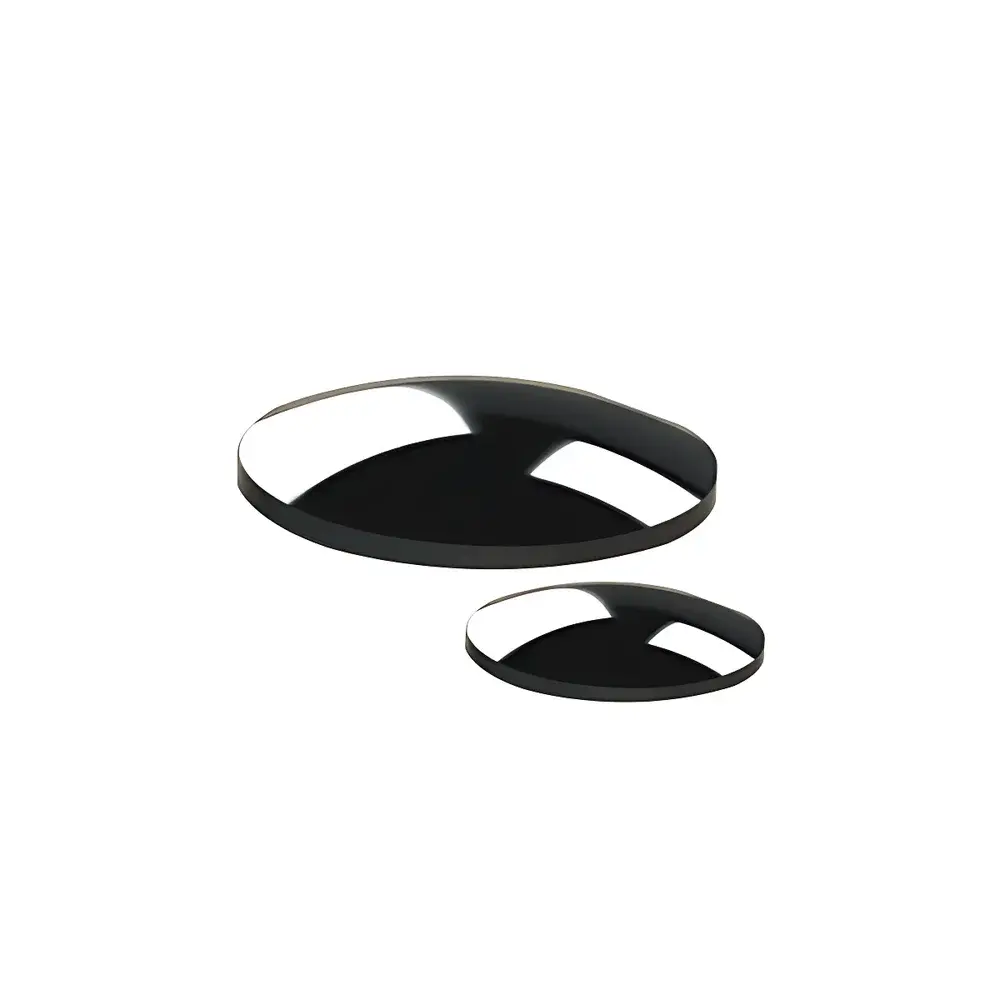
GL92 Germanium Meniscus Lens (Uncoated Base, IR Anti-Reflection Coated @ 8–12 µm)
| Origin | Beijing |
|---|---|
| Manufacturer Type | Distributor |
| Origin Category | Domestic (China) |
| Model | GL92 |
| Price Range | USD 70–140 |
| Component Category | Optical Element |
| Diameter | 25.0 mm / 50.0 mm |
| EFL | 25–100 mm |
| BFL | 23.3–96.5 mm |
| R₁ | 28.3–107.0 mm |
| R₂ | 42.5–160.5 mm |
| Center Thickness T₁ | 2.5–5.0 mm |
| Edge Thickness T₂ | 1.3–3.8 mm |
| Coating | Dual-Side IR AR (IR2), Rₐᵥg < 1.5% @ 8–12 µm |
Overview
The GL92 Germanium Meniscus Lens is a precision optical component engineered for high-transmission performance in the long-wave infrared (LWIR) spectral region—specifically optimized for operation between 8 and 12 micrometers. Constructed from single-crystal germanium (Ge), this meniscus-form lens leverages the material’s exceptionally high refractive index (~4.0 at 10 µm) and near-zero absorption in the atmospheric transmission window to enable efficient beam shaping, focusing, and collimation in thermal imaging systems, FTIR spectrometers, CO₂ laser delivery optics, and uncooled microbolometer-based sensors. Unlike plano-convex or biconvex geometries, the meniscus design minimizes spherical aberration while maintaining compact optical path lengths—particularly advantageous in space-constrained LWIR modules where back focal length (BFL) control and chief ray angle management are critical. The lens substrate is left uncoated in its base state; however, all standard variants feature dual-side IR2 anti-reflection coating, specified to average reflectance <1.5% across the full 8–12 µm band, thereby maximizing system throughput and minimizing ghost reflections and thermal self-emission artifacts.
Key Features
- High-purity Czochralski-grown germanium substrate with certified homogeneity and low dislocation density (<100 cm⁻²)
- Meniscus geometry optimized for reduced wavefront error and improved off-axis performance in convergent LWIR beams
- Dual-side IR2 anti-reflection coating: Ravg < 1.5% @ 8–12 µm, deposited via ion-assisted e-beam evaporation for environmental durability and thermal stability
- Precision diamond-turned surfaces with surface figure accuracy λ/4 @ 10.6 µm (peak-to-valley) and scratch-dig specification of 60-40 per MIL-PRF-13830B
- Available in two standard diameters (25.0 mm and 50.0 mm) with seven discrete EFL options spanning 25 mm to 100 mm
- Controlled center and edge thickness tolerances (±0.05 mm) to ensure repeatable mounting and stress-free integration into kinematic lens mounts
Sample Compatibility & Compliance
The GL92 series is fully compatible with industry-standard lens mount interfaces, including PN35022-LM250-S (for 25 mm variants) and PN35004-LM500-S (for 50 mm variants), both compliant with ISO 10110-7 mounting interface specifications. All lenses meet RoHS Directive 2011/65/EU for hazardous substance restrictions and are manufactured under ISO 9001:2015 quality management protocols. While germanium is intrinsically opaque to visible light and unsuitable for UV/VIS/NIR applications, its thermal expansion coefficient (6.1 × 10⁻⁶ K⁻¹) and mechanical hardness (Mohs 6.5) support stable performance in ambient and moderately elevated temperature environments (operating range: –40 °C to +70 °C). No regulatory certification (e.g., FDA, CE marking) applies, as the component is supplied as a passive optical element—not an end-use device.
Software & Data Management
As a passive optical component, the GL92 lens does not incorporate embedded firmware, connectivity, or data logging capabilities. However, comprehensive optical prescription data—including surface radii (R₁, R₂), center thickness (T₁), edge thickness (T₂), BFL, and coating spectral curves—is provided in Zemax-compatible .ZAR and Code V .SEQ formats upon request. Spectral reflectance and transmittance datasets (CSV and ASCII) are traceable to NIST-calibrated FTIR measurements performed in accordance with ASTM E1421–20. All product documentation complies with ISO 10110-1 for optical drawing standards and includes GD&T callouts for mounting interface features.
Applications
- Objective and relay lens elements in uncooled LWIR camera cores (e.g., VOx and a-Si microbolometer arrays)
- Focusing optics in industrial thermal inspection systems operating at 10.6 µm (CO₂ laser wavelength)
- Collimating and beam-expanding elements in portable FTIR spectrometers with DTGS or MCT detectors
- Secondary optics in multi-spectral surveillance platforms integrating MWIR/LWIR dual-band detection
- Reference-grade components in metrology setups for LWIR wavefront sensor calibration
FAQ
Is the germanium substrate polished or diamond-turned?
All GL92 lenses feature diamond-turned surfaces followed by magnetorheological finishing (MRF) to achieve the required surface figure and roughness specifications.
Can the IR2 coating withstand high-power CO₂ laser irradiation?
The IR2 coating is rated for continuous-wave irradiance up to 500 W/cm² at 10.6 µm; pulsed operation requires derating based on pulse duration and repetition rate—consult technical datasheet for LIDT test reports.
What is the maximum operating temperature before thermal lensing becomes significant?
Germanium exhibits measurable thermo-optic drift above +60 °C; for applications requiring sub-mrad pointing stability, active temperature stabilization or athermalized mechanical mounts are recommended.
Are custom diameters or focal lengths available?
Yes—custom prescriptions, including non-standard EFLs, aspheric corrections, or hybrid coating stacks (e.g., broadband IR + hydrophobic top layer), are supported under NRE-based engineering agreements.
Do you provide mounting hardware or alignment fixtures?
Standard lens cells (PN35022-LM250-S and PN35004-LM500-S) are available separately; custom kinematic mounts with tip/tilt adjustment and thermal compensation can be quoted upon request.




