
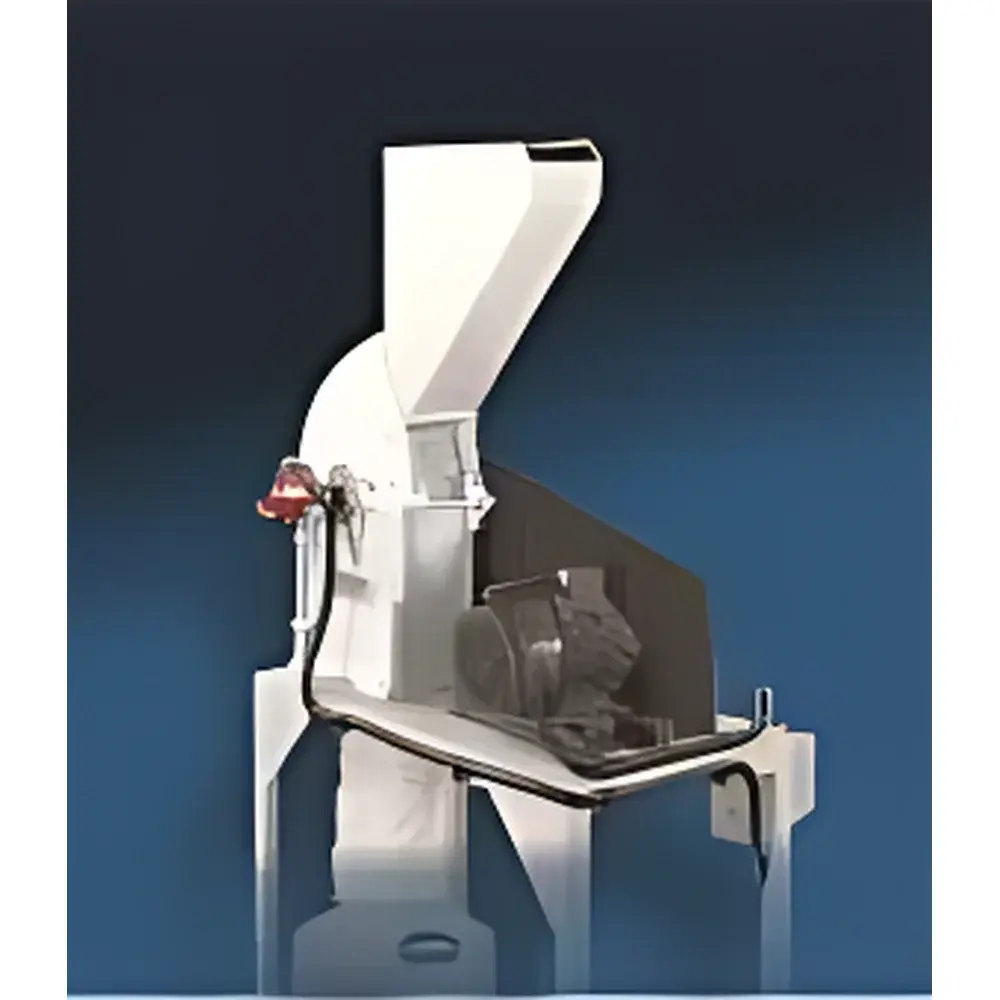
Glen Creston Model 10 Pendulum Hammer Grinder
| Brand | Glen Creston |
|---|---|
| Origin | United Kingdom |
| Model | Model 10 |
| Recommended Operating Speed | 3650 rpm |
| Footprint | 91 cm × 104 cm |
| Discharge Type | Gravity-fed (Bottom Discharge) |
| Motor | TEFC, Single-phase 230 V / Three-phase 400 V, 50 Hz |
| Power Rating (Bottom Discharge) | 2.2 kW |
| Feed Opening | 15.2 cm × 15.2 cm |
| Maximum Throughput | 1000 kg/h |
| Sieve Area | 640.8 cm² |
| Ingress Protection Rating | IP54 |
| Sieve Aperture Range | 0.5–30 mm |
| Hammer Material | Hardened Steel, 4-sided reversible design |
| Grinding Surface | Cast iron with serrated profile |
| Optional Accessories | Magnetic trap, air-product separator (fan-assisted models only), custom mounting frames and chutes |
Overview
The Glen Creston Model 10 Pendulum Hammer Grinder is a robust, gravity-fed size reduction system engineered for high-throughput, low-energy comminution of diverse brittle and fibrous materials in laboratory, pilot-scale, and light industrial settings. It operates on the principle of impact grinding: feed material enters the chamber via a cast-iron hopper equipped with a safety baffle, then undergoes repeated high-velocity collisions with rotating hardened steel hammers mounted on a pendulum shaft. These hammers pivot freely under centrifugal force, striking material against a fixed serrated cast-iron grinding surface. Particle size reduction occurs through combined impact, shear, and attrition mechanisms. Final product exits the chamber via gravitational passage through a replaceable stainless-steel sieve—ensuring consistent output granularity without pneumatic assistance. This mechanical architecture delivers exceptional reliability, minimal maintenance intervals, and inherent process stability across variable feed compositions.
Key Features
- Cast-iron main frame with integrated serrated grinding surface—engineered for long-term dimensional stability and wear resistance
- Four-edge reversible hardened steel hammers—each edge fully utilized during rotation, extending service life and reducing consumable replacement frequency
- Modular sieve system with interchangeable mesh inserts (0.5 mm to 30 mm aperture)—enabling rapid adaptation to target particle size distributions
- TEFC (Totally Enclosed Fan-Cooled) motor compliant with IEC 60034 standards—available in single-phase 230 V or three-phase 400 V configurations, 50 Hz
- IP54-rated enclosure—providing protection against dust ingress and water splashes for safe operation in typical laboratory and controlled production environments
- Large feed opening (15.2 cm × 15.2 cm) with integrated safety baffle—facilitating manual or conveyor-fed introduction of bulk solids while preventing operator contact with moving components
- Compact footprint (91 cm × 104 cm)—optimized for space-constrained laboratories and quality control facilities
- Gravity-driven discharge mechanism—eliminating reliance on auxiliary air systems, thereby reducing energy consumption and operational complexity
Sample Compatibility & Compliance
The Model 10 is validated for consistent size reduction of heterogeneous organic and inorganic feedstocks, including but not limited to: granular chemicals, crushed glass, paper stock, thermoset resins, limestone and quartzite fragments, hardwood chips, cereal grains, animal bone fragments, synthetic foams, and municipal solid waste fractions. Its mechanical design avoids thermal degradation pathways common in high-shear or friction-based mills, preserving sample integrity for downstream analytical applications (e.g., XRF sample preparation, calorimetric analysis, or leaching studies). The unit complies with CE marking requirements under the Machinery Directive 2006/42/EC and meets EN 61000-6-2 (immunity) and EN 61000-6-4 (emissions) electromagnetic compatibility standards. All electrical components conform to IEC 60204-1 for safety of machinery.
Software & Data Management
This is a stand-alone electromechanical grinder with no embedded digital control system or data logging capability. Operational parameters—including motor voltage, frequency, and nominal power—are fixed per configuration and documented in the technical manual. For laboratories requiring audit-trail compliance (e.g., GLP or ISO/IEC 17025 environments), external process monitoring can be implemented using third-party power analyzers or tachometric sensors interfaced via analog outputs (optional upon request). No software installation, firmware updates, or cybersecurity protocols apply. Maintenance records, calibration logs (e.g., sieve mesh verification per ISO 3310-1), and operational checklists are maintained manually in accordance with institutional SOPs.
Applications
- Preparation of homogenized samples for elemental analysis (XRF, ICP-OES) where particle size uniformity directly affects measurement reproducibility
- Routine size reduction of reference materials prior to gravimetric or volumetric dispensing in formulation labs
- Processing of composite waste streams for density separation or pyrolysis feedstock conditioning
- Particle size standardization of botanical materials for pharmacognosy studies or extract yield optimization
- Fragmentation of brittle polymers and composites for rheological or thermal characterization
- Feedstock conditioning in small-scale biofuel or anaerobic digestion pilot trials
FAQ
What materials are incompatible with the Model 10 Pendulum Hammer Grinder?
Materials exhibiting high ductility (e.g., aluminum foil, copper wire), extreme moisture content (>15% w/w), or significant fibrous elasticity (e.g., raw jute, uncut sisal) may cause hammer jamming or screen blinding and are not recommended.
Can the Model 10 be integrated into an automated feed system?
Yes—its standard feed hopper accepts belt conveyors, vibratory feeders, or screw augers; mounting flanges and base plate anchoring points are provided for secure integration.
Is sieve calibration traceable to national standards?
Sieves supplied with the unit are manufactured to ISO 3310-1 tolerances; users may verify aperture dimensions using certified optical comparators or laser micrometers per ISO/IEC 17025-accredited procedures.
What routine maintenance is required?
Bi-weekly visual inspection of hammer edges and sieve integrity; monthly lubrication of main shaft bearings (NLGI #2 lithium grease); annual torque verification of hammer retention bolts per manufacturer specifications.
Does Glen Creston provide validation documentation for GMP environments?
While the Model 10 itself is not a GMP-certified instrument, it supports IQ/OQ documentation packages—including dimensional verification, electrical safety testing reports, and material-of-construction certificates (EN 10204 3.1)—available upon order confirmation.



