
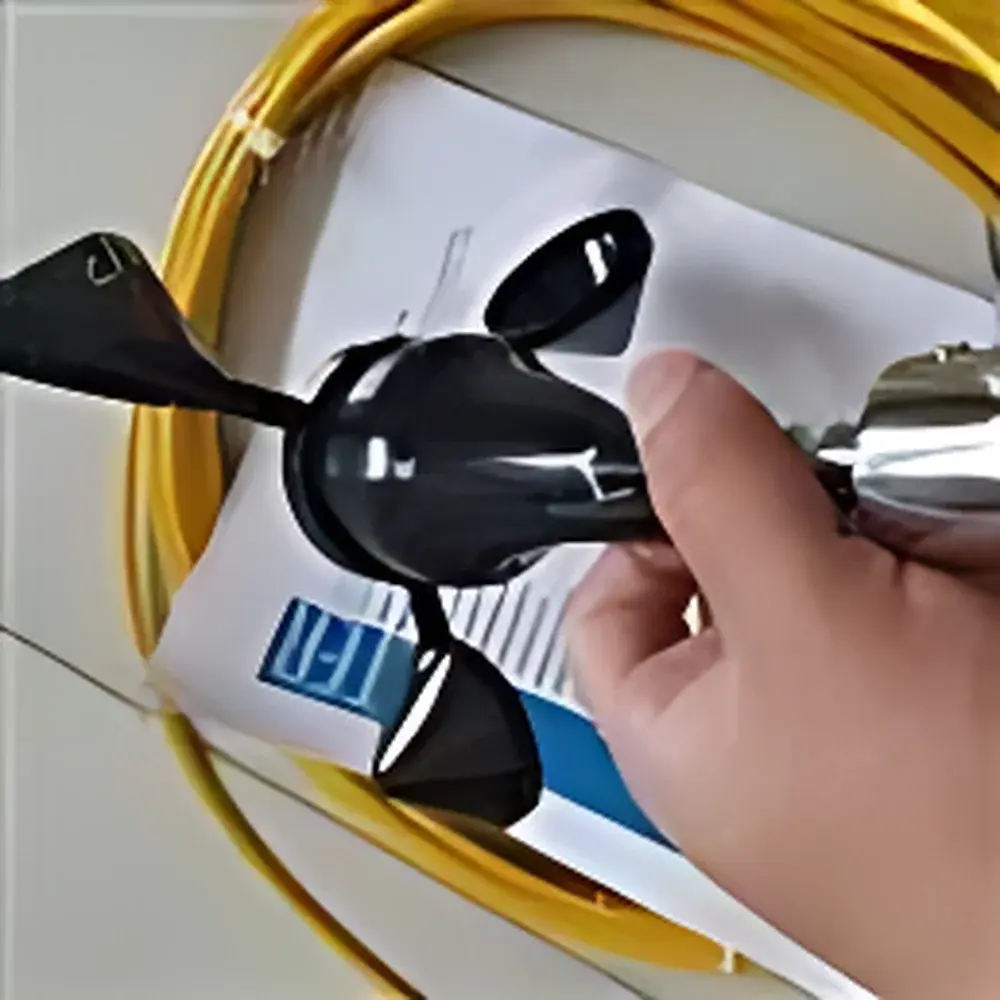
Global Water WE550 Anemometer
| Brand | Global Water |
|---|---|
| Origin | USA |
| Model | WE550 |
| Output Signal | 4–20 mA (2-wire) |
| Wind Speed Range | 0–50 m/s |
| Starting Threshold | <1.35 m/s |
| Accuracy | ±0.09 m/s (within 4.9–24.6 m/s) |
| Operating Voltage | 10–36 VDC |
| Warm-up Time | ≥3 s |
| Operating Temperature | −40 °C to +55 °C |
| Dimensions | 18 cm diameter × 21.6 cm height |
| Weight | 0.5 kg |
| Cable | Marine-grade, standard 7.6 m (custom lengths up to 152 m available) |
| Enclosure | Fully potted electronics in marine-grade epoxy-rubber compound |
| Mounting | 1-inch NPT threaded fitting |
| Sensor Type | Three-cup anemometer |
Overview
The Global Water WE550 Anemometer is a precision-engineered three-cup rotational anemometer designed for long-term, unattended wind speed monitoring in demanding environmental and agricultural meteorological applications. Based on the fundamental principle of cup rotation proportional to wind-induced torque, the WE550 converts aerodynamic force into a linear 4–20 mA analog output signal—compatible with industry-standard data loggers, SCADA systems, PLCs, and environmental monitoring platforms. Its robust mechanical architecture features high-impact UV-stabilized polymer cups and precision-balanced stainless-steel shafts, ensuring consistent angular response across the full 0–50 m/s range. With a low starting threshold of less than 1.35 m/s, the sensor reliably captures subtle airflow variations critical for boundary-layer studies, microclimate analysis, and irrigation scheduling models. The device operates without internal moving contacts or slip rings, eliminating wear-related drift and supporting multi-year calibration stability under continuous exposure.
Key Features
- Three-cup design optimized for directional insensitivity and high reproducibility across turbulent flow regimes
- Fully potted electronics housed in marine-grade epoxy-rubber encapsulation—IP68-rated against moisture, salt fog, and thermal cycling
- Standard 7.6-meter marine-grade twisted-pair cable with tinned copper conductors and polyolefin jacket; custom lengths available up to 152 meters without signal degradation
- Integrated 1-inch NPT male threaded mounting interface for rigid pole or mast attachment
- Wide operating voltage range (10–36 VDC) supports battery-, solar-, or grid-powered deployments
- Fast thermal stabilization: ≤3 seconds warm-up time minimizes latency in transient wind event capture
- Extended environmental tolerance: functional performance verified from −40 °C to +55 °C ambient conditions
Sample Compatibility & Compliance
The WE550 is validated for deployment in open-field agricultural meteorological stations, coastal observatories, forest canopy networks, and industrial site perimeter monitoring systems. It complies with IEC 61260-1:2014 Class 2 specifications for environmental transducers and meets mechanical durability requirements outlined in ASTM D5096–22 (Standard Practice for In-Field Calibration of Anemometers). While not certified to UL/CSA safety standards as a standalone device, its 4–20 mA output conforms to ISA-50.00.01 (IEC 60381-1) analog signal protocols, enabling seamless integration into facilities governed by ISO 9001, ISO 14001, or FDA 21 CFR Part 11–compliant data acquisition infrastructures when paired with audit-trail-capable logging hardware.
Software & Data Management
The WE550 operates as a passive analog transducer and requires no embedded firmware or onboard configuration. Its 4–20 mA output maps linearly to wind speed (e.g., 4 mA = 0 m/s, 20 mA = 50 m/s), enabling direct scaling within any supervisory control system supporting HART-compatible analog inputs. When integrated with Global Water’s SOLAR-LOG series or third-party platforms such as Campbell Scientific CR1000X, Onset HOBO RX3000, or Siemens Desigo CC, the sensor supports automated alarm triggering (e.g., gust thresholds >15 m/s), time-synchronized data stamping, and export to CSV/NetCDF formats. All raw current measurements retain traceability to NIST-traceable calibrations performed at Global Water’s ISO/IEC 17025-accredited facility in San Marcos, CA.
Applications
- Agricultural microclimate monitoring for evapotranspiration modeling and smart irrigation control
- Wind resource assessment at distributed solar farm perimeters and agrivoltaic test sites
- Regulatory compliance reporting for EPA air quality monitoring networks requiring auxiliary wind data
- Long-term ecological research in alpine, arid, or coastal zones where sensor longevity and minimal maintenance are essential
- Industrial stack emission dispersion modeling requiring synchronized wind vector inputs
- Educational meteorology installations emphasizing ruggedness, simplicity, and signal interoperability
FAQ
What is the recommended calibration interval for the WE550?
Global Water recommends annual field verification using a portable reference anemometer traceable to NIST standards; full recalibration is advised every two years or after exposure to extreme mechanical shock.
Can the WE550 be used for wind direction measurement?
No—the WE550 measures wind speed only. For vector wind data, pair it with a compatible vane-type wind direction sensor (e.g., Global Water WD-1) and synchronize outputs via common timestamping.
Is the 4–20 mA output intrinsically safe for hazardous locations?
The WE550 itself is not IS-certified; however, it may be deployed in Class I, Division 2 areas when powered through an approved intrinsic safety barrier compliant with IEC 60079-11.
Does the sensor require grounding or shielding for EMI mitigation?
Yes—marine-grade cable must be grounded at the logger end only; twisted-pair construction and epoxy potting provide inherent noise rejection, but proper shield termination reduces susceptibility to RF interference near radio transmitters or variable-frequency drives.
How does temperature affect measurement accuracy?
The electronics are compensated for thermal drift across the full −40 °C to +55 °C range; published accuracy (±0.09 m/s) applies only within 4.9–24.6 m/s and assumes stable ambient conditions per IEC 61260-1 Annex B.
Related Products







