
Gloria-LDLS-A Laser-Driven Light Source (LDLS)
| Brand | ZOLIX |
|---|---|
| Origin | Beijing, China |
| Manufacturer Type | Direct Manufacturer |
| Product Category | Domestic |
| Model | Gloria-LDLS-A |
| Light Source Type | Laser-Driven Plasma White Light Source |
| Spectral Range | 170–2100 nm |
| Spectral Radiance | 40 mW/(mm²·sr·nm) @ 400 nm |
| Output Mode | Free-Space |
| Numerical Aperture | 0.47 |
| Power Stability | RMS < 0.3% over 30 s |
| Typical Lamp Lifetime | 10,000 hours |
| Emission Spot Size | 97 × 194 µm |
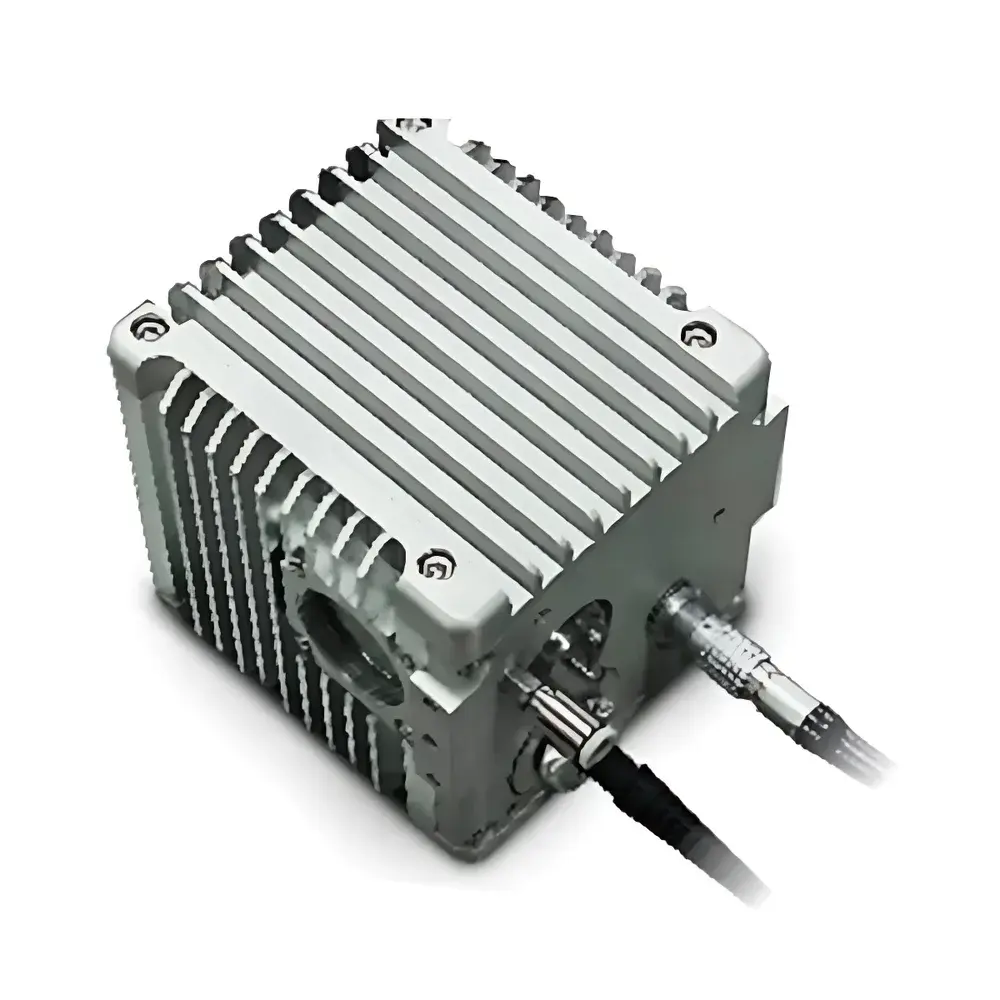
| Source Dimensions | 82 × 86 × 76 mm |
| Power Supply Dimensions | 113 × 111 × 209 mm |
| Cooling | Passive (Natural Convection) |
| DUV Operation Requirement | Nitrogen Purge Required |
Overview
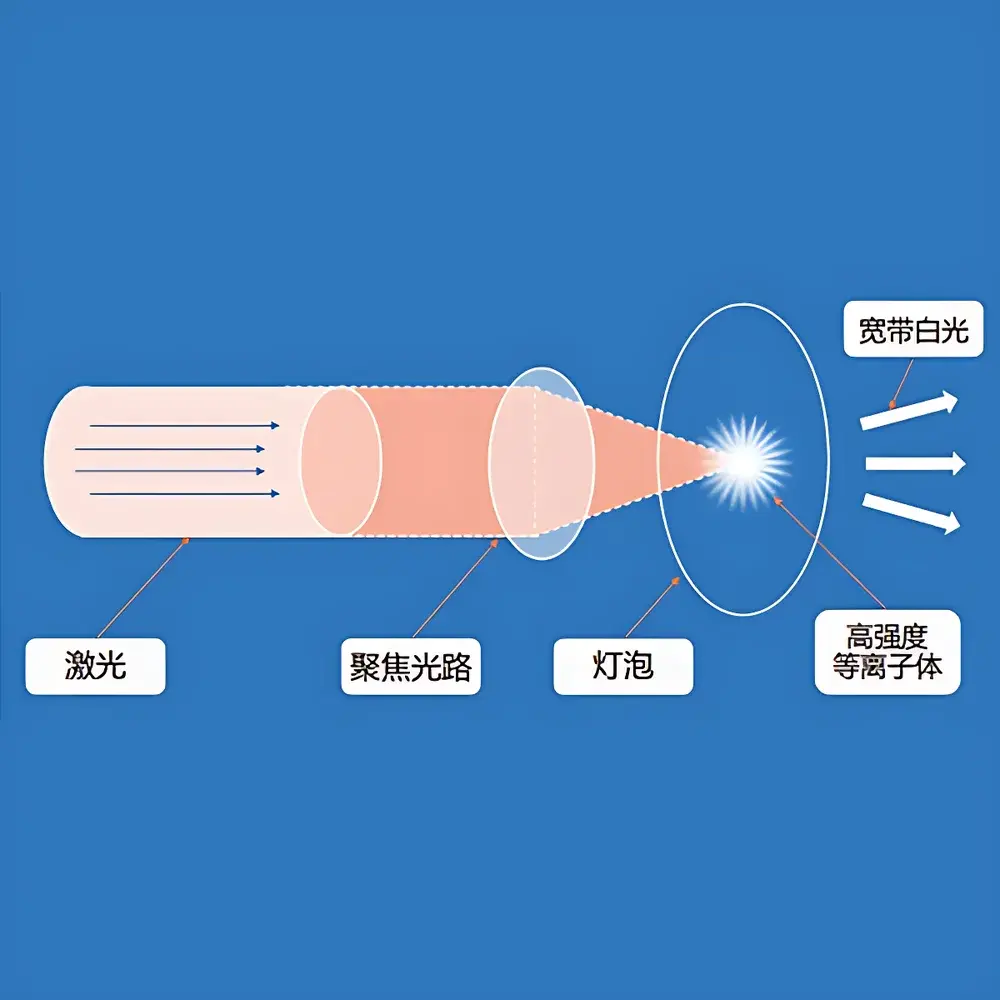
The Gloria-LDLS-A is a high-performance laser-driven light source (LDLS) engineered for demanding optical laboratory applications requiring broadband, stable, and electrode-free illumination. Unlike conventional arc lamps—such as xenon or mercury lamps—the LDLS-A utilizes a continuous-wave laser to pump a xenon plasma within a fused silica capillary, generating a spatially confined, high-brightness plasma without physical electrodes. This electrodeless architecture eliminates electrode erosion, spectral drift, and intensity flicker commonly associated with traditional discharge lamps. The resulting output spans the deep ultraviolet (DUV) through near-infrared (NIR), from 170 nm to 2100 nm, with exceptional radiance—40 mW/(mm²·sr·nm) at 400 nm—and sub-0.3% RMS power stability over 30-second intervals. Its compact form factor, passive thermal management, and compatibility with nitrogen purging for DUV operation make it suitable for integration into spectroscopic ellipsometers, UV-Vis-NIR spectrophotometers, monochromator-based systems, and metrology platforms where long-term repeatability and spectral fidelity are critical.
Key Features
- Laser-driven plasma generation ensures electrode-free operation, eliminating spectral degradation and lifetime limitations inherent in electrode-based lamps.
- Broad spectral coverage from 170 nm (deep UV) to 2100 nm (near-IR), supporting multi-region calibration and cross-platform instrument validation.
- High spatial coherence and small emission spot (97 × 194 µm) enable efficient coupling into fiber optics, monochromators, and imaging spectrometers.
- Numerical aperture of 0.47 facilitates high-throughput optical design while maintaining collimation control in free-space configurations.
- Passive cooling architecture eliminates need for external chillers, water lines, or forced-air systems—reducing system complexity and acoustic noise.
- 10,000-hour typical lamp lifetime significantly exceeds that of standard xenon arcs (typically 500–2,000 h), lowering total cost of ownership and maintenance frequency.
Sample Compatibility & Compliance
The Gloria-LDLS-A is designed for integration into ISO/IEC 17025-accredited laboratories and regulated environments where traceable, stable illumination is required. Its spectral continuity and low temporal noise support compliance with ASTM E308 (computing CIE tristimulus values), ISO 13655 (spectral measurement of printing), and USP (UV-Vis spectrophotometer qualification). For DUV applications below 190 nm—including photoelectron spectroscopy or synchrotron beamline calibration—the unit requires continuous nitrogen purge to suppress atmospheric oxygen absorption. All mechanical interfaces conform to standard optomechanical mounting practices (e.g., SM1-threaded housings, kinematic base options available), and the power supply meets IEC 61000-6-3 (EMC emissions) and IEC 61000-6-2 (immunity) requirements.
Software & Data Management
While the Gloria-LDLS-A operates as a stand-alone analog source, it includes TTL-compatible status monitoring (lamp-on, interlock, fault) and analog 0–10 V intensity modulation input for external feedback control. Integration with LabVIEW, Python (via PyVISA), or MATLAB is supported through optional RS-232 or USB-to-serial adapters. Full operational logs—including cumulative runtime, thermal history, and power-on cycles—are retained in non-volatile memory for GLP/GMP audit readiness. Firmware updates are performed via secure UART interface; no cloud connectivity or proprietary software installation is required. Instrument metadata (serial number, calibration date, spectral reference file hash) can be exported in CSV or JSON format for LIMS integration.
Applications
- Calibration of hyperspectral imagers and Fourier-transform spectrometers across UV-VIS-NIR bands.
- Reference source in reflectance and transmittance measurements per ISO 13485-compliant medical device optical testing.
- Illumination for high-resolution micro-spectroscopy, including confocal Raman and photoluminescence mapping.
- Stable excitation source in time-resolved fluorescence lifetime systems requiring low-intensity noise.
- Primary standard replacement in national metrology institutes conducting spectral irradiance intercomparisons.
- DUV lithography mask inspection systems requiring stable 170–200 nm output under nitrogen-purged enclosures.
FAQ
Is the Gloria-LDLS-A compatible with vacuum or UHV environments?
No—the source is rated for ambient air or nitrogen-purged enclosures only. It is not designed for direct vacuum integration due to internal gas fill and thermal expansion constraints.
Can the output be fiber-coupled?
Yes, the free-space output can be efficiently coupled into multimode fibers (e.g., 400 µm core, NA 0.22) using standard achromatic focusing objectives; coupling efficiency exceeds 65% with proper alignment.
What is the warm-up time to achieve spectral and power stability?
Full radiometric stability is achieved within 15 minutes of cold start; spectral shape stabilizes within 5 minutes.
Does the unit include factory spectral calibration data?
Yes—each unit ships with NIST-traceable spectral radiance data measured at 1 nm resolution across 170–2100 nm, provided in HDF5 and CSV formats.
Is remote interlock support available for safety-critical setups?
Yes—the rear panel includes a hardware-enabled safety interlock loop (24 V DC, dry contact) compliant with IEC 61508 SIL-2 requirements.




