
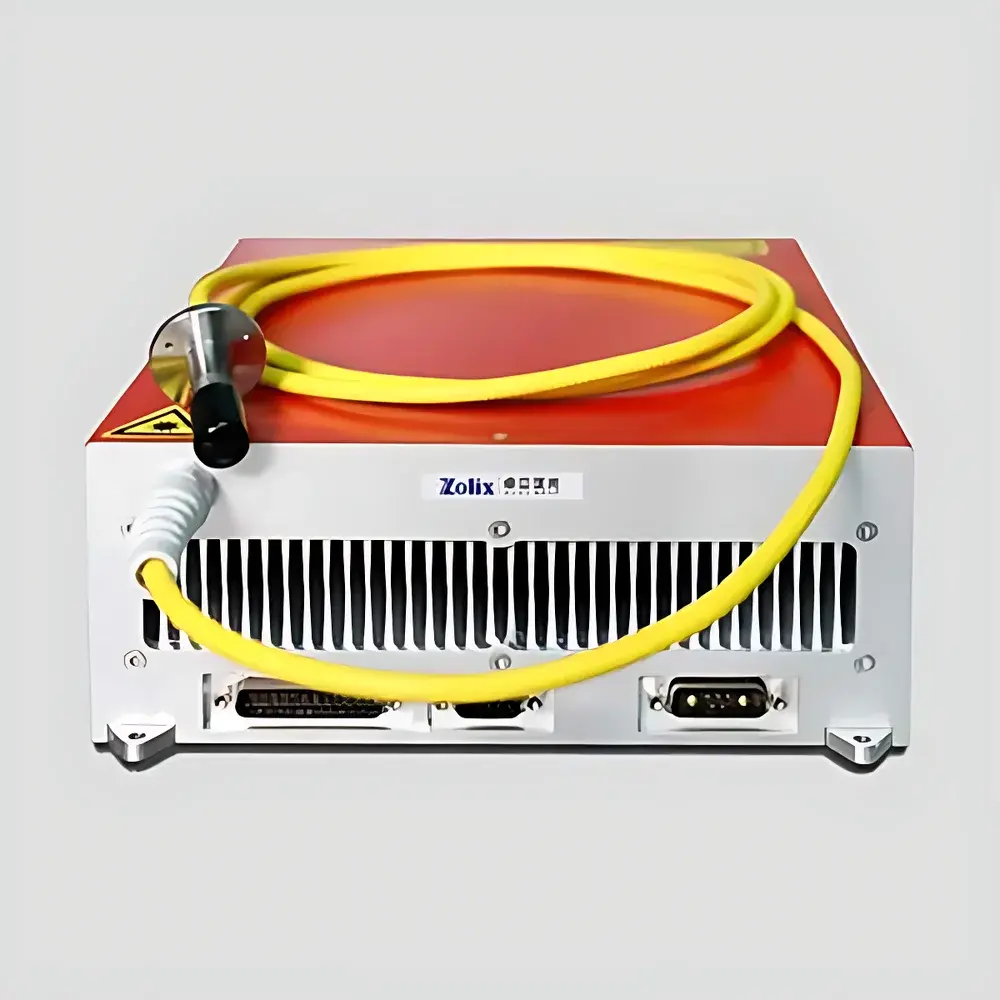
Gloria-SC-N Series Ultrafast Supercontinuum Laser Source by ZOLIX
| Brand | ZOLIX |
|---|---|
| Model | Gloria-SC-N |
| Wavelength Range | 420–2300 nm |
| Cut-in Wavelength | ≥420 nm (intensity >0.1 mW/nm) |
| Total Output Power | 7 W |
| Visible Power (350–850 nm) | 1.1 W |
| Power Stability | <0.5% RMS |
| Repetition Rate Tunability | 100 kHz – 1 MHz |
| Beam Quality (M²) | <1.1 |
| Polarization | Random |
| Output Fiber Length | 1.5 m |
| Synchronization Signal | BNC, TTL-compatible |
| Input Voltage | 100–240 V AC, 50/60 Hz |
| Power Consumption | <120 W |
| Dimensions (W×H×L) | 387 × 301 × 100 mm |
| Weight | 11 kg |
Overview
The Gloria-SC-N Series Ultrafast Supercontinuum Laser Source is a turnkey, fiber-integrated broadband light source engineered for demanding optical laboratory applications requiring high spectral density, temporal stability, and flexible pulse control. Unlike conventional arc lamps or LED-based white-light sources, the Gloria-SC-N generates supercontinuum radiation through nonlinear spectral broadening in photonic crystal fiber (PCF), pumped by a high-repetition-rate nanosecond pulsed laser. This process yields a smooth, spatially coherent output spanning from the visible (420 nm) to the short-wave infrared (2300 nm), with exceptional power stability (<0.5% RMS) and near-diffraction-limited beam quality (M² <1.1). Designed and manufactured in Beijing by ZOLIX — a vertically integrated Chinese OEM specializing in precision optical instrumentation — the system delivers industrial-grade reliability while supporting research-grade experimental flexibility, including external TTL triggering and user-configurable repetition rate and average power scaling.
Key Features
- Ultra-broad spectral coverage: 420–2300 nm, with guaranteed cut-in intensity >0.1 mW/nm at 420 nm
- High total average power: up to 7 W, including 1.1 W within the visible band (350–850 nm)
- Adjustable pulse repetition rate: digitally tunable from 100 kHz to 1 MHz, enabling synchronization with time-resolved detection systems
- Stable, low-noise output: <0.5% RMS power fluctuation over 8 hours under constant thermal conditions
- Integrated single-mode polarization-maintaining (PM) output fiber: 1.5 m length, FC/APC connector, optimized for coupling into spectrometers, interferometers, or fiber-optic sensors
- Built-in TTL-synchronous trigger output (BNC) for precise timing alignment with cameras, lock-in amplifiers, or pump-probe setups
- Compact, rack-mountable chassis (387 × 301 × 100 mm) with passive convection cooling — no water chiller required
Sample Compatibility & Compliance
The Gloria-SC-N is compatible with standard optical tables, free-space beam delivery paths, and fiber-coupled measurement platforms. Its random polarization state is suitable for unpolarized spectroscopic applications; for polarimetric measurements, an external polarization controller or waveplate may be inserted post-output. The system complies with IEC 61000-6-3 (EMC emission limits) and IEC 61000-6-2 (immunity requirements), and meets CE marking directives for laboratory equipment. While not certified to ISO/IEC 17025 as a calibrated reference source, its performance parameters are traceable to internal factory characterization using NIST-traceable spectroradiometric standards. For GLP/GMP environments, users may implement periodic verification protocols per ASTM E275 (Standard Practice for Calibration of Spectrophotometers) or ISO 17025-accredited third-party calibration services.
Software & Data Management
The Gloria-SC-N operates in standalone mode without mandatory software dependency. However, ZOLIX provides optional LabVIEW™ and Python SDKs (via USB-CDC or RS-232 interface) for remote configuration of repetition rate, power scaling, and status monitoring. All firmware updates and diagnostic logs are stored locally on-device and exportable via USB flash drive. No proprietary cloud connectivity or telemetry is implemented — consistent with data sovereignty requirements in academic and defense-sensitive laboratories. Audit trails for parameter changes can be enabled via external logging scripts, supporting compliance with FDA 21 CFR Part 11 when integrated into validated analytical workflows.
Applications
- Fiber optic characterization: chromatic dispersion mapping, nonlinear coefficient measurement, and attenuation profiling across telecom and SWIR bands
- Nanomaterial spectroscopy: absorption, scattering, and photoluminescence excitation of quantum dots, graphene oxide dispersions, and carbon nanotube suspensions
- Time-resolved reflectance and transmittance studies of thin-film photovoltaic materials (e.g., perovskites, CIGS)
- Optical coherence tomography (OCT) system development, particularly in ophthalmic and dermatological imaging where extended spectral bandwidth improves axial resolution
- Micro-defect inspection in semiconductor wafers and transparent ceramics using multispectral dark-field illumination
- Calibration of hyperspectral imagers and Fourier-transform spectrometers requiring stable, broadband radiance references
FAQ
Is the Gloria-SC-N compatible with femtosecond pump lasers?
No — the Gloria-SC-N is a self-contained nanosecond-pumped supercontinuum source. It does not accept external pump laser inputs.
Can the output spectrum be filtered or spectrally shaped?
Yes — the broadband output is fully compatible with standard bandpass filters, acousto-optic tunable filters (AOTFs), or liquid crystal tunable filters (LCTFs) placed in the free-space path after fiber collimation.
What is the expected lifetime of the pump laser module?
ZOLIX specifies a minimum operational lifetime of 20,000 hours under continuous use at nominal repetition rate and ambient temperature ≤25°C.
Does the system support analog modulation of output power?
No — power adjustment is digital and stepwise via front-panel menu or serial command; analog modulation is not supported.
Is the output fiber connector interchangeable?
The standard FC/APC connector may be replaced with FC/PC or SMA905 upon request during order configuration; custom fiber types (e.g., large-mode-area or hollow-core) require factory integration and lead-time extension.




