
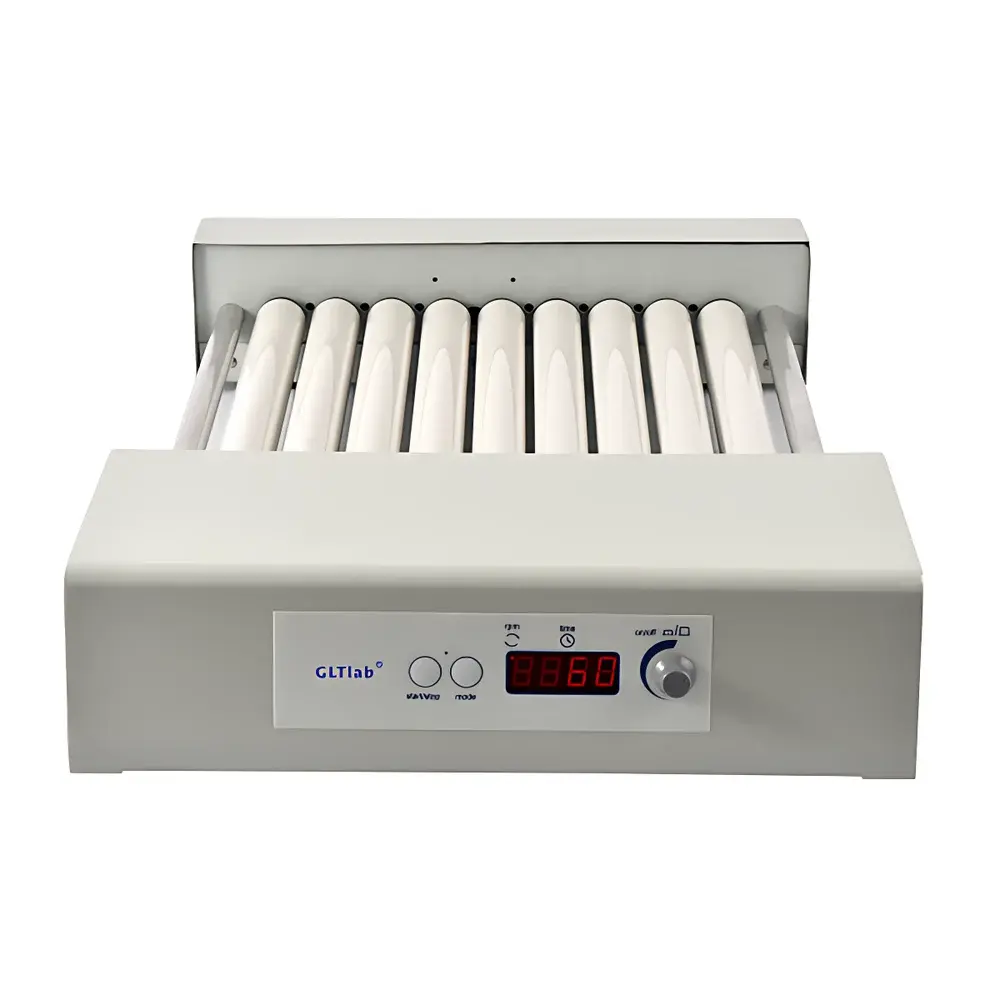
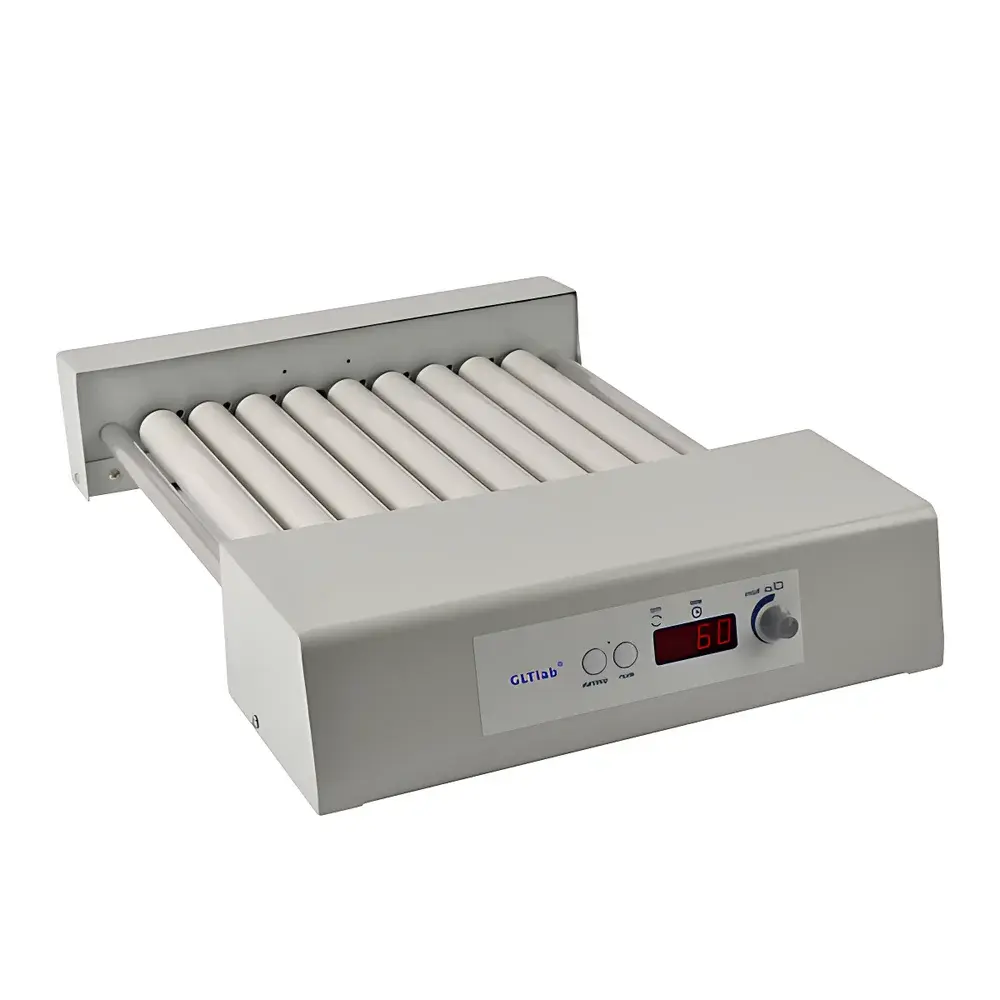
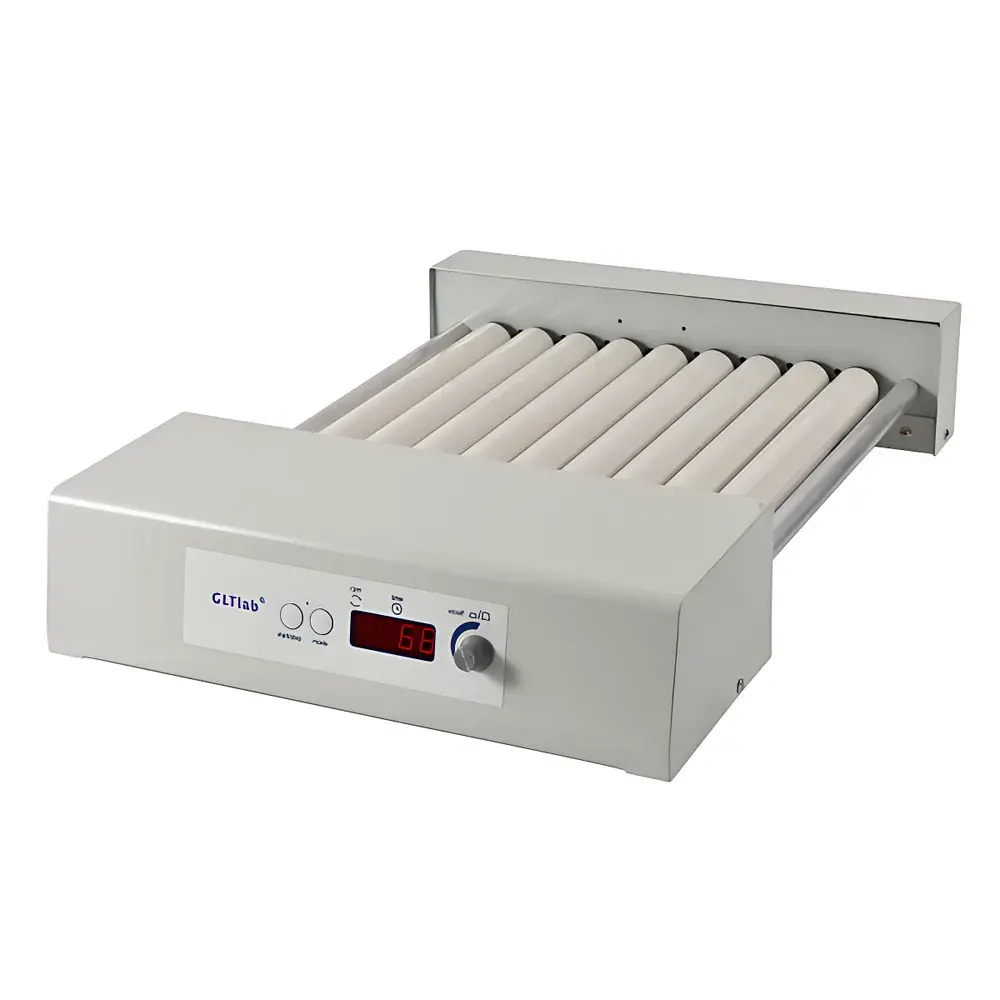
GLTlab LTR-2D Digital Orbital/Rolling Mixer
| Brand | GLTlab |
|---|---|
| Origin | Guangdong, China |
| Manufacturer | GLTlab (GLTlab & Maplelab are registered trademarks of the manufacturer |
| Model | LTR-2D |
| Speed Range | 5–300 rpm |
| Roll Mode | Dual-axis orbital rocking + pure rolling |
| Roller Count | 9 |
| Load Capacity | 10 kg |
| Roller Dimensions | 340 × 30 mm (L × D) |
| Unit Dimensions (W × D × H) | 392 × 556 × 98 mm |
| Net Weight | 9 kg |
| Power Supply | DC 12 V, 5 A |
| Timer Range | 1 min – 200 h |
| Direction Alternation Interval | 1–15 min |
| Operating Modes | Clockwise / Counterclockwise / Alternating |
| Compliance | CE-marked design principles, GLP-aligned control architecture |
Overview
The GLTlab LTR-2D Digital Orbital/Rolling Mixer is an engineered solution for gentle, reproducible sample homogenization in clinical, pharmaceutical, and research laboratories. Unlike conventional rotary shakers or vortex mixers, the LTR-2D operates on a dual-mode mechanical principle: it supports both continuous unidirectional rolling and controlled orbital rocking—achieved by adjustable angular offset between the main drive shaft and roller axis. This design enables precise modulation of shear stress and mixing intensity without requiring accessory adapters or tube clamps. The unit employs a brushless DC motor with direct-drive transmission, eliminating gear trains and associated wear mechanisms that compromise long-term speed stability and maintenance intervals. Its compact footprint (392 × 556 × 98 mm) and low-voltage DC power architecture (12 V, 5 A) support safe operation in biosafety cabinets, cold rooms, and regulated cleanroom environments where EMI sensitivity or electrical safety compliance is critical.
Key Features
- Dual-mode operation: Selectable pure rolling (zero angular offset) for dry powder blending or gentle suspension re-suspension, or orbital rocking (adjustable tilt angle) for enhanced mixing of viscous fluids, cryopreserved blood samples, and heterogeneous solid–liquid suspensions.
- Nine precision-machined rollers (340 × 30 mm each), spaced to accommodate tubes from 10 mL to 50 mL, microcentrifuge tubes, culture flasks (up to 250 mL), and custom cylindrical containers—no adapters required.
- Full digital speed control across 5–300 rpm with ±1 rpm resolution, maintained under full 10 kg load; calibrated via factory-traceable encoder feedback.
- Bidirectional programmability: Independent selection of clockwise-only, counterclockwise-only, or time-scheduled alternation (1–15 minute intervals) to prevent sediment stratification in density-sensitive assays.
- Extended timer range (1 minute to 200 hours) with non-volatile memory retention; power-fail recovery preserves set parameters upon restart.
- Modular roller spacing: Front-mounted quick-release mechanism allows removal of individual rollers to widen inter-roller distance—enabling accommodation of oversized vessels up to 70 mm diameter.
Sample Compatibility & Compliance
The LTR-2D accommodates a broad spectrum of container formats—including polypropylene, glass, and stainless-steel tubes, conical centrifuge vials, and flat-bottomed flasks—without mechanical clamping or thermal interference. Its low-shear profile meets ASTM D4097 (Standard Practice for Mixing Suspensions for Particle Size Analysis) and ISO 8573-1 Annex B guidelines for gentle agitation prior to analytical sampling. The absence of AC mains voltage and use of isolated DC power supply aligns with IEC 61010-1 requirements for laboratory equipment in wet-location applications. Firmware architecture supports audit-ready operation logs (start/stop timestamps, speed/direction settings, elapsed runtime), facilitating GLP-compliant documentation per FDA 21 CFR Part 11 when integrated with validated LIMS platforms.
Software & Data Management
While the LTR-2D operates as a standalone instrument with intuitive membrane keypad interface, its embedded controller records all operational events—including mode selection, speed setpoint, directional sequence, and timer activation—in internal EEPROM. These logs are accessible via USB-C diagnostics port using GLTlab’s proprietary LabLink Utility (v2.1+), which exports timestamped CSV reports compatible with Excel, JMP, and LabArchives e-Notebook systems. Optional RS-485 Modbus RTU interface enables integration into centralized building management or QC workflow automation systems for remote monitoring and SOP-driven parameter locking.
Applications
- Clinical hematology: Uniform resuspension of anticoagulated whole blood prior to CBC analysis or peripheral smear preparation.
- Biopharmaceutical QC: Homogenization of lyophilized protein formulations during reconstitution validation studies.
- Environmental testing: Gentle mixing of soil–water slurries for TCLP extraction protocols (EPA Method 1311).
- Cryobiology: Controlled thawing of frozen cell suspensions and tissue homogenates without thermal shock or foam generation.
- Materials science: Blending of nanoparticle dispersions in high-viscosity polymer precursors where shear-induced aggregation must be minimized.
FAQ
What is the maximum tube diameter supported without adapter modification?
Up to 70 mm, achievable by removing two central rollers to increase inter-roller clearance.
Does the LTR-2D comply with FDA 21 CFR Part 11 for electronic records?
The device itself does not include user authentication or digital signature capability; however, its audit trail export functionality supports Part 11 compliance when used within a validated system environment with appropriate procedural controls.
Can the unit operate continuously for 72 hours or longer?
Yes—the 200-hour timer supports uninterrupted operation; thermal management is rated for continuous duty at ambient temperatures ≤35°C and relative humidity ≤80% non-condensing.
Is calibration certificate included with shipment?
A factory-issued speed verification report (traceable to NIST-standard tachometer) is provided; ISO/IEC 17025 calibration services are available upon request.
What maintenance is required beyond routine cleaning?
None—brushless motor design eliminates brush replacement; roller surfaces require only periodic isopropanol wipe-down to maintain grip integrity.



