
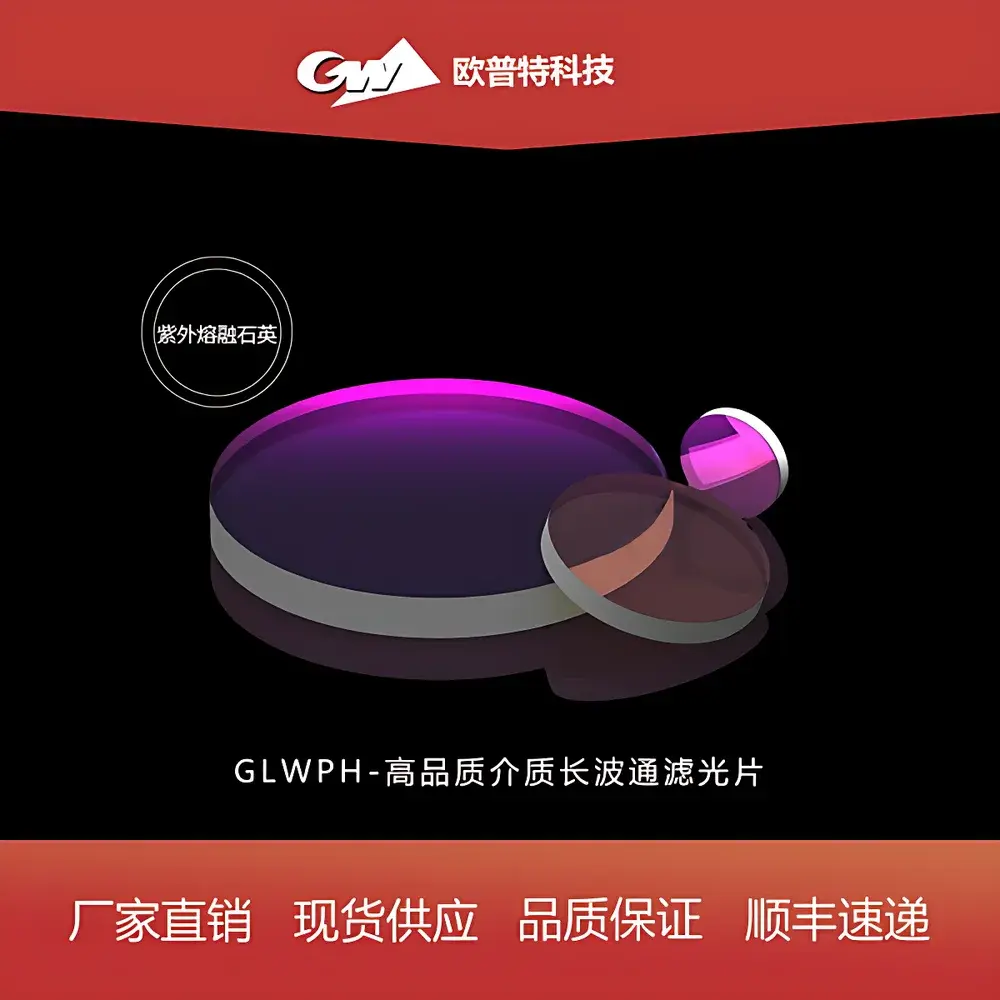
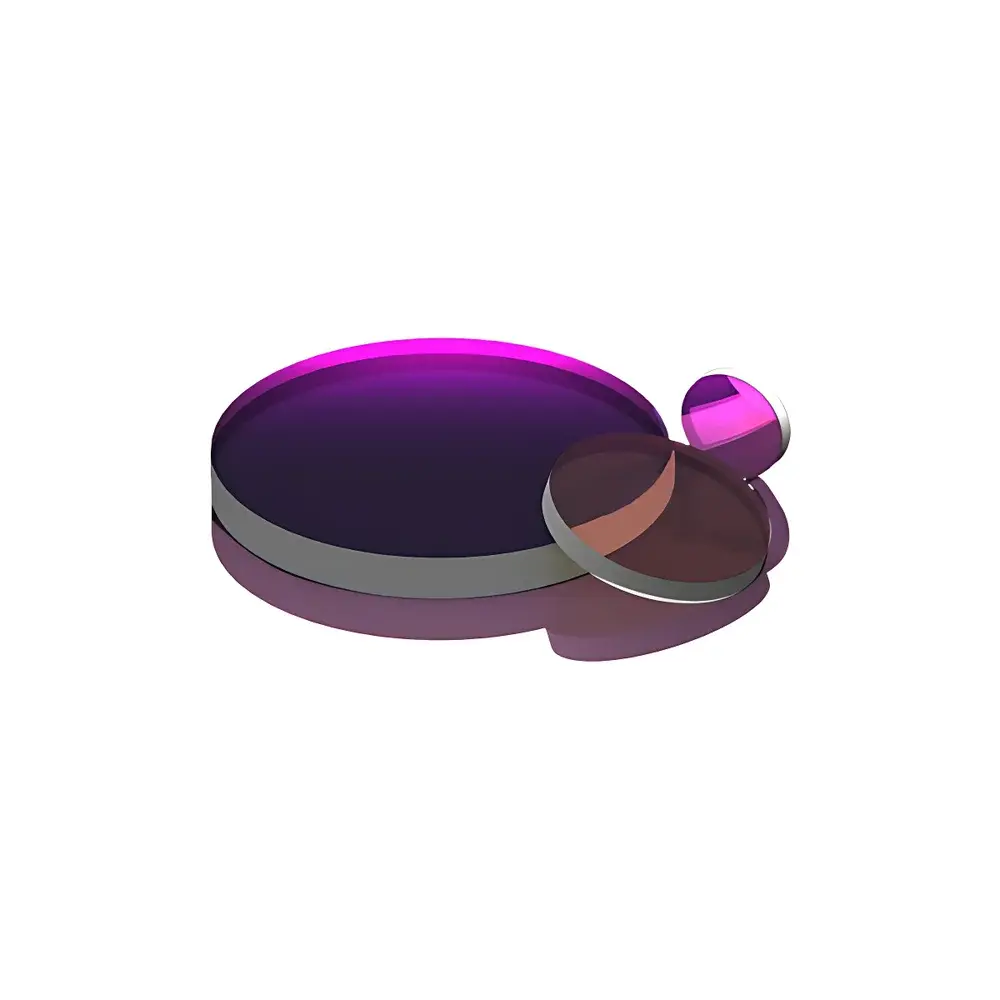
GLWPH High-Performance Longpass Optical Filter
| Origin | Beijing, China |
|---|---|
| Manufacturer Type | Authorized Distributor |
| Origin Category | Domestic (China) |
| Model | GLWPH |
| Price Range | USD 70–140 (per unit, depending on diameter and CWL) |
| Component Category | Optical Element |
| Available Diameters | Φ12.5 mm, Φ25 mm, Φ50 mm |
| Cut-on Wavelengths (CWL) | 400–1100 nm (in 25 nm increments) |
| Transmission Band | CWL +15 nm to 2000 nm |
| Blocking Range | 200–(CWL −15) nm |
| Optical Density (OD) in Blocking Region | ≥4.0 (typical) |
| Substrate | Fused Silica (UV-grade) |
| Surface Quality | 60-40 scratch-dig |
| Parallelism | <3 arcmin |
| Thickness | 3.0 ±0.2 mm (standard) |
Overview
The GLWPH series is a precision-engineered longpass optical filter designed for demanding spectroscopic, fluorescence, Raman, and laser-based applications requiring high transmission efficiency above a defined cut-on wavelength and deep blocking of shorter-wavelength radiation. Based on multi-layer dielectric thin-film interference technology deposited onto UV-grade fused silica substrates, each GLWPH filter delivers sharp spectral transition characteristics, minimal wavefront distortion, and excellent environmental stability. The cut-on wavelength (CWL) is defined as the wavelength at which transmission reaches 50% of its maximum value in the passband; the transition region is typically ≤25 nm full width at 10%–90% transmission. These filters operate on the principle of constructive and destructive interference within precisely controlled quarter-wave optical stacks, enabling wavelength-selective transmission without absorption-based degradation or thermal load accumulation.
Key Features
- Wide selection of cut-on wavelengths from 400 nm to 1100 nm in precise 25 nm increments — ensuring optimal matching to excitation sources (e.g., 405 nm, 488 nm, 532 nm, 633 nm, 785 nm lasers) and emission bands.
- High average transmission (>90%) across the designated passband (CWL +15 nm to 2000 nm), with peak transmission exceeding 95% at key wavelengths under normal incidence.
- Deep ultraviolet and visible blocking: OD ≥4.0 (i.e., <0.01% transmission) from 200 nm up to (CWL −15) nm, minimizing stray light and background noise in sensitive detection systems.
- Three standard clear apertures: Φ12.5 mm (GLWPH-XXX-D12), Φ25 mm (GLWPH-XXX-D25), and Φ50 mm (GLWPH-XXX-D50), all with centering tolerance ≤±0.1 mm and surface flatness λ/4 @ 633 nm.
- UV-grade fused silica substrate ensures high transmission down to 185 nm, low autofluorescence, and superior resistance to laser-induced damage (LIDT >500 MW/cm² for nanosecond pulses at 1064 nm).
- Hard-coated, ion-assisted deposition (IAD) multilayer stack provides mechanical durability, humidity resistance, and compatibility with standard optical cleaning protocols (per MIL-C-48497A).
Sample Compatibility & Compliance
GLWPH filters are compatible with standard kinematic mounts, lens tubes, filter wheels, and modular optical breadboards used in OEM instrumentation and research-grade setups. They meet industry-standard dimensional tolerances per ISO 10110-3 for optical components and conform to RoHS Directive 2011/65/EU for hazardous substance restrictions. While not certified to specific regulatory standards (e.g., FDA, IEC 61000), their performance parameters align with common requirements for analytical instrumentation under ISO/IEC 17025-accredited laboratories. No calibration certificate is supplied by default; however, optional NIST-traceable spectral transmittance reports (measured on PerkinElmer Lambda 1050+ with 1 nm resolution) are available upon request for GxP-aligned workflows.
Software & Data Management
No proprietary software is required for operation. Spectral transmission data (CSV and SDF formats) for all 29 standard CWL variants are provided digitally upon order confirmation, enabling direct import into optical design tools such as Zemax OpticStudio, CODE V, or FRED. Each product code (e.g., GLWPH-650-D25) corresponds to a unique spectral dataset referenced in our online spectral library — accessible via secure customer portal with TLS 1.2 encryption. Audit-ready documentation packages—including lot-specific coating run logs, substrate certification, and inspection reports—can be delivered in PDF/A-1b format compliant with ISO 19005-1 for long-term archival.
Applications
- Laser line cleanup and harmonic separation in confocal and multiphoton microscopy systems.
- Excitation/emission isolation in fluorescence lifetime imaging (FLIM) and time-resolved spectroscopy.
- Background suppression in FTIR spectrometers operating beyond 2 µm.
- Beam combining and spectral routing in tunable OPO and supercontinuum source architectures.
- UV-curable resin monitoring where deep UV blocking prevents premature photoinitiator activation.
- Environmental sensor head assemblies requiring stable spectral edge definition under thermal cycling (−20 °C to +70 °C operational range).
FAQ
What is the typical damage threshold for GLWPH filters under continuous-wave laser illumination?
For CW lasers at 532 nm, the specified LIDT is ≥10 kW/cm² (measured at 10 s exposure, 1/e² beam diameter); values scale inversely with wavelength and are reduced by ~30% for focused beams with spot sizes <100 µm.
Can GLWPH filters be used at angles of incidence other than 0°?
Yes, but angular tuning shifts the cut-on wavelength toward shorter wavelengths (~0.5 nm per degree for AOI <10°); spectral modeling using thin-film design software is recommended for non-normal configurations.
Is custom diameter or substrate material available?
Custom diameters up to Φ75 mm and alternate substrates (CaF₂, Sapphire, or BK7) are available under NRE agreement; minimum order quantity applies.
Do you provide mounting hardware or retention rings?
Standard SM1- and SM2-threaded retaining rings (Thorlabs-compatible) are offered as optional accessories; custom machined mounts can be quoted separately.
How is spectral performance verified prior to shipment?
Every production lot undergoes 100% spectral verification using a calibrated double-monochromator system traceable to NIST SRM 2036, with pass/fail criteria based on transmission uniformity (<±2% across clear aperture) and edge steepness (Δλ10–90% ≤22 nm).




