
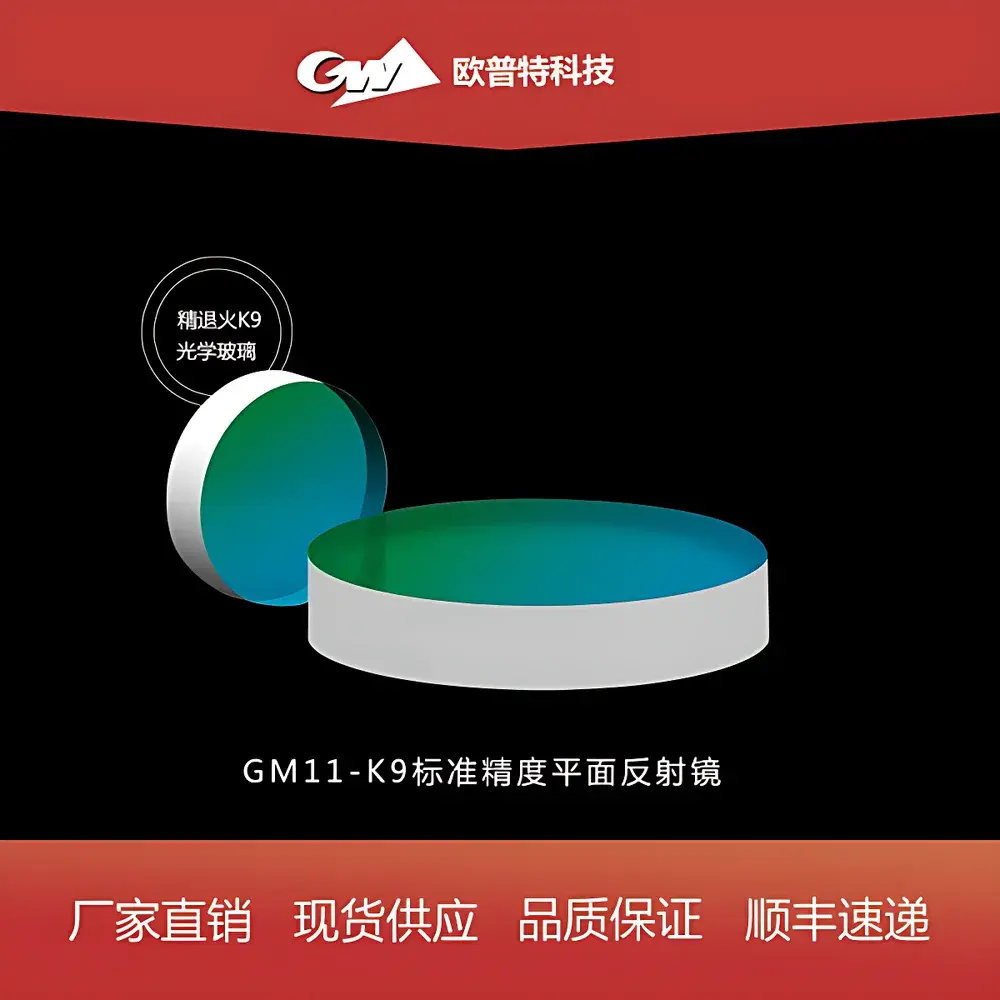
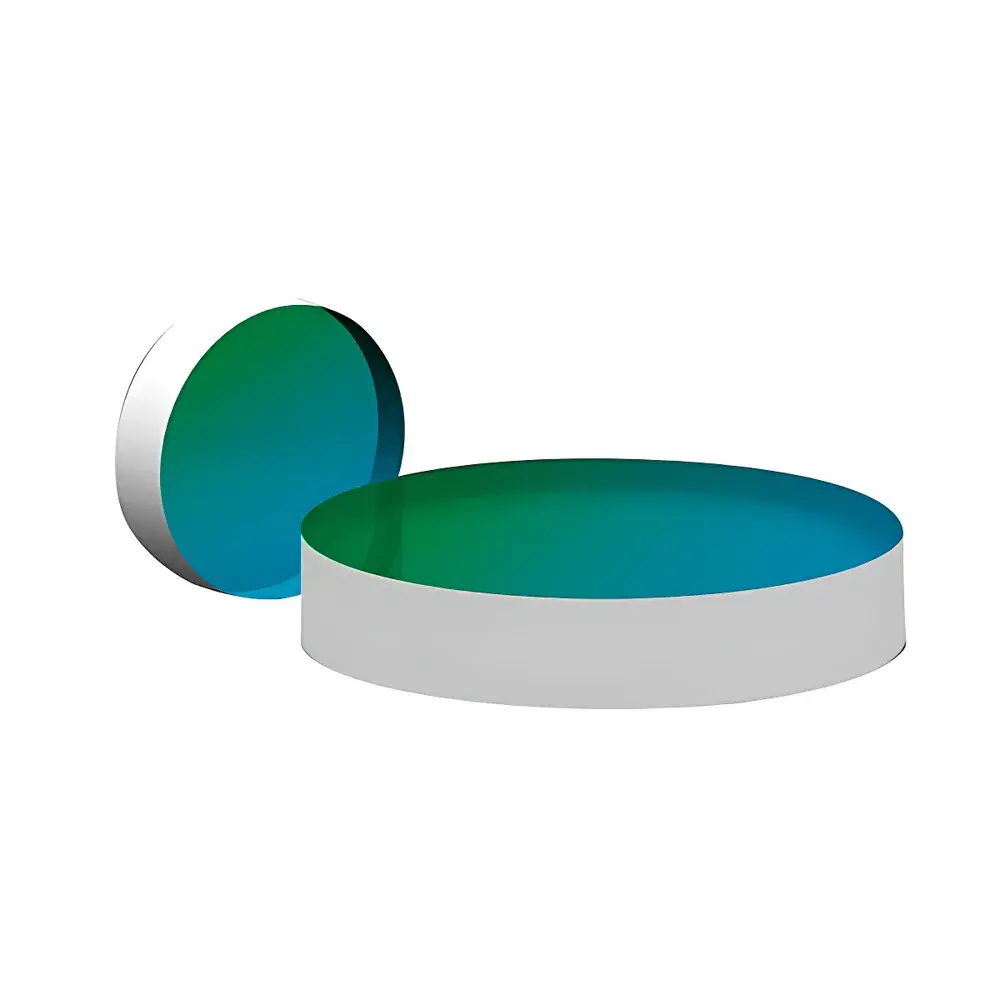
GM11-K9 Precision Grade Plane Mirror
| Origin | Beijing |
|---|---|
| Manufacturer Type | Distributor |
| Origin Category | Domestic |
| Model | GM11 |
| Price Range | USD 0.15–75.00 |
| Component Category | Optical Element |
| Material | Precision Annealed K9 Optical Glass |
| Surface Figure | λ/4 @ 633 nm |
| Parallelism | < 3 arcmin |
| Surface Quality | 3–4 Scratch-Dig |
| Back Surface | Fine Ground |
| Dimensional Tolerance | +0.0 / −0.1 mm |
| Thickness Tolerance | ±0.2 mm |
| Edge Treatment | Protective Chamfer 0.2–0.5 mm × 45° |
| Coating Options | Uncoated, Aluminum + SiO₂ Protection, UV-Enhanced Aluminum + SiO₂, Silver + SiO₂, Gold + SiO₂ |
Overview
The GM11-K9 Precision Grade Plane Mirror is a high-fidelity optical component engineered for stability, wavefront fidelity, and long-term dimensional integrity in demanding laboratory and industrial optical systems. Constructed from precision-annealed K9 borosilicate crown glass—a material widely specified per ISO 10110-2 and MIL-O-13830 for its low bubble/inclusion content, excellent homogeneity (Δn ≤ 5 × 10⁻⁶), and predictable thermal expansion coefficient (α ≈ 7.1 × 10⁻⁶ /°C)—this mirror serves as a foundational element in interferometric setups, beam steering assemblies, cavity alignment, and optical metrology platforms. Its surface figure of λ/4 at the helium–neon reference wavelength (633 nm) ensures minimal wavefront distortion during reflection, supporting applications requiring sub-microradian angular stability and high Strehl ratio preservation. Unlike economy-grade mirrors, the GM11-K9 undergoes full interferometric verification using phase-shifting Fizeau interferometry, with certified test reports available upon request.
Key Features
- Precision-annealed K9 optical substrate with certified homogeneity and stress birefringence < 5 nm/cm, compliant with ISO 10110-4 Class 2 specifications.
- λ/4 surface figure tolerance (RMS) at 633 nm, verified via calibrated interferometry against NIST-traceable standards.
- Parallelism controlled to < 3 arcminutes between front reflective surface and rear ground surface—critical for minimizing beam walk-off in multi-mirror folding configurations.
- Surface quality rated 3–4 scratch-dig per MIL-PRF-13830B, ensuring compatibility with Class 100 cleanroom handling and laser-grade alignment protocols.
- Protective 45° chamfer (0.2–0.5 mm) applied to all edges to mitigate chipping during mounting and reduce stray light generation.
- Tight dimensional tolerances: +0.0 / −0.1 mm on diameter or side length; ±0.2 mm on thickness—enabling repeatable kinematic mounting in optomechanical breadboards and lens tubes.
Sample Compatibility & Compliance
The GM11-K9 mirror is compatible with standard SM-threaded mounts (e.g., Thorlabs SM05, SM1), kinematic mirror cells, and custom CNC-machined holders. Its K9 substrate exhibits broad spectral transmission (350–2000 nm), making it suitable for visible, NIR, and near-UV applications when paired with appropriate dielectric or metallic coatings. All coated variants meet ISO 9001 manufacturing controls and are tested for adhesion (per ASTM D3359 Tape Test), humidity resistance (IEC 60068-2-30), and laser-induced damage threshold (LIDT) certification at 1064 nm (CW) and 532 nm (pulsed) upon request. Uncoated versions comply with USP particulate limits for optical-grade components used in regulated photonic instrumentation.
Software & Data Management
While the GM11-K9 is a passive optical component, its metrological data—including interferogram files (ZEMAX .ZBF, Zygo .DAT), surface error maps, and coating spectral reflectance curves (300–1200 nm)—are archived in a secure, audit-ready digital repository. Customers may access calibration certificates with full uncertainty budgets (k = 2) aligned with ISO/IEC 17025 requirements. For integration into automated optical alignment workflows, standardized STEP AP214 geometry files and GD&T annotations (per ASME Y14.5) are provided for CAD-based mechanical design validation.
Applications
- Beam steering and folding in confocal microscopy, OCT, and laser scanning systems.
- Reference surfaces in Michelson, Mach–Zehnder, and Twyman–Green interferometers.
- Optical cavity end mirrors in low-power diode-pumped solid-state (DPSS) lasers and frequency-stabilized HeNe systems.
- Alignment fiducials in semiconductor lithography tool calibration and wafer inspection optics.
- Calibration standards for optical flatness testers and coordinate measuring machines (CMMs) equipped with laser trackers.
FAQ
Is the GM11-K9 mirror suitable for high-power laser applications?
Standard aluminum- and silver-coated variants are rated for CW power densities up to 500 W/cm² at 1064 nm; gold-coated versions support up to 200 W/cm² in the NIR. LIDT testing reports are available for specific coating–wavelength–pulse-duration combinations.
Can custom diameters or thicknesses be manufactured?
Yes—custom dimensions, tighter surface figure tolerances (e.g., λ/10), and alternate substrates (e.g., fused silica for UV or ultra-low expansion glass for thermal stability) are available under OEM agreements with lead times of 6–10 weeks.
Do you provide traceable calibration certificates?
All GM11-K9 units shipped with coated or uncoated specifications include ISO/IEC 17025-accredited calibration certificates listing measurement uncertainty, environmental conditions during testing, and operator identification per GLP requirements.
What mounting recommendations do you suggest for vibration-sensitive setups?
We recommend kinematic mounts with three-point contact (e.g., flexure-based or piezo-adjustable cells) and avoidance of over-torquing—maximum clamping force should not exceed 0.8 N·m for Φ25 mm and smaller variants to prevent substrate deformation.
Are coating spectral curves available digitally?
Yes—reflectance/transmittance data in CSV and SPECTRAL format are delivered with each order and can be imported into Zemax OpticStudio, CODE V, or FRED for system-level modeling.





