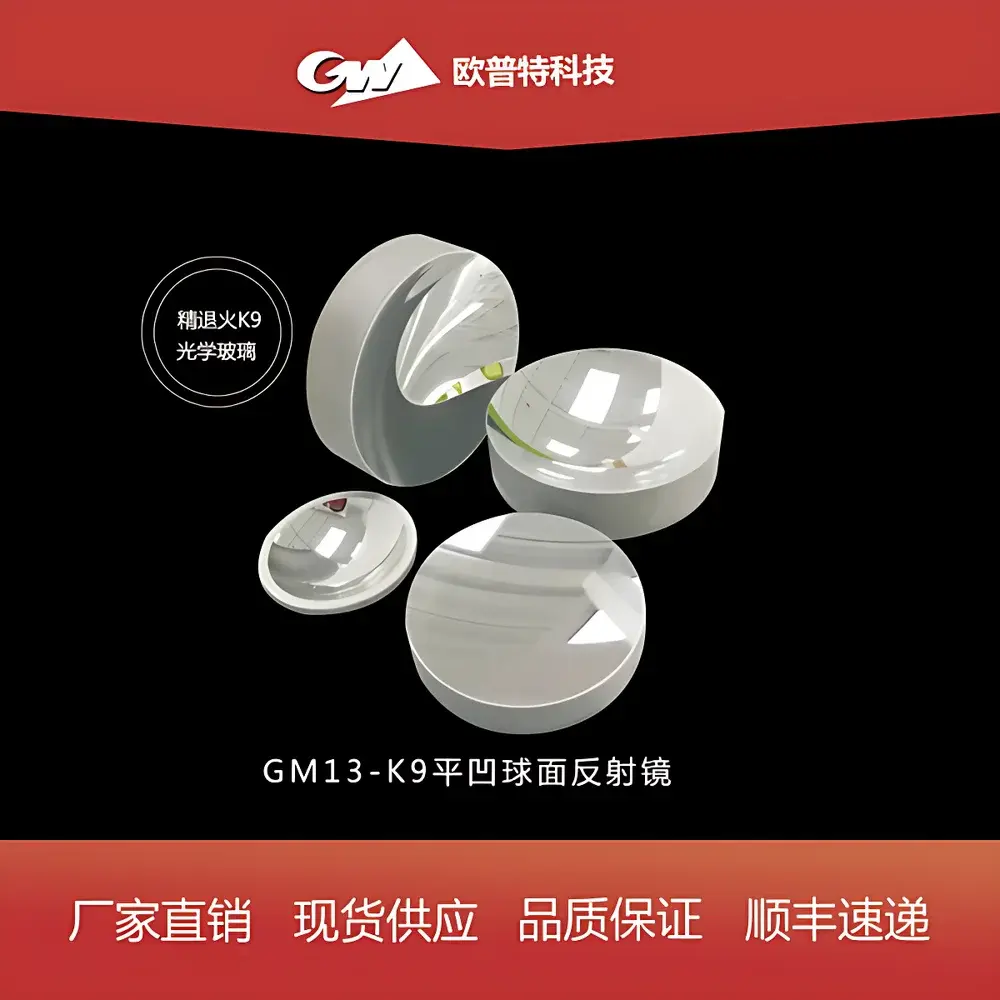
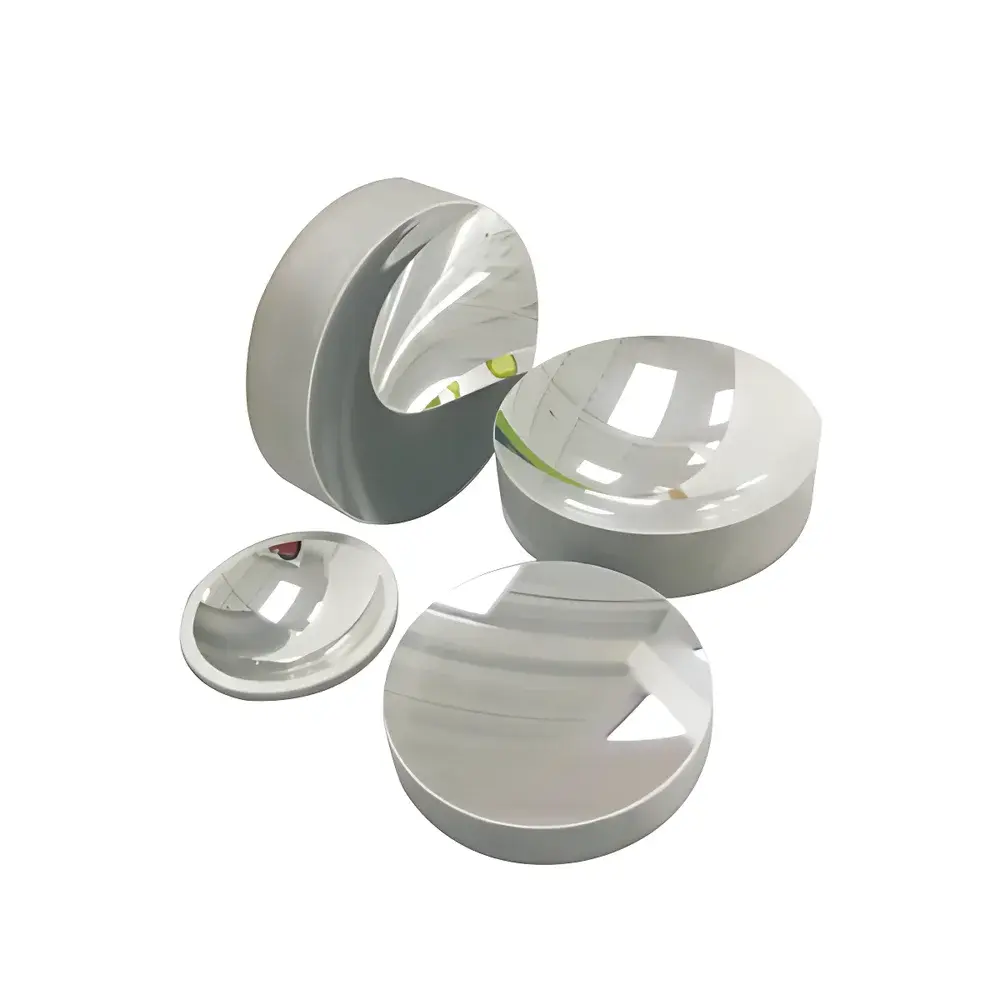
GM13-K9 Plano-Concave Spherical Mirror
| Diameter | 12.5 mm / 12.5 × 12.5 mm / 25.0 mm |
|---|---|
| Focal Length | –5.0 to –150.0 mm |
| Thickness | 3 mm / 6 mm |
| Radius of Curvature | –10.0 to –300.0 mm |
| Substrate Material | K9 Optical Glass |
| Coating | Standard Protected Aluminum (Ravg > 87% @ 400–700 nm) |
| Surface Quality | 60-40 Scratch-Dig |
| Clear Aperture | ≥90% of Diameter |
Overview
The GM13-K9 Plano-Concave Spherical Mirror is a precision optical component engineered for beam expansion, light collimation, and image inversion in demanding laboratory and industrial optical systems. Constructed from high-homogeneity K9 borosilicate crown glass—compliant with ISO 10110-1 and GB/T 903—this mirror features a polished plano surface on one side and a spherically concave surface on the other, delivering predictable negative focal power across the visible spectrum (400–700 nm). Its design adheres to classical Gaussian optics principles: incident collimated light converges at the focal point located at half the radius of curvature (f = R/2), enabling precise ray tracing in laser cavity alignment, interferometry setups, and Fourier optical benches. The concave geometry introduces controlled wavefront divergence, making it especially suitable for applications requiring controlled beam retro-reflection or spatial filtering without introducing higher-order aberrations typical of aspheric elements.
Key Features
- High-precision spherical concave surface manufactured to λ/2 peak-to-valley (PV) surface accuracy per ISO 10110-5, verified via phase-shifting interferometry
- Plano reference surface polished to λ/4 PV flatness, ensuring stable mounting and minimal wavefront distortion at the interface
- Standard protected aluminum coating (Al + SiO₂ overcoat) providing average reflectance >87% across 400–700 nm; optional enhanced coatings available (e.g., UV-enhanced Al, dielectric high-reflectivity @ 532 nm or 1064 nm)
- Consistent edge thickness tolerance ±0.1 mm and center thickness tolerance ±0.05 mm for reproducible kinematic mounting in lens tubes and optomechanical cages
- Scratch-dig specification of 60-40 per MIL-PRF-13830B, validated under 50× magnification with calibrated reference standards
- Thermal stability optimized via K9’s low coefficient of thermal expansion (7.1 × 10⁻⁶ /°C) and annealed substrate structure, minimizing focal drift under ambient lab temperature fluctuations (±2°C)
Sample Compatibility & Compliance
The GM13 series supports integration into standard Ø12.5 mm, Ø25.0 mm, and square 12.5 × 12.5 mm optomechanical mounts (e.g., Thorlabs SM05, SM1, or Newport KM100 series). All mirrors are cleaned to ISO 14644-1 Class 5 cleanroom standards prior to packaging and sealed in nitrogen-purged, static-dissipative containers. Manufacturing complies with ISO 9001:2015 quality management requirements. Surface specifications conform to ISO 10110 parts 1 (drawing notation), 2 (material properties), 3 (surface form), 5 (surface imperfections), and 7 (coating requirements). Documentation includes individual test reports with interferometric surface maps and spectral reflectance curves traceable to NIM (National Institute of Metrology, China).
Software & Data Management
Each GM13 mirror batch is assigned a unique serial number linked to a digital manufacturing dossier containing metrology data (interferograms, spectrophotometry scans, dimensional CMM reports). While the component itself requires no embedded firmware or drivers, full traceability supports GLP-compliant optical system validation workflows. Reflectance and surface error datasets can be exported in CSV and ZMX (Zemax) format for integration into optical design simulations (e.g., Zemax OpticStudio, Code V, FRED). For regulated environments, audit trails—including operator ID, calibration certificate numbers, and environmental monitoring logs during polishing and coating—are retained for ≥10 years in accordance with ISO/IEC 17025 documentation retention guidelines.
Applications
- Laser resonator end mirrors and mode-matching optics in HeNe, diode-pumped solid-state (DPSS), and Ti:sapphire oscillators
- Beam expanders in confocal microscopy and optical coherence tomography (OCT) source arms
- Reference elements in Michelson and Twyman-Green interferometers for cavity length stabilization
- Collimation optics for fiber-coupled LED and VCSEL sources in photometric calibration labs
- Optical path folding in compact spectrometer designs where space-constrained negative focal power is required
- Alignment fiducials in vacuum-compatible UHV optical tables (when specified with low-outgassing coating options)
FAQ
What is the damage threshold for the standard protected aluminum coating?
The LIDT (Laser Induced Damage Threshold) for pulsed 1064 nm, 10 ns pulses is ≥0.5 J/cm²; for CW operation at 532 nm, it is rated at ≤500 W/cm². Exact values depend on beam profile uniformity and spot size—consult the certified LIDT report provided with each batch.
Can these mirrors be used in vacuum environments?
Yes—when ordered with optional vacuum-compatible coating (e.g., bare aluminum or dielectric stacks deposited via ion-assisted e-beam evaporation), they meet outgassing requirements per ASTM E595 for total mass loss (TML) <1.0% and collected volatile condensable materials (CVCM) <0.1%.
Is custom radius of curvature available?
Yes—radii from –3.0 mm to –500.0 mm are manufacturable under OEM agreement, subject to minimum order quantity and extended lead time; all custom variants undergo full interferometric verification.
Do you provide mounting adapters or kinematic cells?
Standard SM-threaded mounts (e.g., SM05RR, SM1RR) and kinematic tip-tilt platforms compatible with GM13 dimensions are available separately; custom adapter plates can be designed upon request with mechanical drawings.
Are measurement uncertainties stated in the test report?
Yes—each report specifies expanded uncertainty (k=2) for radius of curvature (±0.15%), surface flatness (±0.02 λ), and reflectance (±0.8% absolute) based on accredited calibration procedures aligned with ISO/IEC 17025.