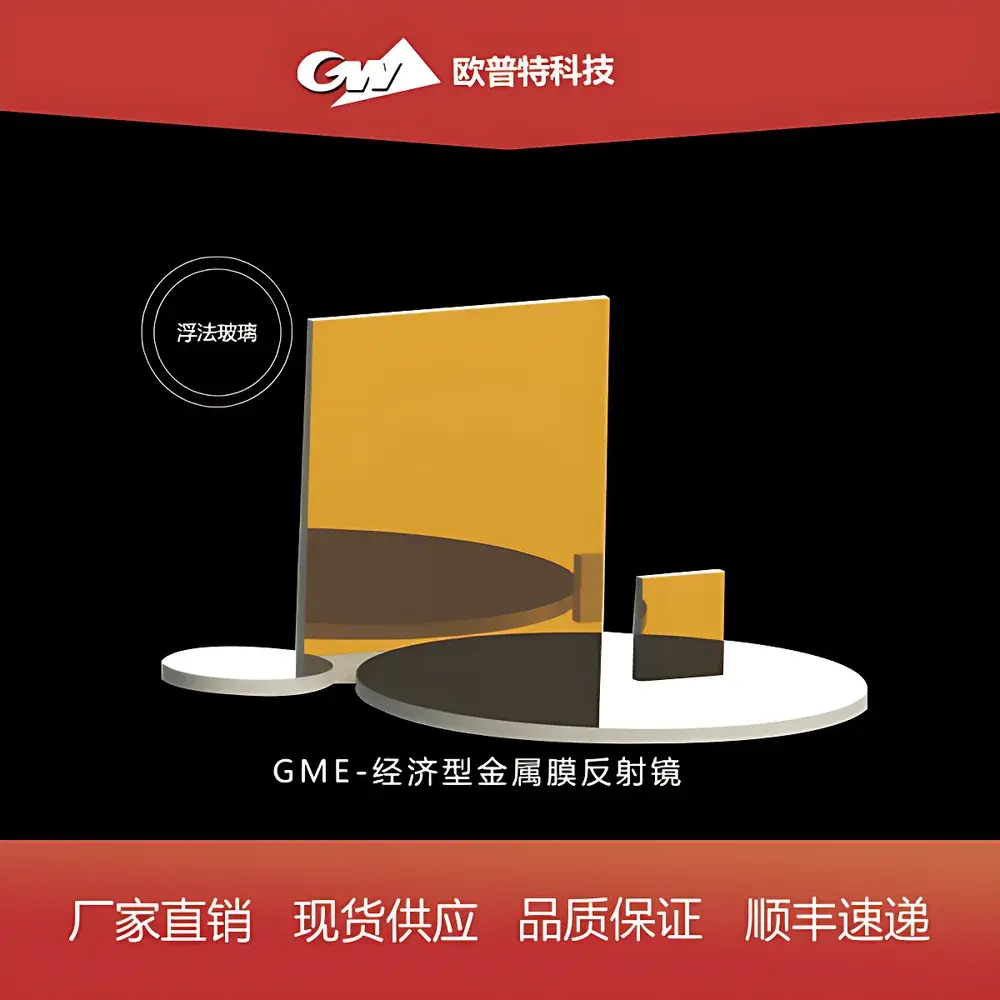
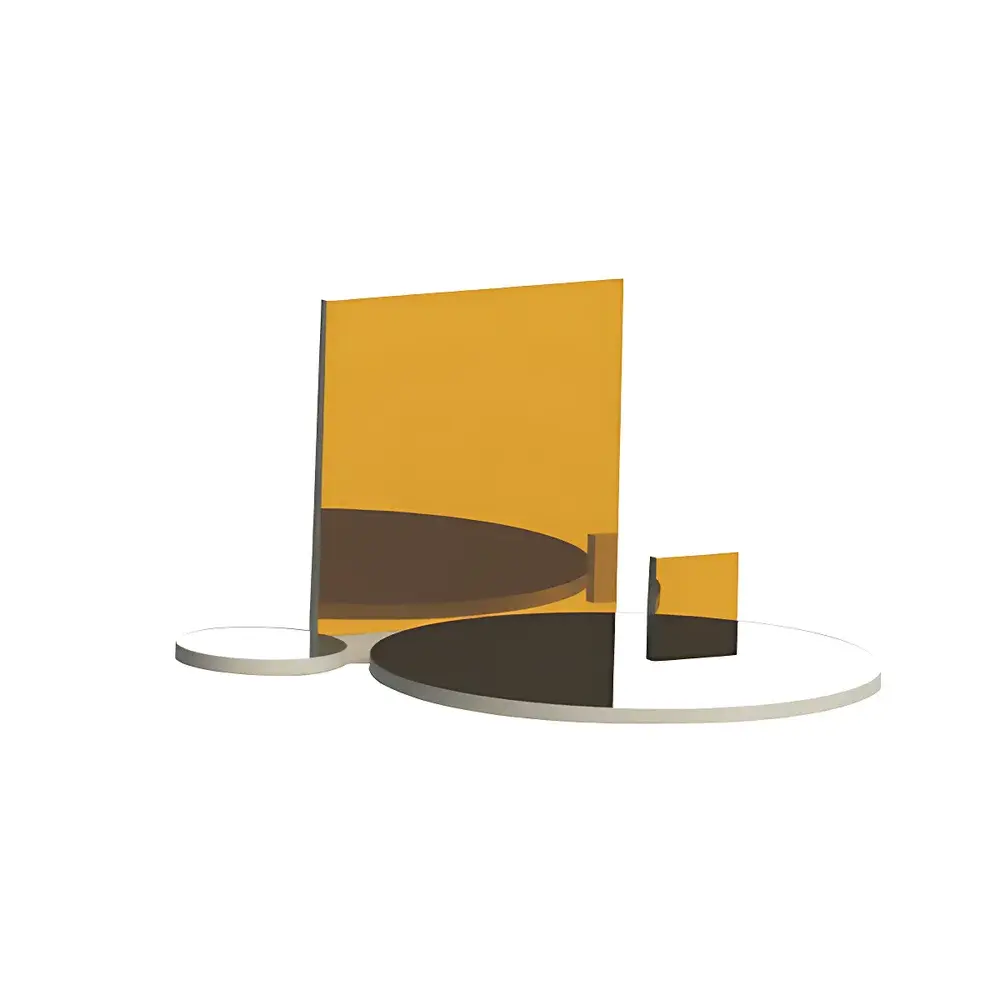
GME Economical Metallic Coated Plane Mirror

| Origin | Beijing, China |
|---|---|
| Manufacturer Type | Distributor |
| Product Origin | Domestic |
| Model | GME |
| Price Range | USD 0.15–75.00 (per unit) |
| Component Category | Optical Element |
| Substrate Material | Float Glass |
| Surface Figure | λ/4–λ/6 @ 25 mm², 633 nm |
| Parallelism | < 3 arcmin |
| Surface Quality | 5 (per MIL-PRF-13830B) |
| Back Surface Finish | Fine Ground or Inspection Polish |
| Dimensional Tolerance | +0.0 / −0.25 mm |
| Thickness Tolerance | ±0.25 mm |
| Edge Treatment | Protective 45° chamfer, 0.2–0.5 mm |
| Coating Options | Protected Aluminum, UV-Enhanced Protected Aluminum, Protected Silver, Protected Gold |
Ask about pricing, availability and specifications.
Overview
The GME Economical Metallic Coated Plane Mirror is a precision optical component engineered for reliable beam steering, alignment, and reference applications in educational laboratories, OEM optomechanical assemblies, and entry-level research instrumentation. Fabricated from high-quality float glass substrate, it provides dimensional stability and low wavefront distortion under standard ambient conditions. Unlike dielectric mirrors optimized for narrowband performance, the GME series utilizes robust metallic thin-film coatings—each overcoated with a durable protective layer—to deliver broad-spectrum reflectance across ultraviolet (UV), visible (VIS), and near-infrared (NIR) spectral regions. Its design adheres to fundamental optical manufacturing standards including MIL-PRF-13830B for surface quality and ISO 10110-7 for surface figure specification. The mirror operates on simple specular reflection physics and requires no active cooling, power, or calibration—making it suitable for passive optical paths in interferometers, laser cavities, spectroscopic setups, and teaching labs.
Key Features
- Float glass substrate with controlled thermal expansion coefficient (≈8.5 × 10⁻⁶ /°C) and low birefringence
- Surface figure specified as λ/4 to λ/6 over a 25 mm² aperture at HeNe wavelength (633 nm), verified via interferometric testing
- Parallelism maintained below 3 arcminutes between incident and exit faces—critical for minimizing beam walk-off in multi-mirror systems
- Surface quality rated Grade 5 per MIL-PRF-13830B, corresponding to ≤5 scratches of width ≤10 µm and ≤5 digs of diameter ≤0.01 mm per 20 mm inspection area
- Protective 45° edge chamfer (0.2–0.5 mm) prevents chipping during handling and mounting
- Four standardized metallic coating variants: protected aluminum (broadband 250–2000 nm), UV-enhanced aluminum (optimized 250–400 nm), protected silver (450–2000 nm), and protected gold (700–12,000 nm)
- Tight dimensional tolerances: ±0.25 mm thickness control and +0.0 / −0.25 mm lateral dimension control ensure repeatable kinematic mounting
Sample Compatibility & Compliance
The GME mirror is compatible with standard optomechanical mounts—including kinematic mirror cells, post-mounted holders, and cage system adapters—due to its consistent thickness (2.3 mm for most sizes; 2.5 mm for 20×20 mm variant) and chamfered edges. All substrates are free of internal striae or bubbles exceeding ISO 10110-3 Class 2 limits. While not certified to ISO 9001 or ISO 14001 at the component level, the manufacturing process follows traceable quality control protocols aligned with general laboratory-grade optical component expectations. No RoHS exemptions apply; all metallic coatings and protective layers comply with EU Directive 2011/65/EU. The product is intended for use in non-life-critical, non-medical-device applications and does not carry FDA 510(k) or CE marking for medical or safety-critical deployment.
Software & Data Management
As a passive optical component, the GME mirror requires no firmware, drivers, or software integration. Reflectance data for each coating type is provided in tabulated form (per ASTM E430 and ISO 9211-4) and referenced in the product datasheet. Users may import these spectral curves into optical design software such as Zemax OpticStudio, CODE V, or FRED for system-level modeling. Batch-specific test reports—including interferograms and photometric measurements—are available upon request for traceability in GLP-aligned environments. No audit trail, electronic signature, or 21 CFR Part 11 compliance is applicable, as the component does not generate, store, or transmit digital data.
Applications
- Laser beam redirection and cavity folding in diode-pumped solid-state (DPSS) and HeNe laser systems
- Reference surfaces in Michelson and Mach-Zehnder interferometers
- Alignment targets and fiducial markers in optical metrology benches
- Light collection and relay optics in UV-Vis spectrophotometers and fluorescence readers
- Cost-sensitive prototyping of optical trains in university teaching labs and student projects
- OEM integration into industrial sensors, barcode scanners, and machine vision illumination modules
FAQ
What is the typical reflectance of the protected aluminum coating in the visible spectrum?
Protected aluminum achieves ≥88% average reflectance from 450–650 nm, with peak values near 92% at 550 nm.
Can the GME mirror be used in vacuum environments?
Yes—float glass substrates and oxide-protected metallic films exhibit low outgassing rates (≤1×10⁻¹⁰ Pa·m³/s·cm² per ASTM E595), making them suitable for moderate vacuum (<10⁻⁴ Torr) applications without special bake-out.
Is custom sizing or coating available?
Standard configurations cover diameters from Φ5.0 mm to Φ20.0 mm and rectangles up to 15×21 mm; custom dimensions and coating combinations (e.g., enhanced UV Al on fused silica) are available under NRE-supported engineering engagement.
How should the mirror be cleaned to preserve coating integrity?
Use solvent-rinsed lens tissue with spectroscopic-grade acetone or isopropanol; avoid abrasive wipes, ultrasonic baths, or ammonia-based cleaners which may degrade protective layers.
Does the mirror meet laser-induced damage threshold (LIDT) specifications?
No LIDT rating is assigned; the GME series is intended for low-to-moderate power CW applications (<500 mW/cm² at 532 nm). For pulsed or high-power use, consult application-specific qualification testing.