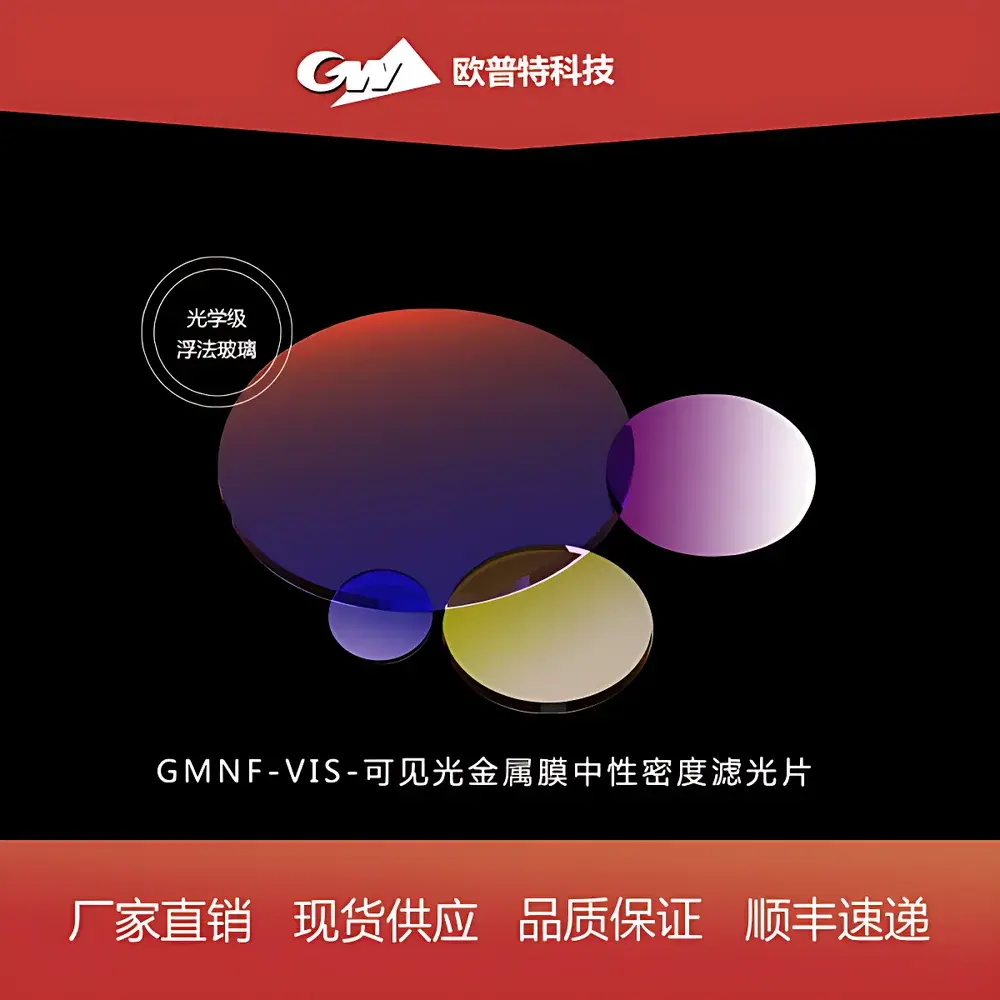
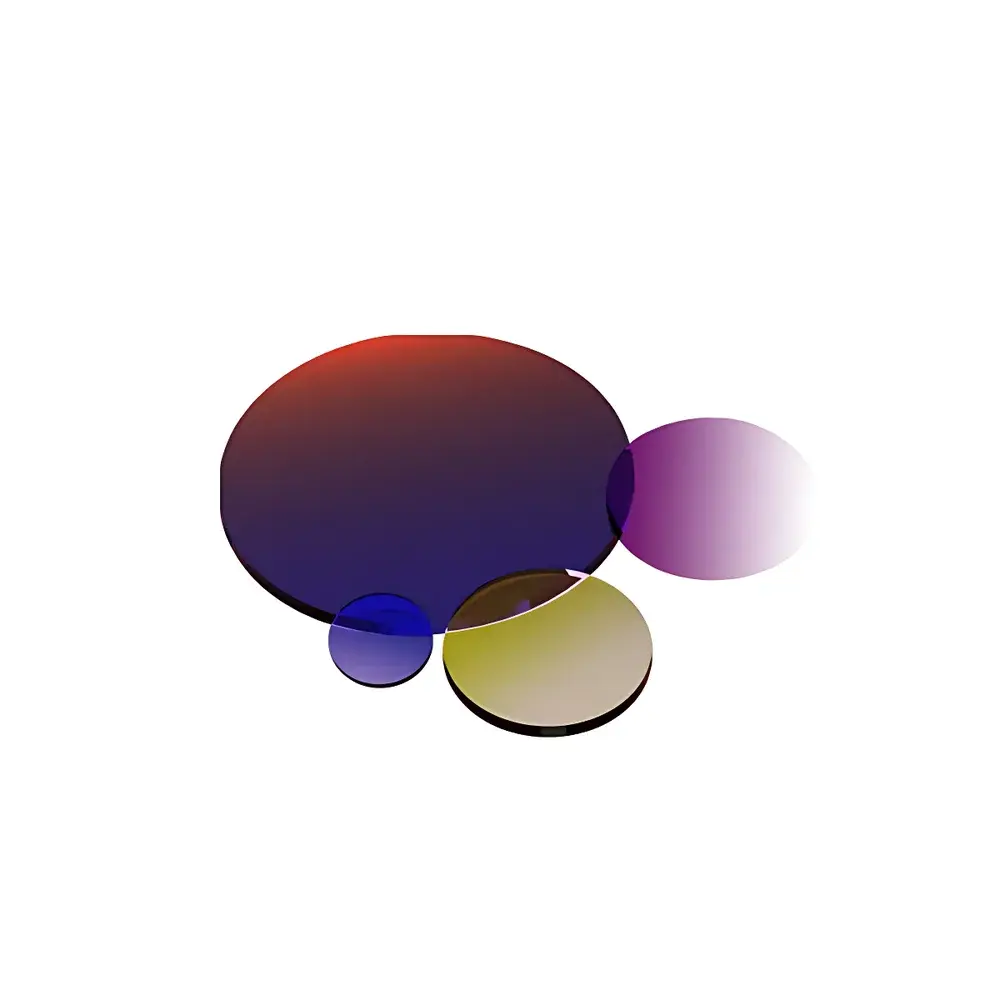
GMNF-VIS Visible-NIR Metallic Neutral Density Filters

| Origin | Beijing, China |
|---|---|
| Manufacturer Type | Authorized Distributor |
| Origin Category | Domestic (China) |
| Model | GMNF-VIS |
| Price Range | USD 1–700 |
| Component Category | Optical Element |
| Optical Density (OD) | 0.1–3.0 |
| Transmission (T) | 79%–0.1% |
| Design Wavelength | 550 nm |
| Available Diameters | Φ12.5 mm, Φ25 mm, 50×50 mm square |
| Substrate Material | Optical Glass (BK7 or equivalent) |
| Coating Type | Vacuum-deposited metallic neutral density film |
| Surface Quality | 60-40 scratch-dig |
| Parallelism | <1 arcmin |
| Clear Aperture | ≥90% of nominal dimension |
| Damage Threshold | >500 MW/cm² (for pulsed lasers, 10 ns @ 1064 nm), >5 W/cm² (CW, 532 nm) |
Ask about pricing, availability and specifications.
Overview
The GMNF-VIS series comprises precision-engineered metallic neutral density (ND) filters designed for stable, spectrally flat attenuation across the visible spectrum (400–700 nm), with peak calibration at 550 nm. Unlike absorptive polymer-based ND filters, these components utilize a vacuum-sputtered metallic thin-film coating—typically nickel-chromium (NiCr) or inconel—on high-homogeneity optical glass substrates (e.g., BK7). This architecture ensures exceptional optical density uniformity (<±0.03 OD across clear aperture), minimal wavefront distortion (λ/4 @ 633 nm), and negligible spectral shift under angular incidence up to ±5°. The filters operate on the principle of controlled partial reflection and absorption, delivering true neutral attenuation without introducing color cast or polarization-dependent loss—critical for quantitative imaging, photometric calibration, laser power management, and interferometric alignment.
Key Features
- Vacuum-deposited metallic ND coating enabling high laser damage resistance and long-term stability under ambient and moderate vacuum conditions
- Optical density tolerance: ±0.05 OD (certified per ISO 9022-3 for photometric accuracy)
- Flat spectral response: transmission variation <±3% over 400–650 nm for OD ≤1.0; <±5% up to OD 3.0
- Low polarization dependence: <0.5% peak differential transmission (s- vs p-polarized light, 0–10° AOI)
- Standard mounting compatibility: threaded cells (SM1, SM25), kinematic mounts, and custom flange options available upon request
- Traceable calibration: each filter batch includes NIST-traceable spectral transmittance data (380–780 nm, 1 nm resolution)
Sample Compatibility & Compliance
The GMNF-VIS filters are compatible with standard optical breadboards, cage systems (e.g., Thorlabs CAGE, Newport 30 mm), and OEM integration into spectrophotometers, confocal microscopes, and laser safety interlocks. All units comply with ISO 10110-7 (surface imperfections), ISO 9211-4 (optical coatings), and RoHS 2015/863/EU directives. For regulated environments—including clinical imaging R&D, aerospace sensor validation, and GLP-compliant photobiomodulation studies—the filters support full documentation packages (CoC, CoA, spectral scan reports) and can be supplied with optional 21 CFR Part 11–compliant electronic records when integrated with validated instrument control software.
Software & Data Management
While the GMNF-VIS is a passive optical component, its performance is fully characterized and documented using industry-standard metrology tools: PerkinElmer Lambda 1050+ UV/Vis/NIR spectrophotometer (traceable to NIST SRM 2036), Zygo Verifire™ interferometer (for wavefront analysis), and Gentec-EO XLP12-3S-H1 thermopile sensors (for laser damage threshold verification). Spectral transmission datasets (.csv and .sdf formats) are provided with each order. For automated optical system calibration workflows, the filters integrate seamlessly with LabVIEW™, MATLAB® Instrument Control Toolbox, and Python-based PyVISA drivers via third-party spectrometer interfaces. Batch-specific calibration certificates include uncertainty budgets per GUM (JCGM 100:2008) and are archived for ≥10 years.
Applications
- Laser power attenuation in CW and pulsed systems (Ti:Sapphire, DPSS, fiber lasers) prior to beam profiling or photodetector input
- Dynamic range extension in scientific CMOS and EMCCD cameras during fluorescence lifetime imaging (FLIM) or particle image velocimetry (PIV)
- Reference standards for photometric linearity verification in ISO/IEC 17025-accredited calibration labs
- Attenuation staging in Michelson and Mach-Zehnder interferometers to balance arm intensities
- Neutral reference elements in hyperspectral push-broom sensor characterization (EN 13032-4 compliant)
- OEM integration into medical endoscopy illumination modules requiring FDA 510(k)-aligned optical safety margins
FAQ
What is the maximum incident angle for maintaining specified OD accuracy?
For OD ≤1.0, angular deviation remains within ±0.03 OD up to ±5°; for OD ≥2.0, limit is ±3° due to increased coating interference effects.
Are custom sizes or non-standard OD values available?
Yes—custom diameters (Φ6 mm to Φ100 mm), rectangular formats (up to 75×75 mm), and OD values in 0.05 increments (0.05–4.0) are available with 4–6 week lead time and NIST-traceable certification.
Do these filters exhibit thermal drift under prolonged CW illumination?
Measured thermal-induced OD shift is <0.002 OD/°C (tested at 5 W/cm², 532 nm, 60 min exposure); substrate thermal expansion coefficient is matched to minimize stress-induced birefringence.
Can GMNF-VIS filters be cleaned using standard optical protocols?
Yes—use spectroscopic-grade acetone followed by IPA, applied with Class 100 cleanroom swabs; avoid ultrasonic cleaning or abrasive solvents to preserve metallic film integrity.
Is there batch-to-batch OD repeatability data available?
Yes—process capability index (Cpk) ≥1.67 across 12 consecutive production lots (2022–2024), verified via in-line spectrophotometric sampling (n=30/filter OD grade).