
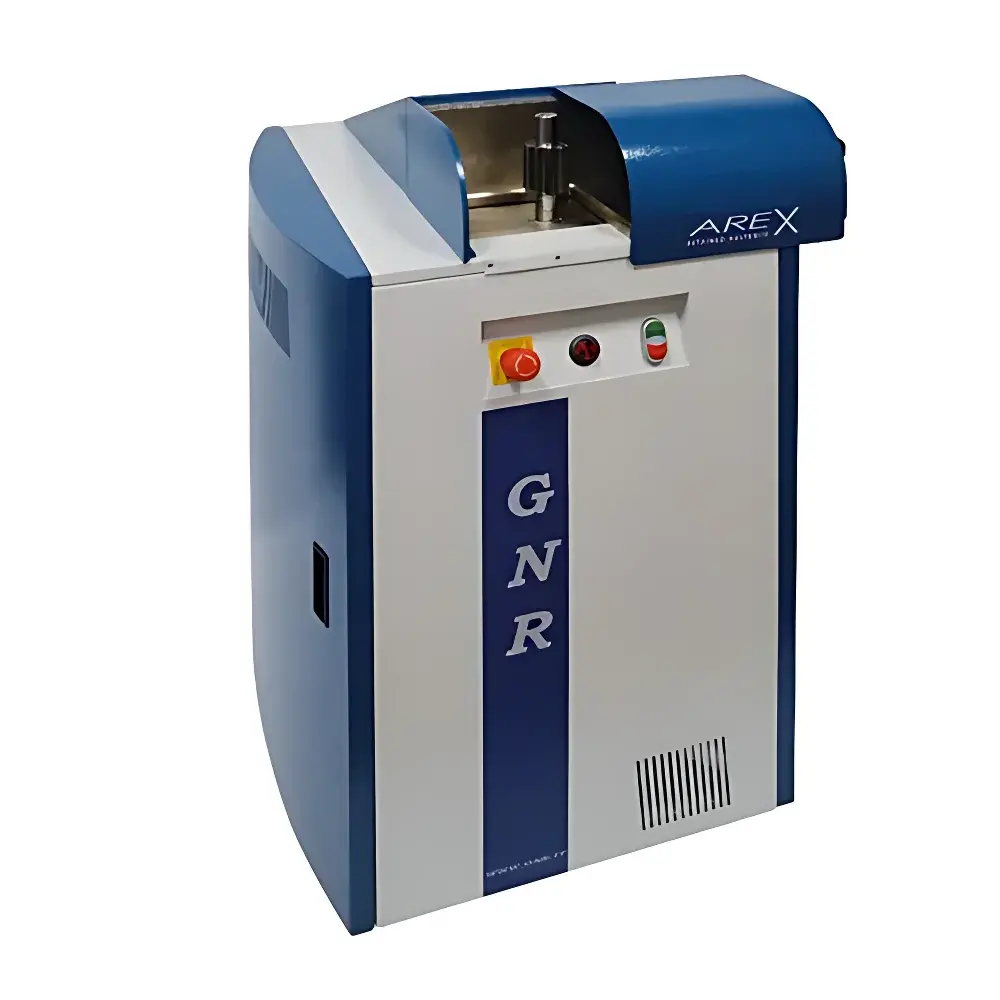
GNR AREX L Residual Austenite Analyzer
| Brand | GNR |
|---|---|
| Origin | Italy |
| Model | AREX L |
| Compliance | ASTM E975 |
| Measurement Principle | X-ray Diffraction (XRD) |
| Detection Limit | ≤0.5% austenite |
| Target Material | Ferrous alloys (steel, cast iron, heat-treated components) |
| X-ray Source | High-power ceramic X-ray tube |
| Optics | High-focus single-capillary collimator |
| Detector | High-resolution CCD detector |
| Stability Control | Precision closed-loop feedback circuit for HV/current regulation |
| Data Acquisition | Multi-peak intensity ratio analysis (austenite {220}, {311} / ferrite {200}, {211}) |
Overview
The GNR AREX L Residual Austenite Analyzer is a dedicated benchtop X-ray diffraction (XRD) system engineered for quantitative phase analysis of retained austenite in ferrous metallurgical materials. It operates on the fundamental principle of Bragg’s law, utilizing characteristic Cu-Kα radiation to resolve and integrate diffraction intensities from specific crystallographic planes—namely austenite (γ-Fe) reflections at {220} and {311}, and ferrite (α-Fe) reflections at {200} and {211}. This multi-peak ratio methodology enables robust quantification even in samples with non-ideal crystallite orientation, mitigating errors associated with texture-induced intensity bias. Designed in strict alignment with ASTM E975, “Standard Test Method for Determining Retained Austenite Content of Steel by X-Ray Diffraction,” the AREX L delivers trace-level detection capability down to 0.5 vol.% retained austenite, making it suitable for quality control in automotive gear steels, bearing components, tool steels, and case-hardened parts where phase stability directly correlates with fatigue life, dimensional stability, and wear resistance.
Key Features
- Dedicated multi-peak XRD configuration compliant with ASTM E975, supporting simultaneous acquisition and integrated intensity evaluation of γ-{220}, γ-{311}, α-{200}, and α-{211} reflections
- High-stability X-ray generation via a sealed ceramic X-ray tube with rated power optimized for surface-sensitive residual stress and phase analysis
- Precision single-capillary collimator delivering sub-0.1 mm beam diameter and enhanced angular resolution for improved peak separation
- Cooling-integrated high-resolution CCD detector with low-noise readout architecture, enabling high signal-to-noise ratio across low-intensity austenite peaks
- Real-time closed-loop feedback control system regulating tube voltage and filament current to maintain ±0.1% output stability over extended measurement cycles
- Automated beam alignment and sample positioning routines minimizing operator dependency and inter-laboratory variability
Sample Compatibility & Compliance
The AREX L accommodates flat, polished metal specimens up to 100 mm × 100 mm and thicknesses ranging from 0.5 mm to 25 mm. Surface preparation follows ASTM E45 and ISO 643 standards: mechanical grinding followed by fine polishing (≤0.05 µm diamond suspension) and etching-free analysis to preserve near-surface phase integrity. The instrument supports both bulk and near-surface (≈10–30 µm depth) measurements depending on incident angle and absorption coefficient. All measurement protocols, calibration procedures, and report generation are fully traceable to NIST-traceable reference materials (e.g., NIST SRM 2982, Fe–Ni austenitic standards). System documentation and audit trails comply with GLP and GMP requirements; raw diffraction data files adhere to the IUCr CIF 1.1 format for third-party verification.
Software & Data Management
The proprietary AREX Control Suite provides guided workflow execution—from automated scan parameter selection (2θ range, step size, dwell time) to peak deconvolution using pseudo-Voigt fitting and Rietveld-assisted background subtraction. Quantitative results are calculated using the direct comparison method per ASTM E975 Annex A1, with optional internal standard correction available. Software enforces user role-based access control, electronic signature capture, and full 21 CFR Part 11-compliant audit trail logging—including timestamps, operator ID, parameter modifications, and raw data hash verification. Export formats include PDF analytical reports, CSV intensity tables, and .xye diffraction patterns compatible with TOPAS, MAUD, and GSAS-II.
Applications
- Quality assurance of carburized, nitrided, or induction-hardened steel components in automotive and aerospace supply chains
- Process validation for cryogenic treatment, tempering cycles, and post-machining stabilization heat treatments
- Failure analysis investigations involving delayed cracking, hydrogen embrittlement, or transformation-induced plasticity anomalies
- R&D of advanced high-strength steels (AHSS), maraging steels, and TRIP/TWIP alloys requiring precise phase fraction mapping
- Calibration support for destructive methods such as dilatometry and TEM-based phase quantification
FAQ
Does the AREX L require external cooling water or compressed air?
No—the ceramic X-ray tube is air-cooled with redundant thermal monitoring; no auxiliary utilities are required beyond standard 230 V AC power.
Can the system measure retained austenite in coated or plated steel substrates?
Yes, provided the coating thickness is ≤5 µm and composed of low-Z elements (e.g., Zn, Cr); thicker or high-absorption coatings (e.g., Ni, Co) necessitate grazing-incidence geometry, which is supported via optional motorized tilt stage.
Is spectral calibration traceable to international standards?
Yes—factory calibration uses NIST SRM 660c (LaB₆) and SRM 640e (Si), with annual recalibration recommended per ISO/IEC 17025 accredited service providers.
What sample preparation standards does GNR recommend for optimal reproducibility?
Per ASTM E975 Section 7.2: mirror-finish polishing without etching, surface roughness Ra < 0.02 µm, and cleaning with acetone followed by ethanol ultrasonication.
How is measurement uncertainty estimated in AREX L reports?
Combined standard uncertainty is calculated per GUM (JCGM 100:2008), incorporating contributions from peak integration error (±0.15%), detector linearity (±0.08%), and reference intensity ratio variability (±0.12%), yielding typical expanded uncertainty (k=2) of ±0.4 vol.% at 1% austenite level.





