
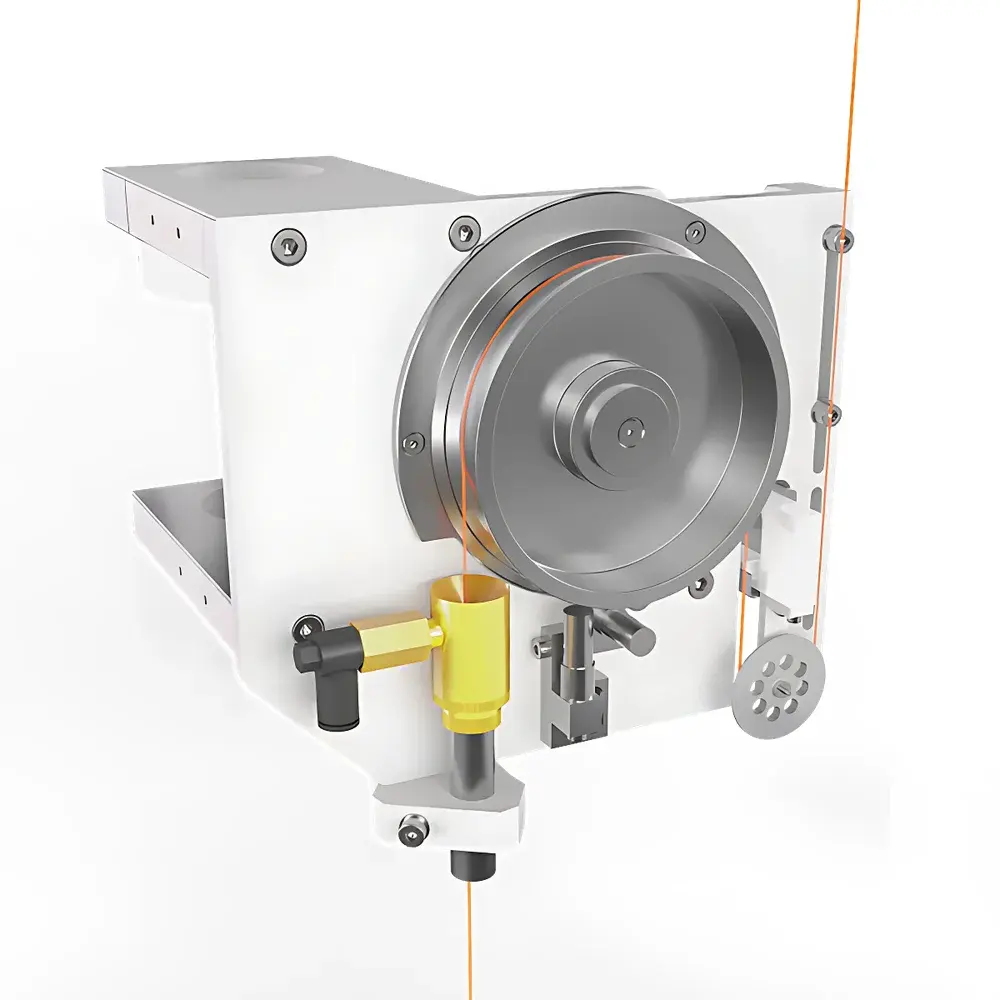
Goettfert Haul-Off Melt Extensional Rheometer
| Brand | Goettfert |
|---|---|
| Origin | Germany |
| Model | Haul-Off |
| Speed Range | 0–600 m/min (optional up to 2000 m/min) |
| Force Range | 0–1.0 N |
| Force Resolution | 0.05 mN |
| Acceleration Modes | Linear or Exponential |
| Dimensions (L×W×H) | 360 × 300 × 360 mm |
| Weight | 10 kg |
Overview
The Goettfert Haul-Off Melt Extensional Rheometer is a precision-engineered instrument designed for the quantitative characterization of polymer melt extensional rheology under controlled uniaxial elongation. Unlike rotational rheometers that measure shear-dominated responses, the Haul-Off applies well-defined tensile deformation—either at constant velocity or with programmable linear/exponential acceleration—to extruded polymer strands, enabling direct measurement of extensional stress growth, apparent extensional viscosity, draw ratio, and melt strength. Its operation is grounded in the principle of uniaxial filament stretching, where a molten polymer strand is drawn between two counter-rotating traction rollers while real-time force and displacement data are acquired. This methodology aligns with fundamental constitutive frameworks such as the Trouton ratio analysis and strain-hardening evaluation, making it indispensable for studying strain-rate-dependent extensional behavior critical to fiber spinning, film blowing, and blow molding processes.
Key Features
- Programmable draw speed from 0 to 600 m/min (upgradable to 2000 m/min), offering broad coverage across low-speed melt stability testing and high-speed industrial simulation scenarios.
- Selectable acceleration profile—linear or exponential—enabling precise replication of transient extensional conditions encountered during start-up or process upsets.
- Traction rollers with non-stick surface coating ensure consistent strand contact without slippage or thermal degradation, preserving sample integrity during high-velocity drawing.
- High-resolution force transducer (0–1.0 N range, 0.05 mN resolution) delivers traceable, low-noise tension measurements essential for detecting subtle strain-hardening onset.
- Fully software-integrated control architecture allows parameter definition, real-time monitoring, synchronized data acquisition, and post-test calculation of extensional viscosity (ηE), draw ratio (λ), and true strain rate (ε̇).
Sample Compatibility & Compliance
The Haul-Off is compatible with thermoplastic melts extruded via capillary rheometers or single-screw extruders (e.g., Goettfert Rheotens, Cogswell-type dies), supporting standard die geometries (e.g., 1 mm or 2 mm diameter, L/D ≥ 10). It accommodates both steady-state and transient extensional protocols per ISO 11443 Annex D (determination of extensional viscosity) and ASTM D3835 (extrusion plastometer-based melt characterization). The system’s mechanical design and calibration traceability support GLP-compliant environments; raw force and position data logs meet audit requirements for 21 CFR Part 11–aligned workflows when paired with validated software versions.
Software & Data Management
Control and analysis are executed via Goettfert’s proprietary WinRheo software platform, which provides intuitive graphical setup of velocity profiles, real-time oscilloscope-style display of force vs. time/strain, and automated derivation of extensional viscosity curves (ηE vs. ε̇). All datasets are stored in structured binary format with embedded metadata (date, operator ID, test parameters, calibration stamps). Export options include CSV, Excel, and PDF reports compliant with internal QA documentation standards. Software validation packages—including IQ/OQ documentation templates—are available upon request for regulated laboratories operating under GMP or ISO/IEC 17025 accreditation.
Applications
- Quantifying strain-hardening behavior of polyolefins (e.g., LLDPE, mLLDPE) for film bubble stability prediction in blown film lines.
- Evaluating melt strength degradation in recycled PET or bio-based polymers subjected to multiple thermal histories.
- Correlating extensional viscosity response with spinline stability in melt spinning of nylon or polypropylene fibers.
- Supporting material selection for thermoforming-grade ABS or PC by assessing sag resistance under gravity-induced extension.
- Validating constitutive model parameters (e.g., Pom-Pom, K-BKZ, or Giesekus) used in CAE simulations of extrusion-based additive manufacturing.
FAQ
Can the Haul-Off be integrated with an existing capillary rheometer?
Yes—it is routinely coupled with Goettfert Rosand RH series or similar capillary systems using standardized mounting interfaces and synchronized trigger signals.
Is temperature control built into the Haul-Off unit?
No—the Haul-Off operates at ambient conditions; melt temperature is maintained upstream via the extrusion source (e.g., heated die or rheometer barrel). Optional environmental enclosures are available for ambient humidity or draft mitigation.
What calibration standards are provided with the system?
A NIST-traceable dead-weight calibration kit for force transducer verification and certified roller diameter gauges are included with initial commissioning.
Does the system support automated sequence testing?
Yes—WinRheo supports batch-mode execution of multi-step velocity/acceleration profiles, with pass/fail criteria based on user-defined thresholds for maximum force or break strain.
How is melt fracture or necking detected during testing?
Real-time force deviation from expected exponential growth, combined with high-speed visual observation (via optional USB microscope integration), enables early identification of instability onset prior to rupture.



