
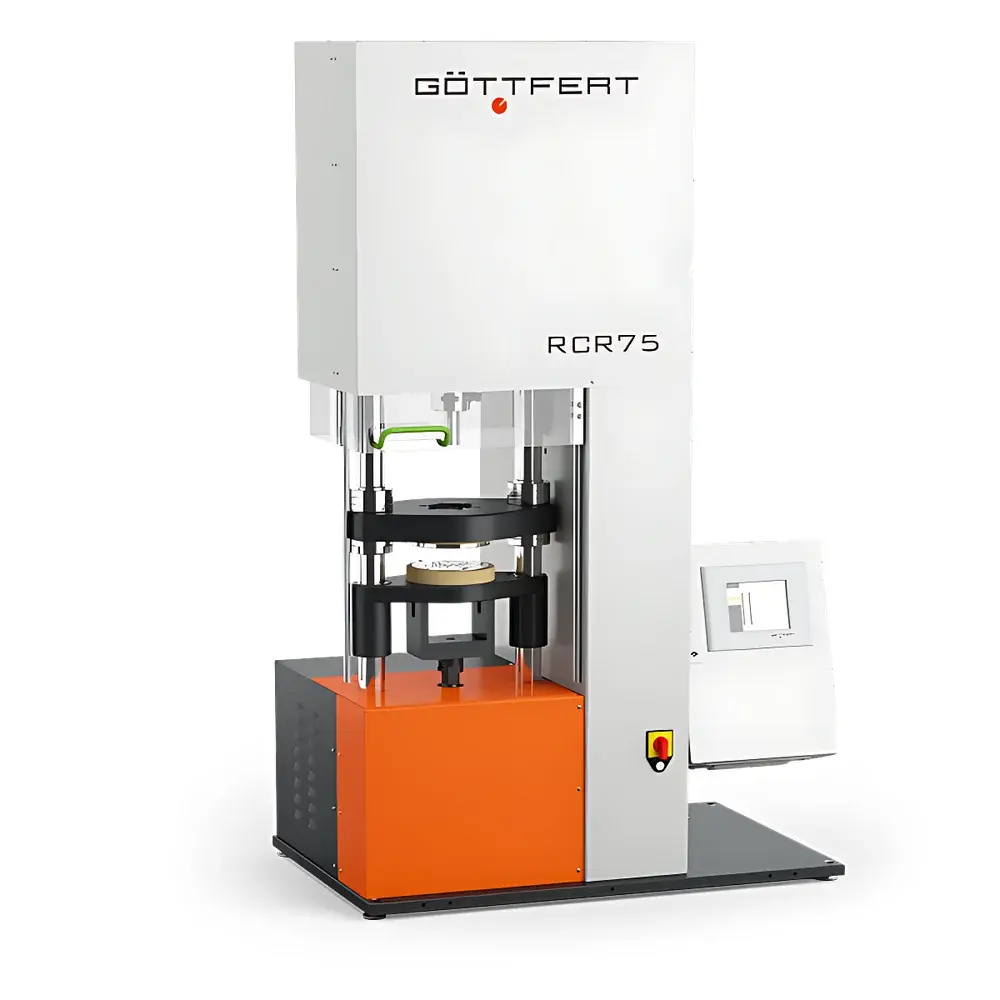
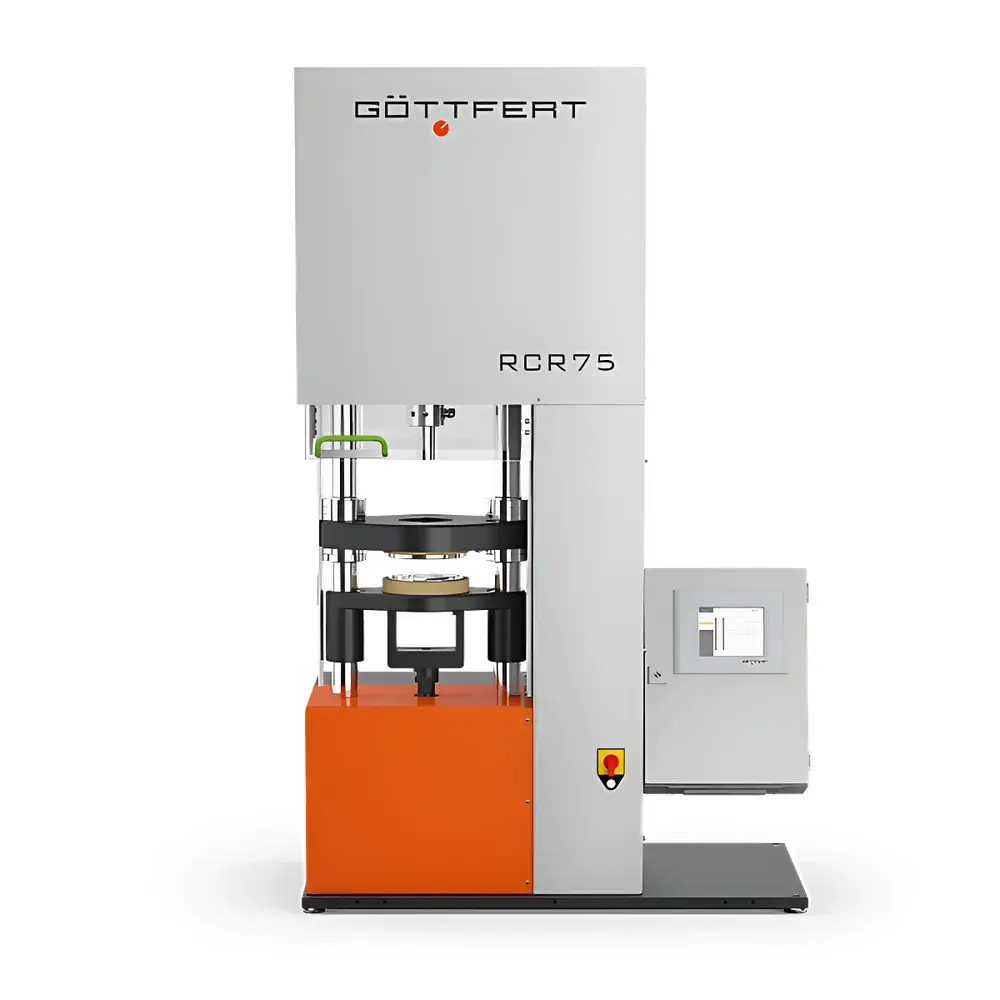
Goettfert RCR75 Capillary Rheometer for Rubber Testing
| Brand | Goettfert |
|---|---|
| Origin | Germany |
| Model | RCR75 |
| Maximum Force | 75 kN |
| Capillary Die Ratio | 20:1 |
| Piston Diameters | 20 / 30 / 35 mm |
| Temperature Range | Ambient to 240 °C |
| Temperature Resolution | 0.01 °C |
| Temperature Stability | ±0.2 °C |
| Speed Resolution | 6.4 × 10⁻⁷ mm/s |
| Dynamic Speed Ratio | 1:800,000 |
| Acceleration | 0–15 mm/s in 0.35 s |
| Compliance Standards | ASTM D5099, ISO 11443, GFT 014-02 |
Overview
The Goettfert RCR75 Capillary Rheometer is a high-precision, thermally controlled instrument engineered specifically for the rheological characterization of uncured and compounded rubber materials under conditions closely simulating industrial processing—particularly extrusion and injection molding. Operating on the principle of capillary rheometry, the RCR75 measures shear stress, shear rate, and apparent viscosity by forcing molten polymer through a precision-machined die (standard 20:1 L/D ratio) while simultaneously recording piston displacement, load, and temperature with metrological traceability. Its 75 kN hydraulic actuation system enables reliable testing of highly filled, high-viscosity elastomeric compounds—including silica- or carbon-black-reinforced rubber formulations—that exhibit significant normal stress differences and strong wall-slip behavior. Unlike rotational rheometers, capillary rheometry provides direct access to extensional flow contributions and melt fracture onset, making the RCR75 indispensable for compound development, process window definition, and QC/QA validation in tire, sealing, and automotive rubber manufacturing.
Key Features
- 75 kN high-force hydraulic drive system with closed-loop pressure control, ensuring stable force delivery across full speed range and minimizing inertial artifacts during rapid acceleration.
- Triple-piston configuration support (20 mm, 30 mm, and 35 mm diameters) allows optimization of shear rate coverage and pressure sensitivity per material class—enabling both low-shear characterization of masterbatches and high-shear simulation of die entry conditions.
- Ultra-high-resolution linear encoder (6.4 × 10⁻⁷ mm resolution) coupled with real-time position feedback delivers sub-micron displacement accuracy critical for calculating true strain rate and detecting subtle melt instabilities such as sharkskin or gross melt fracture.
- Dual-mode operational architecture: extrusion mode (continuous or stepwise) for steady-state flow curve generation and die swell analysis; injection mode (programmable stroke profile) for transient pressure decay, fill time correlation, and gate freeze-off assessment.
- Thermal chamber with active air circulation and PID-controlled heating elements maintains uniform temperature distribution (±0.2 °C stability) across the barrel, die, and piston assembly up to 240 °C—validated per ASTM E74 and ISO/IEC 17025 calibration protocols.
- Dynamic speed range of 1:800,000 supports measurement from 10⁴ s⁻¹, accommodating both slow relaxation studies and high-rate processing simulations without hardware reconfiguration.
Sample Compatibility & Compliance
The RCR75 accommodates raw rubber compounds, sulfur-cured stocks, thermoplastic elastomers (TPEs), and highly filled elastomer blends in pellet, crumb, or preformed slug form. Its robust barrel design and interchangeable die sets comply with internationally recognized test standards including ASTM D5099 (Standard Test Method for Determining the Melt Flow Rate of Thermoplastics Using Capillary Rheometers), ISO 11443 (Plastics — Determination of the Rheological Properties of Molten Polymers Using Capillary Rheometers), and GFT 014-02 (German Rubber Industry Association specification for rubber compound evaluation). All thermal and mechanical calibrations are traceable to national metrology institutes (PTB, NIST), and the system architecture supports audit-ready documentation required under GLP and GMP environments.
Software & Data Management
Control and analysis are performed via Goettfert’s WinRHEO software platform, a Windows-based application compliant with FDA 21 CFR Part 11 requirements for electronic records and signatures. The software features automated test sequence programming, real-time visualization of pressure–time, force–displacement, and viscosity–shear rate curves, and built-in calculation modules for Bagley, Rabinowitsch, and Weissenberg corrections. Raw data export is supported in CSV, ASCII, and XML formats; all measurement metadata—including calibration certificates, environmental logs, and user authentication trails—is embedded and timestamped. Optional integration with LIMS systems enables seamless transfer of validated results into enterprise quality databases.
Applications
- Development and optimization of rubber compound formulations for improved extrudability and mold filling behavior.
- Quantification of die swell ratio (B) and its dependence on shear rate, temperature, and filler loading.
- Identification of critical shear rates associated with melt fracture onset—essential for die design and process troubleshooting.
- Correlation of laboratory-scale capillary data with production-line extruder output, enabling predictive modeling of throughput and energy consumption.
- QC release testing of incoming raw materials and final compounds against internal specifications or customer-defined flow envelopes.
- Support for regulatory submissions requiring rheological evidence of batch-to-batch consistency in medical-grade elastomers (e.g., ISO 10993-17).
FAQ
What is the primary difference between capillary and rotational rheometry for rubber testing?
Capillary rheometry subjects the sample to uniaxial extensional and high-shear compressive flow fields representative of actual processing equipment, whereas rotational rheometry applies simple shear in a confined gap—often insufficient to capture wall slip or extensional thickening effects dominant in filled rubber systems.
Can the RCR75 be used for thermoset rubber compounds?
Yes—provided the compound remains stable at elevated temperatures for the duration of the test cycle; crosslinking onset must be assessed independently (e.g., via DSC) to ensure measurements reflect true melt rheology rather than early-stage vulcanization.
Is the system compatible with automated sample handling?
Optional accessories include an auto-feeder for sequential slug loading and an automated die cleaning module that reduces operator intervention and improves inter-test reproducibility.
How is temperature uniformity verified across the barrel and die?
Goettfert supplies factory-verified temperature mapping reports per IEC 60584 and ASTM E220, conducted using calibrated miniature thermocouples at ≥12 axial and radial locations under static and dynamic operating conditions.
Does WinRHEO support multi-user permission levels and electronic audit trails?
Yes—role-based access control (administrator, analyst, reviewer), full electronic signature workflows, and immutable audit logs of all parameter changes, test executions, and data exports are natively implemented and configurable per organizational SOPs.



