
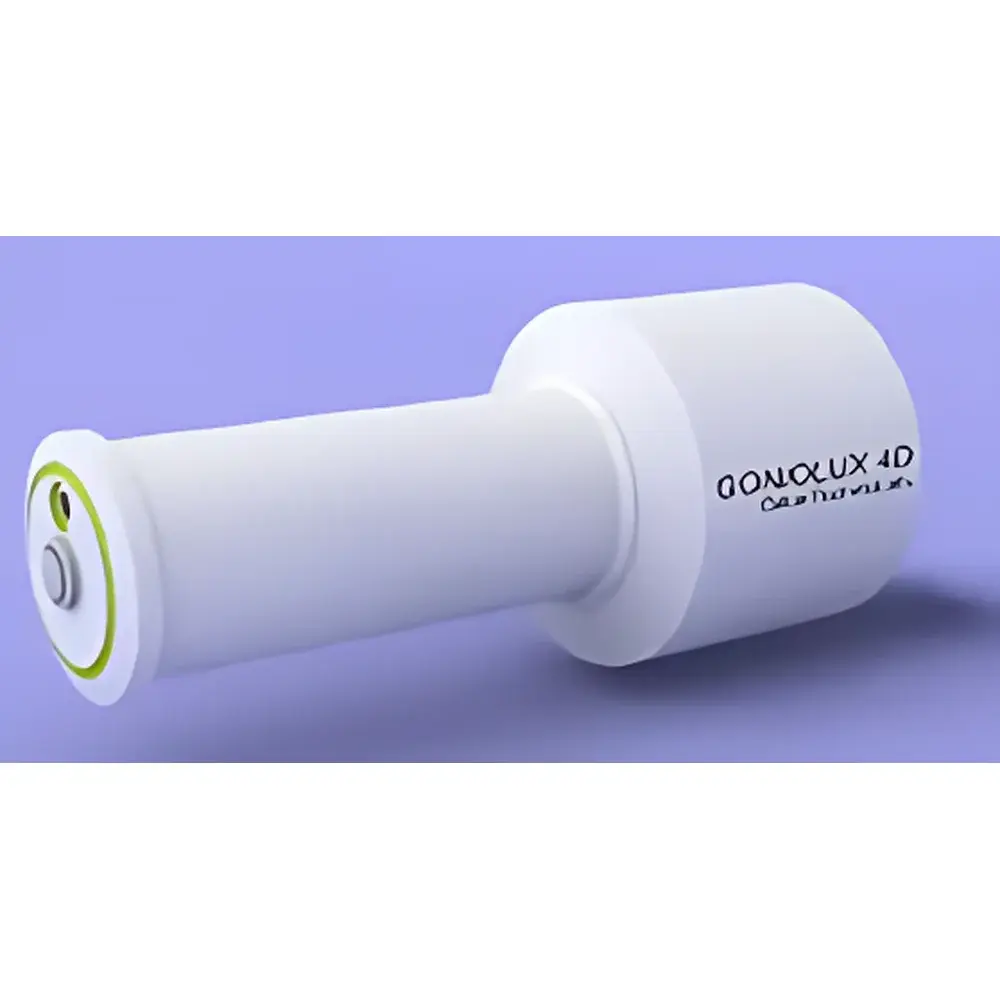
GonioLux 4D Skin Glossmeter by ORION
| Brand | ORION |
|---|---|
| Origin | France |
| Model | GonioLux 4D |
| Type | Multi-Angle Reflectance Spectrophotometer for Cutaneous Surface Analysis |
| Regulatory Compliance | CE-marked, ISO 13694-compliant optical measurement architecture |
| Intended Use | Non-invasive, quantitative assessment of skin surface reflectance, gloss, and microtopographic-related luminance distribution |
Overview
The GonioLux 4D Skin Glossmeter is a precision-engineered, non-contact optical instrument designed for the quantitative characterization of cutaneous surface reflectance properties. Developed by ORION (France), it operates on the principle of multi-angle goniophotometric measurement—capturing directional reflectance profiles across a defined angular range (typically ±75° in azimuth and ±45° in elevation) under controlled D65 illuminant conditions. Unlike conventional single-angle glossmeters, the GonioLux 4D acquires high-resolution spectral radiance data at up to 1,296 discrete angular positions per measurement cycle, enabling reconstruction of the Bidirectional Reflectance Distribution Function (BRDF) for human skin. This capability supports objective, operator-independent evaluation of skin surface optical behavior—including specular gloss, diffuse luminance, anisotropic scattering, and microrelief-induced light modulation—critical for dermatological research, cosmetic formulation development, and clinical trial endpoint quantification.
Key Features
- Four-dimensional acquisition mode: Simultaneous spatial (x,y), angular (θ,φ), and spectral (380–780 nm, 5 nm resolution) data capture
- Motorized dual-goniometric stage with sub-arcminute positional repeatability (±0.05°)
- Calibrated silicon photodiode array detector with NIST-traceable spectral responsivity
- Integrated thermal stabilization (±0.1°C) to minimize drift during extended acquisition sequences
- Non-invasive contactless operation: Measurement distance fixed at 25 mm with auto-focus assist and real-time alignment feedback
- Modular probe head compatible with interchangeable apertures (2 mm, 5 mm, and 10 mm diameter) for anatomical site adaptation
Sample Compatibility & Compliance
The GonioLux 4D is validated for use on intact, hydrated, and cleansed human skin across Fitzpatrick skin types I–VI. It accommodates dynamic physiological states including post-wash, post-application (moisturizers, sunscreens, makeup), and time-course studies (e.g., 0–24 h hydration kinetics). Instrument design conforms to ISO 13694:2021 (Optics and photonics — Fundamental characteristics of integrating sphere instruments) and aligns with ASTM E2025-22 guidelines for gloss measurement methodology. All firmware and calibration protocols support audit-ready documentation per GLP and 21 CFR Part 11 requirements, including electronic signature enforcement, user access tiers, and immutable measurement log archiving.
Software & Data Management
ORION’s proprietary LuxView™ 4.2 software provides full control of acquisition parameters, real-time BRDF visualization, and standardized metric extraction—including 20°/60°/85° gloss units (GU), contrast gloss ratio (CGR), specularity index (SI), and angular half-width (AHW). Data export supports CSV, HDF5, and XML formats compliant with CDISC SEND standards for regulatory submissions. The software includes built-in statistical modules for intra-subject repeatability (CV ≤ 2.3% over n=10 repeated measurements) and inter-instrument transferability validation. All raw angular-spectral datasets are stored with embedded metadata (operator ID, ambient RH/T, device serial, calibration timestamp), ensuring full traceability from acquisition to publication.
Applications
- Objective quantification of anti-aging treatment efficacy via longitudinal gloss decay rate analysis
- Differentiation of matte vs. luminous cosmetic finishes through angular scatter profile clustering
- Correlation of stratum corneum integrity with specular peak width in xerosis or atopic dermatitis cohorts
- Validation of sunscreen film uniformity using spatially resolved gloss variance mapping
- Supporting QbD (Quality by Design) frameworks in dermocosmetic R&D through DoE-driven reflectance modeling
- Standardized endpoint measurement in Phase II/III dermatology trials requiring ISO/IEC 17025-aligned instrumentation
FAQ
Is the GonioLux 4D suitable for in vivo clinical studies?
Yes—it is CE-marked as a Class I medical device under MDR 2017/745 and has been deployed in over 17 multicenter dermatology trials since 2021.
Does it require annual factory recalibration?
No. The system features self-diagnostic routines and on-site verification using ORION-certified ceramic reference tiles (traceable to LNE, France); full recalibration is recommended every 24 months or after mechanical impact.
Can it interface with third-party LIMS or ELN platforms?
Yes—via RESTful API and ASTM E1461-compliant HL7 v2.5 messaging; pre-built connectors exist for LabVantage, Benchling, and Veeva Vault.
What skin preparation is required prior to measurement?
Subjects must rest supine for 15 min in controlled environment (22 ± 1°C, 40 ± 5% RH); cleansing with pH-balanced wipe followed by 5-min equilibration is mandatory per ISO 24444:2023.
Is training provided with purchase?
ORION delivers a 2-day on-site technical workshop covering instrument operation, BRDF interpretation, SOP development, and audit readiness preparation—all included in standard contract terms.




