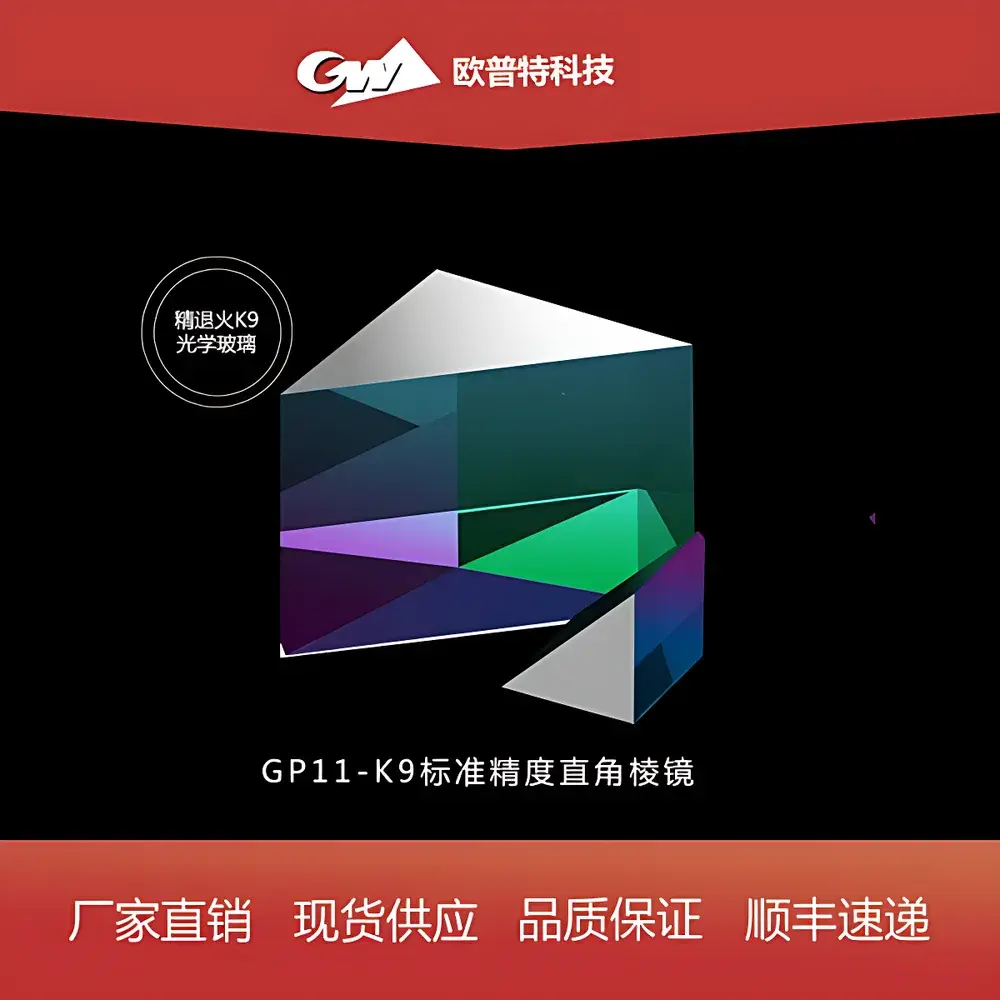

GP11-K9 Precision Right-Angle Prism

| Origin | Beijing, China |
|---|---|
| Manufacturer Type | Authorized Distributor |
| Origin Category | Domestic (China) |
| Model | GP11 |
| Component Category | Optical Element |
| Material | K9 Grade Optically Annealed Crown Glass |
| Dimensional Tolerance | +0.0 / −0.2 mm |
| Surface Flatness | λ/4 @ 632.8 nm |
| Surface Quality | 3–4 Scratch-Dig |
| Angular Accuracy | ±3 arcminutes |
| Beam Deviation (Tower Error) | <10 arcminutes |
| Edge Chamfer | 0.25–0.5 mm × 45° |
| Coating Options | Uncoated, VIS AR (400–700 nm), NIR AR (700–1100 nm), Alumina-Protected Aluminum on Hypotenuse or Legs |
Ask about pricing, availability and specifications.
Overview
The GP11-K9 Precision Right-Angle Prism is a fundamental optical component engineered for high-fidelity beam deviation, image erection, and optical path folding in laboratory, industrial, and OEM instrumentation systems. Constructed from optically annealed K9 borosilicate crown glass—a material certified to ISO 10110-1 and MIL-O-13830 standards—the prism delivers exceptional homogeneity, low birefringence, and thermal stability across visible and near-infrared spectral bands. Its 90° apex angle enables total internal reflection (TIR) when light enters the hypotenuse face at angles exceeding the critical angle (~41.2° for K9 at 587.6 nm), resulting in precise 90° beam redirection with minimal wavefront distortion. Alternatively, when coated with protected aluminum on the hypotenuse, the prism functions as a high-reflectance mirror for oblique incidence applications where TIR is not feasible—such as wide-angle scanning or non-normal-incidence alignment setups. The GP11 series adheres to stringent metrological tolerances defined per ISO 10110-3, ensuring compatibility with interferometric alignment, laser cavity construction, and polarization-sensitive configurations.
Key Features
- Precision-ground and polished geometry: angular tolerance of ±3 arcminutes and tower error <10 arcminutes, verified via autocollimation and Fizeau interferometry.
- Surface flatness of λ/4 at HeNe wavelength (632.8 nm), enabling use in coherent optical systems without introducing measurable phase aberrations.
- Controlled surface quality (3–4 Scratch-Dig per ISO 10110-7), minimizing scatter-induced signal loss in low-light or high-dynamic-range detection paths.
- Consistent edge chamfer (0.25–0.5 mm × 45°) to prevent chipping during handling and mounting—critical for vacuum-compatible or vibration-prone optical benches.
- Multiple coating variants available: uncoated (for TIR operation), VIS broadband anti-reflection (400–700 nm, R<0.5% per surface), NIR broadband AR (700–1100 nm, R90% from 400–2000 nm, durability compliant with MIL-C-675C).
- Scalable dimensional range from 1.0 mm to 50.0 mm leg length (A = B = C), supporting compact micro-optics integration and large-aperture collimation systems alike.
Sample Compatibility & Compliance
The GP11-K9 prism is compatible with standard kinematic mounts (e.g., Thorlabs KM100, Newport U100), anodized aluminum lens tubes, and stainless-steel optomechanical housings. Its K9 substrate exhibits coefficient of thermal expansion (CTE) of 7.1 × 10⁻⁶ /K and refractive index dispersion (nd = 1.5163, νd = 64.2) suitable for achromatic doublet pairing and collimator design. All units undergo 100% inspection per ISO 10110-3 and are traceable to NIM (National Institute of Metrology, China) calibration protocols. Documentation includes individual test reports listing measured flatness, angular deviation, and surface quality—supporting GLP-compliant optical assembly validation and FDA-regulated medical device manufacturing (e.g., endoscopic imaging modules).
Software & Data Management
While the GP11-K9 is a passive optical element, its performance parameters are fully integrated into common optical design platforms including Zemax OpticStudio (v23+), CODE V (v12+), and Synopsys LightTools. Pre-characterized K9 material files (including Sellmeier coefficients and thermal expansion data) are embedded in the default material library. For traceability and configuration control, each batch is assigned a unique serial prefix (e.g., GP11-025-VIS-01-SN23489), recorded in a secure, audit-ready database compliant with ISO 9001:2015 Clause 8.5.2 (Identification and Traceability). Raw interferogram data and coordinate measuring machine (CMM) reports are archived for 10 years and available upon request for QA/QC audits.
Applications
- Laser beam steering and cavity folding in DPSS and fiber-coupled diode laser systems.
- Image inversion and relay optics in stereo microscopes, borescopes, and machine vision inspection rigs.
- Beam combiners/splitters in interferometers (Michelson, Mach-Zehnder) and OCT light engines.
- Alignment fiducials in photolithography steppers and wafer inspection tools.
- Optical isolation stages requiring orthogonal path separation in fluorescence microscopy and Raman spectroscopy setups.
- OEM integration into portable spectrometers, LIDAR receivers, and hyperspectral sensor modules.
FAQ
What is the maximum incident angle for reliable total internal reflection (TIR) in the GP11-K9 prism?
For uncoated K9 prisms operating at 587.6 nm, TIR is sustained for angles of incidence >41.2° on the hypotenuse face. Performance degrades near Brewster’s angle (≈57°); users requiring wide-angle reflection should select the protected aluminum-coated variant.
Can GP11 prisms be used in vacuum environments?
Yes—K9 glass is outgassing-compliant per ASTM E595, and all coatings meet NASA low-outgassing specifications (CVCM <1.0%, TML <1.0%). No adhesives or organic binders are used in fabrication.
Is there a specification sheet available for each individual prism?
Yes—every shipped unit includes a Certificate of Conformance (CoC) with interferometric flatness map, angular deviation measurement, and surface inspection record. Digital copies are provided in PDF and CSV formats upon order confirmation.
How does the GP11 series differ from standard commercial right-angle prisms?
The GP11 series implements tighter angular tolerance (±3′ vs. typical ±10′), λ/4 flatness (vs. λ/2), and mandatory edge chamfering—meeting requirements for Class 1000 cleanroom assembly and alignment-critical applications.